
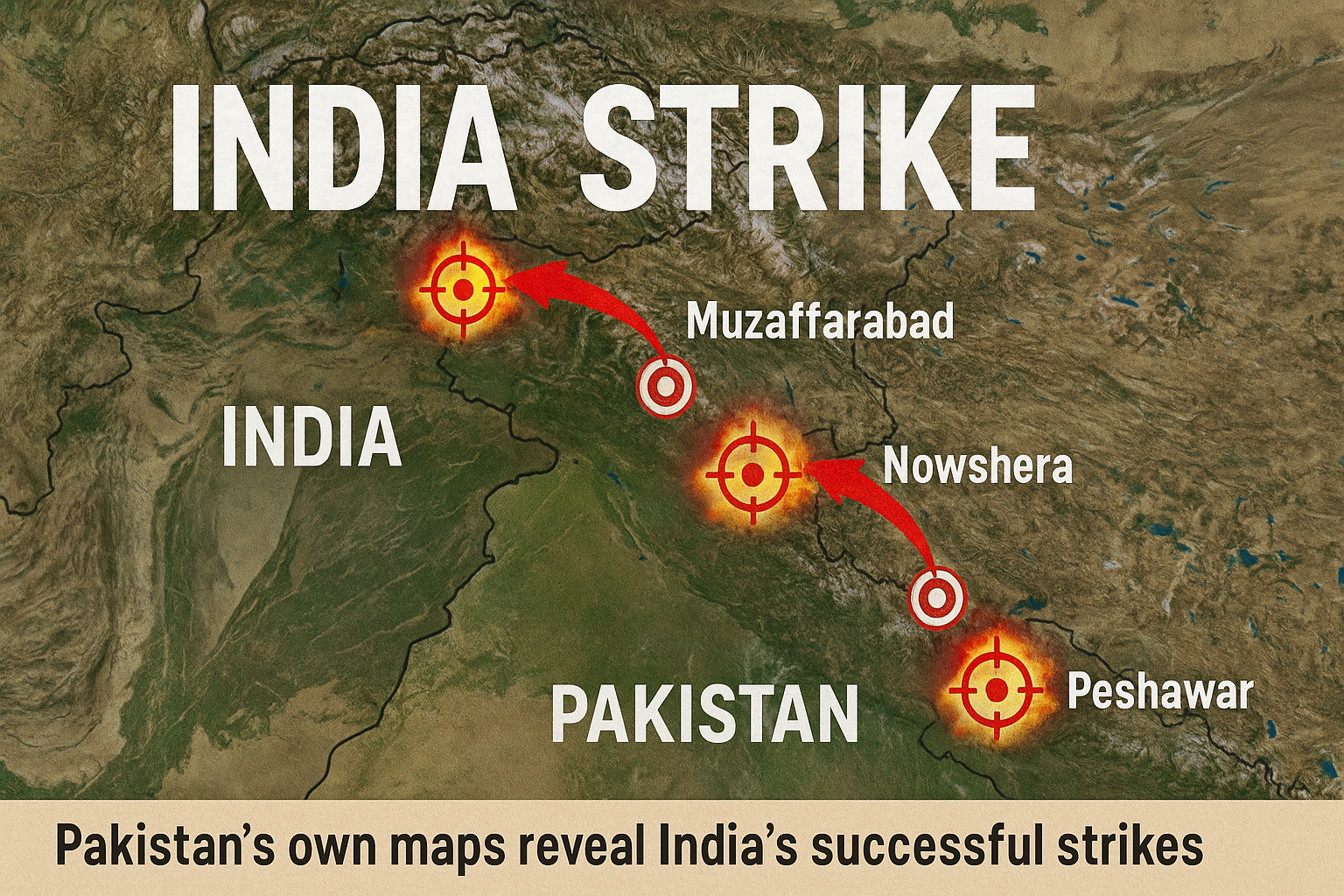
Pakistan’s Own Report Confirms India’s Military Superiority
In a stunning twist, Pakistan’s recently released dossier dated May 18, 2025, intended to portray India as an aggressor, has backfired spectacularly. Instead of gaining sympathy or strategic leverage, the document inadvertently confirms India’s successful precision strikes and exposes the scale of Pakistan’s military vulnerability.
At first glance, the report appears to be a classic exercise in international lobbying — maps, target lists, and serious-sounding accusations. But a deeper look reveals something else: a quiet, devastating admission.
The dossier details Indian drone and missile strikes on major Pakistani cities including Peshawar, Attock, Gujrat, Jhang, Bahawalnagar, Hyderabad, and Chhor — some as far as 1,000 kilometers from the Line of Control. These were not random or speculative entries; they were backed by maps, exact coordinates, and grim confirmation: the strikes hit.
What’s more shocking? There was no denial from Pakistan. No mention of interception, resistance, or deflection. Just a grim list of what was targeted and what was lost.
Among the most telling admissions:
- 10 Brigade HQ at KG Top – destroyed
- 80 Brigade HQ at Naushera – destroyed
- A Field Supply Depot – completely decimated

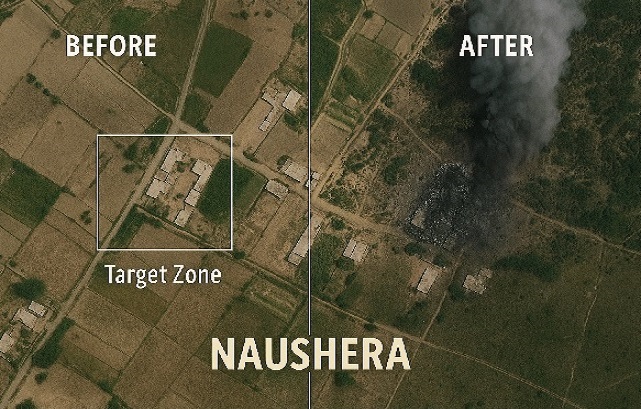
These are not peripheral or symbolic targets. These are core operational facilities in the LoC theatre, vital for combat operations and troop logistics.
But perhaps the most chilling sentence in the entire document is this:
“Indian drones hovered over key military and political installations — unintercepted.”
That one line alone lays bare Pakistan’s defence paralysis:
- Airspace violations
- India’s technological edge
- Surveillance failures
- Operational helplessness
Even more notably, the report makes no mention of Indian casualties, downed aircraft, or successful Pakistani counterattacks. Cities like Nagrota, Beas, and Bhuj were named as retaliatory targets, but none were confirmed as actually hit.
So the big question arises: Why did Pakistan release this?
The answer may lie in geopolitics and economic desperation. By publishing the dossier, Pakistan’s leadership may have hoped to:
- Garner global sympathy by portraying India as the belligerent
- Rally domestic sentiment by highlighting civilian suffering
- Justify escalatory rhetoric in forums like the UN and OIC
- Expedite international loans by dramatizing conflict
In essence, they were willing to sacrifice strategic credibility for emotional impact. But in doing so, they exposed the very truths India had chosen to withhold.
While India remained strategically silent — with Prime Minister Modi stating calmly from Madhubani, “We do not escalate. We enforce.” — Pakistan’s own dossier filled in the blanks, offering the world a detailed look at India’s precision and preparedness.
This episode underscores the power of information warfare. Sometimes, silence is more potent than spectacle. In trying to shout about Indian aggression, Pakistan ended up documenting Indian military superiority.
And if Chanakya were alive today, one could imagine him adding to the Arthashastra:
“Do not detail your victory. Let your enemy declare his own defeat.”
Key Takeaways:
- Pakistan’s dossier confirms India’s unmatched strategic accuracy.
- Major cities and military hubs were hit — with no denials.
- Pakistan exposed its own technological and defence weaknesses.
- The global narrative shifted in India’s favor without a single boast.
[Based upon a post by Rakesh Krishnam Simha]