
NSTL is widely regarded as a cornerstone of India’s indigenous naval weapons programme, particularly in the strategic underwater domain. The visit underscored Parliament’s continued focus on strengthening self-reliance in defence technology.
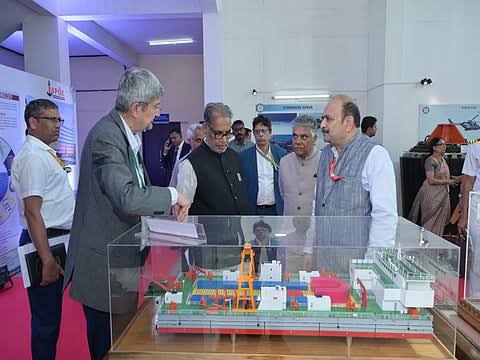

During the visit, the committee was briefed on and shown a range of NSTL-developed products, including advanced torpedoes such as the Advanced Light Weight Torpedo (ALWT), the indigenously developed heavyweight torpedo Varunastra, and the Electric Heavy Weight Torpedo (EHWT).
Members were also apprised of naval mine systems like the Moored Influence Ground Mine (MIGM) and the Programmable Bottom Ground Mine (PBGM), along with sophisticated decoys including the Self-Floating Decoy (SFD) and Torbuster, designed to enhance survivability of naval platforms.
Advanced Platforms and Emerging Technologies
The committee also reviewed next-generation systems such as SMART (Supersonic Missile Assisted Release of Torpedo), High-Endurance Autonomous Underwater Vehicles (HEAUV), SWARM technologies, and a range of underwater systems and vehicles.
These technologies are critical to enhancing India’s underwater combat capability, surveillance reach and rapid response options in complex maritime environments.
Live Demonstration of Hydrodynamic Testing
A highlight of the visit was a live demonstration at NSTL’s Sea-Keeping and Manoeuvring Basin facility. The committee witnessed hydrodynamic testing conducted on a scaled-down ship model, showcasing the laboratory’s ability to simulate real-world sea conditions.
Such facilities play a vital role in validating ship design, stability and manoeuvrability, thereby contributing to safer and more efficient naval platforms.
Leadership Briefings and Institutional Overview
The visiting delegation was welcomed by Secretary, Department of Defence R&D and Chairman DRDO, Dr Samir V. Kamat, along with Director General (Naval Systems & Materials) Dr R. V. Hara Prasad and Director, NSTL, Dr Abraham Varughese.
Dr Varughese provided a comprehensive briefing on ongoing research programmes at NSTL, highlighting collaboration with industry and academic institutions to accelerate technology development and production readiness.
Focus on Maritime and Underwater Domain Awareness
The Committee appreciated NSTL’s sustained efforts in the strategically important areas of Maritime Domain Awareness and Underwater Domain Awareness. These capabilities are increasingly vital in safeguarding India’s vast coastline and maritime interests.
Members noted that indigenous development of such technologies reduces dependence on foreign suppliers while ensuring operational secrecy and adaptability to India-specific maritime challenges.
Boost to Atmanirbhar Bharat in Defence
The visit comes amid a broader national push for Atmanirbhar Bharat in defence manufacturing and research. Parliamentary oversight of frontline laboratories like NSTL is seen as crucial in aligning policy support, funding and long-term capability planning.
Officials indicated that feedback from such visits helps shape future roadmaps, ensuring that R&D outcomes remain closely aligned with the evolving needs of the Indian Navy.
Parliamentary Appreciation
Members of the Standing Committee expressed satisfaction with the depth and maturity of NSTL’s research programmes. They acknowledged the laboratory’s role in translating complex science into deployable systems that strengthen national security.