
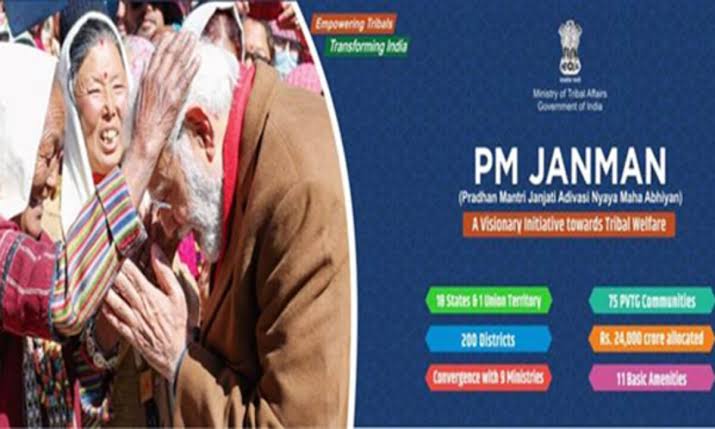
Launched on November 15, 2023, the Pradhan Mantri Janjati Adivasi Nyaya Maha Abhiyan (PM JANMAN) is a historic mission to transform the lives of India’s 75 Particularly Vulnerable Tribal Groups (PVTGs) across 18 states and 1 union territory.
With a massive budget of ₹24,104 crore, this flagship initiative targets basic but life-changing services — from safe housing and clean water to education, nutrition, healthcare, and telecom and road connectivity.


For decades, PVTGs have remained isolated from mainstream development. These communities face barriers to modern services due to their remote locations, traditional lifestyles, and lack of access to documents like Aadhaar or caste certificates.
PM JANMAN aims to close this gap in just three years by ensuring every PVTG household gets the opportunities and dignity they deserve.
Holistic Development Through 11 Interventions
The mission is being implemented through 11 key interventions by 9 central ministries. These include:
- Construction of pucca (permanent) houses
- Access to safe drinking water and sanitation
- Electrification of unelectrified households
- Primary and secondary education infrastructure
- Health and nutrition services, including maternal care
- Telecom and road connectivity
- Livelihood training and support
Each intervention is aligned with the Sustainable Development Goals (SDGs), making it a model of inclusive, sustainable, and rights-based development.
Budget and Implementation Strategy
The total outlay of ₹24,104 crore includes a central share of ₹15,336 crore and a state share of ₹8,768 crore. Funds are directly tied to results and real benefits on the ground.
States are crucial partners in execution. Coordination between state departments and central ministries ensures smooth delivery of services.
Empowering Through Awareness: IEC Camps
Implementation isn’t just about building infrastructure. It’s also about awareness.
That’s why the Ministry of Tribal Affairs, in partnership with states, is holding IEC (Information, Education & Communication) camps. These camps help tribal families get crucial documents like:
- Aadhaar cards
- Caste certificates
- Jan Dhan bank accounts
These documents unlock access to key schemes like Ayushman Bharat, PM Awas Yojana, and MNREGA. It’s a gateway to welfare benefits that many PVTGs never had access to before.
Real People, Real Impact
Consider the case of the Baiga tribe in Madhya Pradesh. Earlier isolated from government outreach, families here are now receiving housing support and clean water. Children are getting enrolled in school for the first time. Health workers are visiting remote hamlets with vaccinations and maternal care kits.
These are not isolated incidents. Similar transformations are taking place in Odisha, Jharkhand, Chhattisgarh, and the Andaman & Nicobar Islands.
Voices From the Government
In a recent reply to an unstarred question by Smt. Mahua Maji in the Rajya Sabha, Minister of State for Tribal Affairs, Shri Durgadas Uikey, reiterated the government’s commitment to ensuring that no tribal community is left behind.
He highlighted that the mission was designed with direct community feedback and is rooted in the spirit of Jan Bhagidari (People’s Participation).
Conclusion: A Bold Step Towards Equity
PM JANMAN is more than just a welfare scheme. It’s a national commitment to justice, inclusion, and empowerment.
It reminds us that development is not complete until the most vulnerable communities feel its impact.
As the mission gains momentum, it holds the promise of bringing 75 forgotten tribes into the heart of India’s development journey — with dignity, opportunity, and hope.