
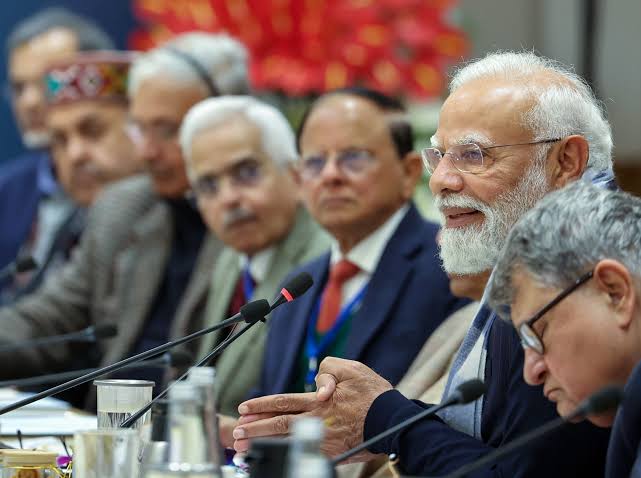
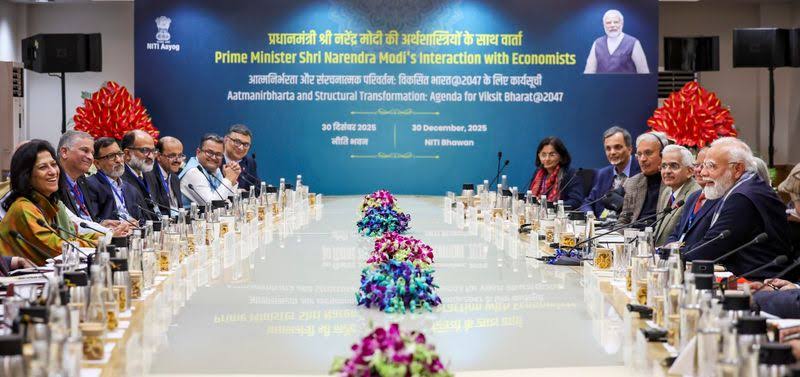

Addressing the gathering, the Prime Minister said that the vision of Viksit Bharat by 2047 has evolved beyond a government programme into a mass aspiration shared by citizens across the country. He noted that changing patterns in education, consumption and global mobility reflect rising ambitions and expectations.
This shift, he said, calls for stronger institutional capacity and forward-looking infrastructure planning to meet the needs of an increasingly aspirational society.
Mission-Mode Reforms for Sustained Growth
Highlighting the need for long-term economic resilience, Prime Minister Modi stressed the importance of mission-mode reforms across diverse sectors. He said India’s policymaking and budgeting must remain firmly anchored to the vision for 2047.
The Prime Minister emphasised that building global capabilities and deeper global integration would be key to sustaining growth, while ensuring that India remains a preferred hub for the global workforce and international markets.
Economists Discuss Productivity and Competitiveness
During the interaction, economists shared strategic insights on enhancing productivity and competitiveness across manufacturing and services sectors. Discussions focused on accelerating structural transformation through higher household savings, robust infrastructure development and greater efficiency.
The experts also highlighted the importance of adopting cutting-edge technologies to improve output, reduce costs and strengthen India’s position in global value chains.
Role of AI and Digital Public Infrastructure
A key area of discussion was the role of Artificial Intelligence as an enabler of cross-sectoral productivity. Participants underlined how AI-driven solutions can transform governance, manufacturing, healthcare and financial services.
The continued scaling of India’s Digital Public Infrastructure was also discussed as a critical driver of inclusive growth, efficiency and transparency across sectors.
Reforms in 2025 and the Road Ahead
The economists noted that 2025 witnessed an unprecedented flurry of cross-sectoral reforms, laying a strong foundation for future growth. They observed that further consolidation of these reforms in the coming year would help unlock new opportunities.
Such measures, they said, would ensure that India continues to remain among the fastest-growing major economies while strengthening its economic fundamentals.
Eminent Participants
The interaction saw participation from several renowned economists and experts, including Shankar Acharya, Ashok K Bhattacharya, N. R. Bhanumurthy, Amita Batra, Janmejaya Sinha, Amit Chandra, Rajani Sinha, Dinesh Kanabar, Basanta Pradhan, Madan Sabnavis, Ashima Goyal, Dharmakirti Joshi, Umakant Dash, Pinaki Chakraborty, Indranil Sen Gupta, Samiran Chakraborty, Abhiman Das, Rahul Bajoria, Monika Halan and Siddhartha Sanyal.