
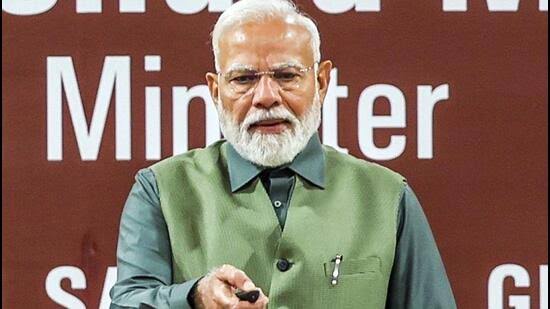
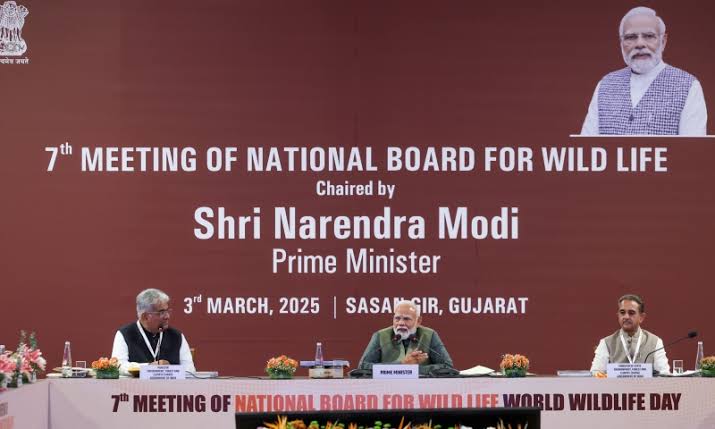
Prime Minister Narendra Modi chaired the 7th meeting of the National Board for Wildlife at Gir National Park, reaffirming the government’s commitment to wildlife conservation. The meeting highlighted significant achievements, including the expansion of protected areas and species-specific conservation programs. The Prime Minister also released India’s first-ever riverine dolphin estimation report, which recorded a population of 6,327 dolphins across 28 rivers in eight states. Uttar Pradesh reported the highest numbers, followed by Bihar, West Bengal, and Assam. He emphasized the importance of raising awareness about dolphin conservation by involving local communities and organizing exposure visits for school children to dolphin habitats.

The Prime Minister stressed the use of remote sensing, geospatial mapping, artificial intelligence, and machine learning to combat forest fires and human-animal conflicts. He proposed collaboration between the Wildlife Institute of India and the Bhaskaracharya National Institute for Space Applications and Geo-informatics (BISAG-N) to address these challenges. Additionally, he suggested a partnership between the Forest Survey of India and BISAG-N to enhance forest fire prediction, detection, and control in sensitive protected areas.
In a major announcement, he revealed that the Cheetah reintroduction program would expand to Gandhisagar Sanctuary in Madhya Pradesh and the Banni Grasslands in Gujarat. He also introduced a new initiative for tiger conservation outside reserves to mitigate conflicts between humans and big cats. To protect declining gharial populations, he launched a dedicated conservation project for the species. Recognizing the critical state of the Great Indian Bustard, he unveiled a National Great Indian Bustard Conservation Action Plan.
He also emphasized the importance of documenting India’s traditional knowledge on forest and wildlife conservation. He directed the Board and the Environment Ministry to gather manuscripts and indigenous conservation practices for research and future strategy development. He underscored Gir’s success in lion and leopard conservation, suggesting that its lessons be documented using AI for application in other national parks and sanctuaries.
The Prime Minister commended the rise of community reserves, which have grown sixfold in the past decade due to active local participation. He called for enhanced cooperation with the United Nations Convention on the Conservation of Migratory Species of Wild Animals. He also encouraged research into medicinal plants in forest areas to support animal health management and promote plant-based medicine systems globally.
Following the meeting, he flagged off motorcycles to enhance mobility for frontline forest staff and interacted with eco-guides, trackers, and forest personnel at Gir. His visit reinforced India’s commitment to wildlife conservation, blending traditional knowledge with modern technology to protect the country’s rich biodiversity.