
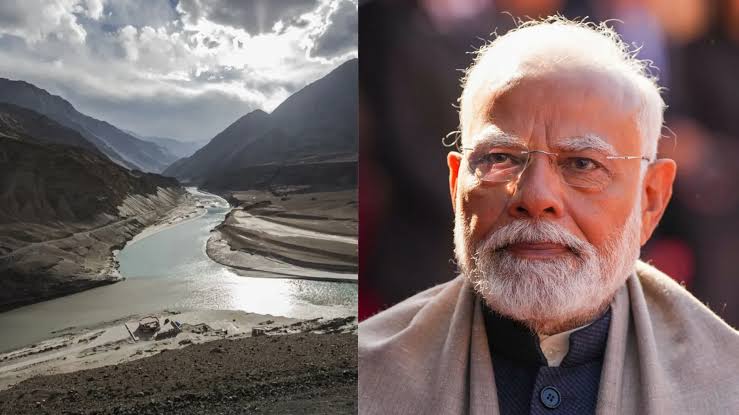
Prime Minister Narendra Modi has strongly criticized the Indus Waters Treaty (IWT), describing it as a “badly negotiated” agreement that has long disadvantaged India and restricted its rightful access to water resources from its own river systems. Speaking at a public gathering in Gandhinagar on Tuesday, the Prime Minister expressed deep concern over how the treaty’s provisions had undermined India’s development, particularly in the context of Jammu and Kashmir.
Addressing a crowd during the celebration of 20 years of Gujarat’s urban development story, PM Modi emphasized that while India seeks peace and good relations with its neighbors, it will not compromise when its strength and sovereignty are tested. “We don’t want enmity with anyone. We want happiness for our neighbours. But if you challenge our strength, India can become a land of heroes,” he said.
Modi shared alarming details about the treaty’s operational restrictions, revealing that crucial dam maintenance activities—such as de-silting and flushing—had been disallowed for decades. He pointed out that for over 60 years, the gates of dams built on rivers in Jammu & Kashmir were not opened, resulting in reservoirs functioning at merely 2–3% of their actual storage capacity. This, he said, was an injustice to the Indian people who were being denied even the share of water allocated to them under the treaty.
The Prime Minister’s comments come in the wake of the April 23 decision by India’s Cabinet Committee on Security to temporarily suspend the treaty, a move triggered by the recent terror attack in Pahalgam. Modi made it clear that this was not a reactionary decision, but a calculated step reflecting growing frustration over Pakistan’s continued support for terrorism. “The treaty has merely been put on hold, and they (Pakistan) are already sweating. We’ve just opened a few gates to clean our dams, and it’s already causing floods there,” he remarked.
This is the first time PM Modi has publicly delved into the technical aspects of the treaty, particularly concerning the Baglihar and Salal hydroelectric projects on the Chenab River. These projects were built in compliance with the IWT, yet India has faced limitations on their operation due to treaty constraints.
India has long viewed the Indus Waters Treaty—brokered by the World Bank in 1960—as unfairly tilted in Pakistan’s favor. With Pakistan’s persistent use of terror as a tool against India, the very foundation of the treaty—peaceful and neighborly relations—appears to have eroded. In this context, Modi’s remarks signal a possible push for a renegotiation of the treaty’s terms, especially the dispute resolution mechanisms that have been seen as inadequate in addressing India’s grievances.
Many in India sympathize with the government’s stance, especially in the wake of repeated provocations and the country’s growing water needs. While the issue remains sensitive, the Prime Minister’s speech reflects a larger shift in India’s approach—one that prioritizes national interest, sustainable development, and regional stability based on mutual respect rather than unilateral compromise.