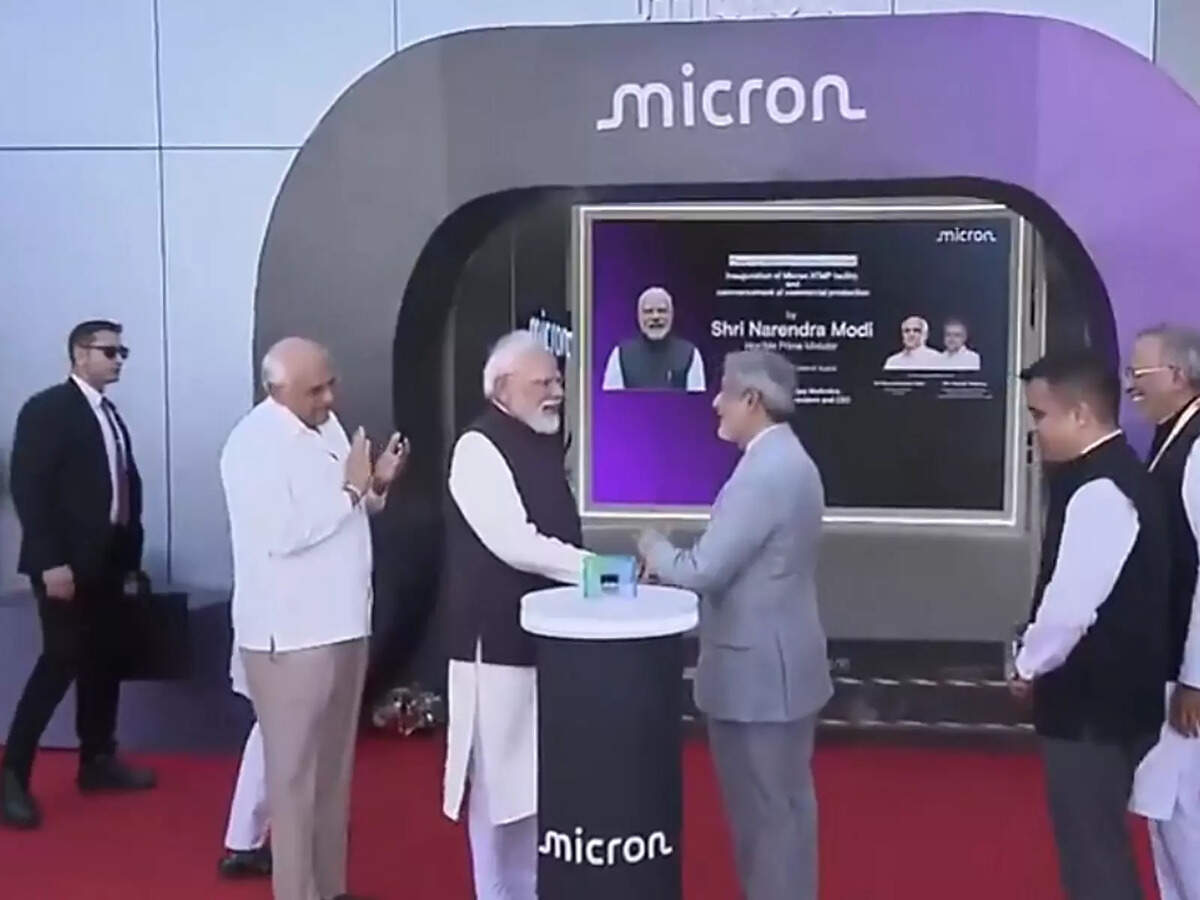
 Addressing the gathering, PM Modi highlighted India’s growing role in global technology: “While India has been known for software, today we are rapidly establishing our identity in the hardware sector. The commencement of commercial production at Micron’s Sanand facility is a testament to India’s commitment to technology leadership.”The Prime Minister traced the project’s rapid development: the MoU was signed in June 2023, groundbreaking occurred in September 2023, pilot machine installations began in February 2024, and full-scale commercial production has now commenced in February 2026. He emphasised India’s efficiency in streamlining regulatory processes, such as Advanced Pricing Agreements (APAs), often completed in months compared to years in other nations.
“When the intent is clear and dedication is toward the nation’s development, policies become transparent and decisions gain momentum,” PM Modi stated, reflecting the “New India” approach of translating policy into production at unprecedented speed.
Noting the strategic collaboration between India and the United States, PM Modi referenced the Pax Silica agreement from the recent AI Summit, aiming to secure reliable global supply chains for critical minerals and semiconductors. He emphasized that this century belongs to the AI revolution and that microchips are the new regulators of technological progress, much like oil shaped the 20th century.
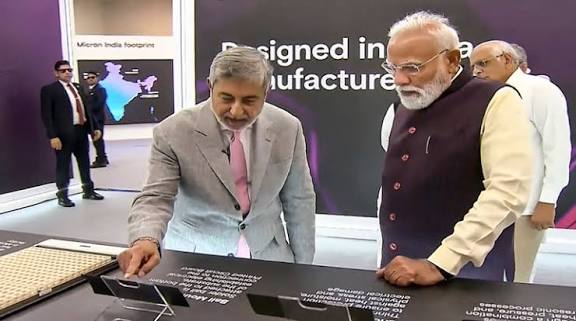
The Sanand facility will produce D-RAM and NAND solutions to power data centers, AI applications, and mobile devices worldwide. It features one of the largest ATMP cleanrooms globally and prioritizes environmental sustainability through minimized water consumption. PM Modi drew parallels to Sanand’s evolution as an automobile hub, asserting that the semiconductor facility will anchor a new ecosystem of advanced technology in Gujarat and across India.
Highlighting India’s national semiconductor vision, the Prime Minister stated, “This is a Pan-India initiative. While 10 projects are already approved under the Semicon India program, three more are set to begin production soon across Uttar Pradesh, Assam, Odisha, and Punjab. New tech hubs for a ‘Viksit Bharat’ are emerging in every corner of the country.”
He also explained that a semiconductor ecosystem extends beyond a single plant, encompassing machine manufacturers, design engineers, research institutions, logistics networks, and skilled technicians. India’s “Semiconductor Mission 2.0,” announced in this year’s budget, aims to strengthen the entire domestic value chain and enhance production, materials, and service demands.
PM Modi highlighted the expanding domestic market, noting that a significant portion of India’s population is becoming first-time gadget users, boosting electronics, automotive, and technological demand. He emphasized that the “Make in India” initiative is now fully operational, offering both domestic and global investment opportunities.
Praising Gujarat’s state policies, the Prime Minister noted efficient approvals, land allotment, and utilities management have strengthened investor confidence. He observed that Dholera and Sanand are rapidly developing as semiconductor clusters, supported by skills centers, chemical and petrochemical industries, and training initiatives.
Concluding his address, PM Modi delivered a strong message to global investors: “India is ready. India is reliable. India delivers. India is capable. India is competitive. India is committed.” His remarks reinforced India’s position as a reliable partner in global semiconductor and AI-driven technology.