
PM Dhan-Dhaanya Krishi Yojana: Focus on 100 Districts
The PM Dhan-Dhaanya Krishi Yojana carries an outlay of ₹24,000 crore and focuses on improving agricultural productivity, promoting crop diversification, enhancing post-harvest storage, and expanding irrigation facilities in 100 selected districts. These districts were chosen based on three parameters: agricultural output per unit of land, cropping intensity, and access to institutional loans.
Under the scheme, 36 existing government schemes will be integrated, including the National Mission on Natural Farming, Per Drop More Crop campaign, and Oilseeds Mission. Localized livestock health campaigns will also be launched to support small farmers and ensure sustainable agriculture practices.


The Dalhan Atmanirbharta Mission, with an investment of ₹11,440 crore, aims to increase domestic pulse production, expand cultivation area by 35 lakh hectares, and strengthen procurement, storage, and processing value chains. The mission is expected to benefit nearly two crore pulse farmers across India, improving both nutritional security and farmer incomes.
Empowering Farmers and Rural Communities
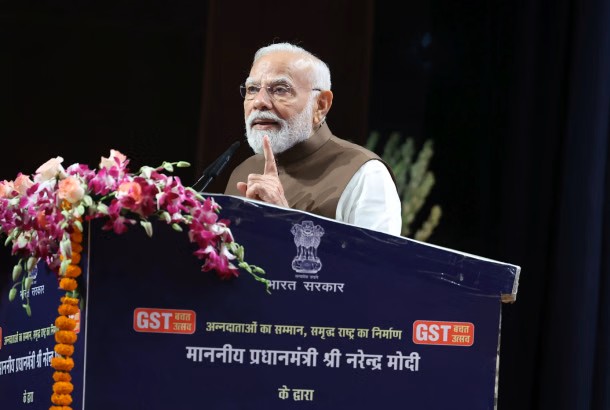
Shri Modi highlighted the government’s success over the past 11 years: doubling agricultural exports, increasing foodgrain production by 90 million metric tonnes, and achieving top global rankings in milk and fish production. He noted the formation of over 10,000 Farmer Producer Organizations (FPOs), distribution of 25 crore Soil Health Cards, and insurance disbursals of ₹2 lakh crore under the Pradhan Mantri Fasal Bima Yojana.
Women farmers and modern techniques like drones for spraying fertilizers, natural farming clusters, and trained Krishi Sakhis are being actively promoted. “Namo Drone Didis” are leading innovation in rural villages, improving efficiency and providing new income opportunities.
Investment in Agriculture, Animal Husbandry, Fisheries, and Food Processing
PM Modi inaugurated projects worth over ₹5,450 crore and laid foundations for additional projects totaling ₹815 crore. These include milk powder plants in Mehsana, Indore, Bhilwara; fish feed plants under the PM Matsya Sampada Yojana; integrated cold chains; trout fisheries in Uttarakhand; and aquaparks in Nagaland and Odisha. The projects aim to enhance productivity, value addition, and market access for farmers, fishers, and dairy producers.
GST Reforms and Financial Support
The PM emphasized GST reforms that reduced costs of tractors, drip irrigation systems, sprinklers, harvesting tools, organic fertilizers, and bio-pesticides, enabling double savings for rural households. Subsidies and financial support continue to empower small and marginal farmers, forming the backbone of Indian agriculture.
Towards a Self-Reliant and Developed India
Shri Modi concluded by urging farmers to not only achieve self-sufficiency but also produce for the global market. He reaffirmed that these initiatives will strengthen India’s position as a leading agricultural nation, ensuring sustainable development, food security, and increased farmer prosperity.