

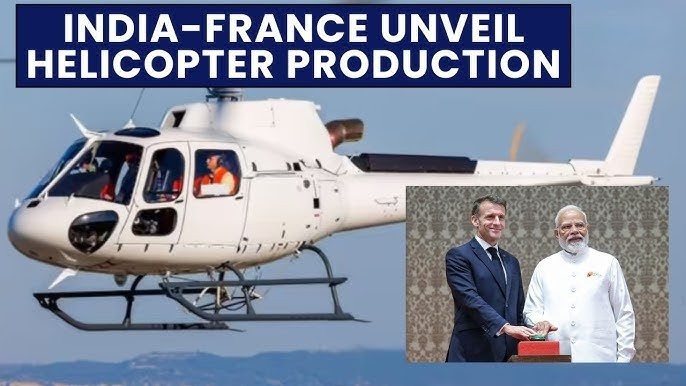

Addressing the gathering, Rajnath Singh said the H125 project underscores the government’s commitment to self-reliance in critical technologies and high-end manufacturing through mutually beneficial international partnerships. He emphasised that initiatives such as Make in India and Aatmanirbhar Bharat have driven India’s industrial growth trajectory since 2014.
The Defence Minister noted that the H125 programme is expected to attract investments exceeding Rs 1,000 crore. The project is likely to generate substantial direct and indirect employment opportunities for skilled youth, while strengthening India’s aerospace manufacturing ecosystem.
He highlighted that this collaboration builds upon the earlier Tata-Airbus partnership for the C-295 military transport aircraft, further consolidating India’s position as a global aerospace manufacturing hub.
H125: A Proven High-Altitude Performer
The Airbus H125 is globally recognised for its reliability, versatility, and operational efficiency in diverse and challenging environments. It is the only helicopter to have successfully landed on the summit of Mount Everest, demonstrating its unmatched high-altitude capability.
For India, where armed forces operate in extreme “high-and-hot” terrains such as the Himalayas, the H125 platform offers a critical operational advantage. The H125M variant is optimised for tactical reconnaissance, surveillance, high-altitude logistics, search and rescue, and medical evacuation missions.
Equipped with low acoustic and thermal signatures, the helicopter enhances stealth capabilities while ensuring rapid-response deployment in remote frontier areas. Officials stated that such advanced platforms will serve as force multipliers for the Indian military.
Private Sector’s Expanding Role in Defence
Rajnath Singh underlined the transformation of India’s defence production landscape over the past decade. He pointed out that reforms including corporatisation of Ordnance Factories, liberalised investment policies, and defence industrial corridors have significantly increased private sector participation.
Today, nearly one-fourth of India’s total defence production comes from the private sector, with exports witnessing substantial growth. Over 16,000 MSMEs are now part of the defence industrial supply chain, supplying components not only domestically but also to global manufacturers.
The Minister invited global companies to deepen collaboration through meaningful technology transfers and advanced solutions that can address the security requirements of friendly nations.
Strengthening Strategic Ties
The presence of French and Indian officials at the event reflected the strategic depth of bilateral defence ties. The H125 assembly line represents the second major Tata-Airbus industrial collaboration in India, following the C-295 transport aircraft programme.
According to the Press Information Bureau (https://pib.gov.in), the project aims to build a comprehensive military aerospace ecosystem in India. Industry observers view the initiative as a step toward integrating India more deeply into global defence supply chains.
As India continues to expand its industrial base through policy reforms and infrastructure development, projects like the H125 assembly line demonstrate how strategic partnerships can drive technological advancement, employment generation, and export potential simultaneously.
The Vemagal facility is expected to play a key role in strengthening India’s indigenous defence manufacturing capacity, aligning with the broader vision of transforming the country into a leading defence exporter.