

New Delhi: At the India AI Impact Summit 2026, Prime Minister Narendra Modi presented a bold human-centric roadmap for artificial intelligence, introducing the M.A.N.A.V framework that anchors technological advancement firmly in ethical and societal values. Addressing global leaders, innovators and policymakers at Bharat Mandapam, the Prime Minister called for shaping AI as an instrument of human empowerment rather than unchecked automation.
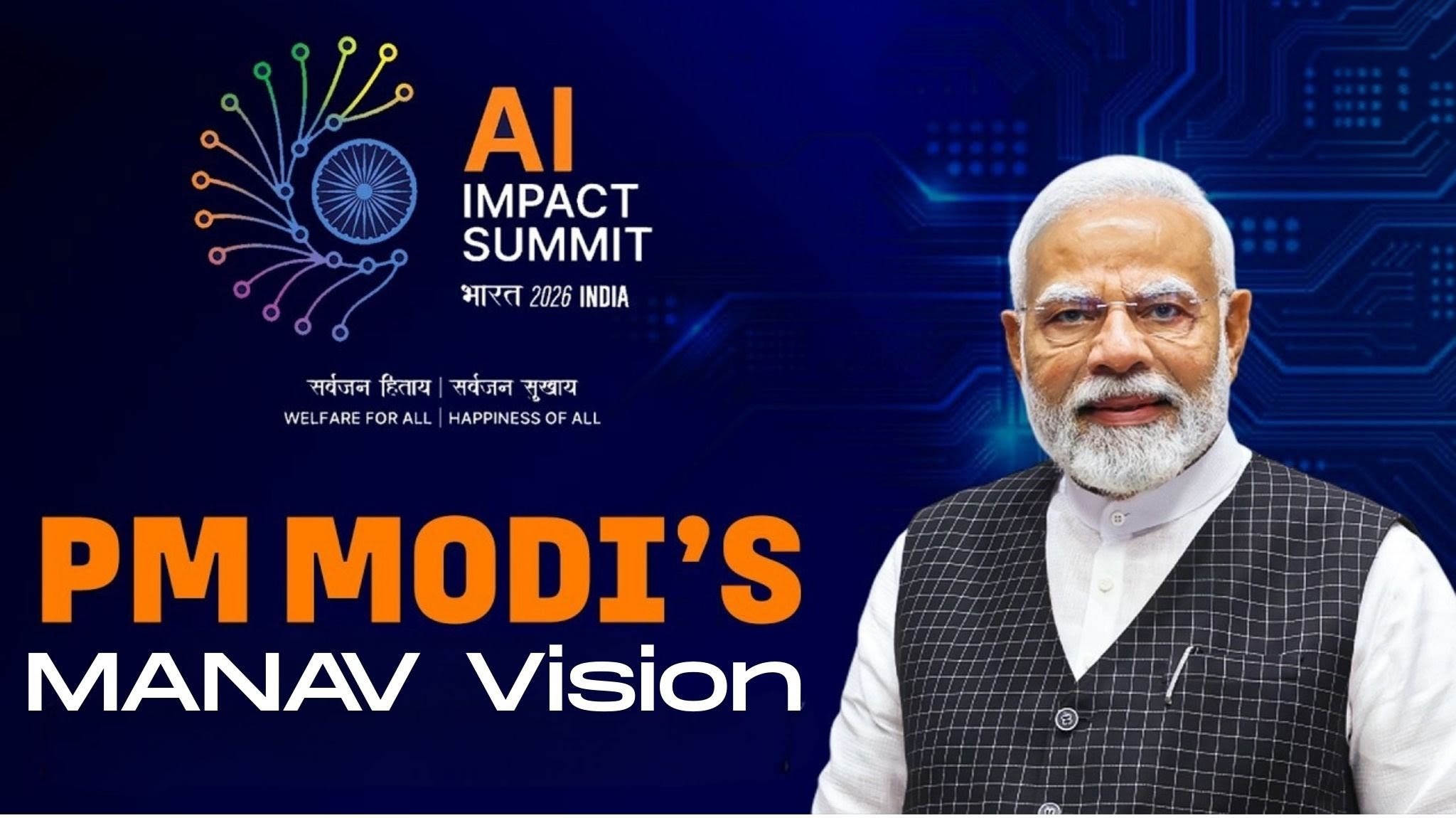

The India AI Impact Summit, being held in New Delhi from February 16 to 20, 2026, has drawn participation from technology pioneers and government representatives worldwide. As a nation home to one-sixth of humanity and the world’s largest youth population, India positioned itself not only as a technology adopter but as a responsible shaper of global AI discourse.
According to the official release by the Press Information Bureau (PIB), the Prime Minister emphasised that India’s scale brings responsibility.
M.A.N.A.V: A Human-Centric AI Doctrine
Prime Minister Modi articulated his AI vision through the acronym M.A.N.A.V, symbolising a framework that integrates innovation with humanity. The pillars include Moral and Ethical Systems, Accountable Governance, National Sovereignty, Accessible and Inclusive AI, and Valid and Legitimate Systems.
He described artificial intelligence not merely as code and computation but as an extension of human aspiration and dignity. The framework, he said, ensures that AI evolves in harmony with democratic values and constitutional principles.
Moral and Ethical Systems at the Core
The first pillar stresses that AI must be rooted in fairness, transparency and human oversight. The Prime Minister underlined that ethical considerations cannot be an afterthought but must be embedded at the design stage.
India’s National Education Policy 2020 integrates digital literacy, computational thinking and AI awareness across educational levels. By introducing ethical AI concepts early, the policy seeks to nurture responsible innovators equipped for the future.
The ethical dimension of AI was also symbolically reinforced during the Summit, where India secured a Guinness World Records title for receiving the highest number of pledges in an AI responsibility campaign within 24 hours. Over 250,000 pledges reflected public engagement in ethical AI practices.
Accountable Governance Through IndiaAI Mission
The second pillar focuses on accountable governance, emphasising transparent regulation and institutional oversight. At the heart of this effort is the IndiaAI Mission, approved with an outlay exceeding ₹10,300 crore.
The Mission aims to strengthen compute infrastructure, skilling initiatives, data access and innovation ecosystems. It also embeds governance standards into AI development and deployment, ensuring accountability in public-sector and private applications.
India’s AI Governance Guidelines complement this framework, promoting trust, equity and explainability in AI systems.
National Sovereignty in the AI Era
Highlighting the third pillar, the Prime Minister stated that sovereignty in the digital age extends beyond territory to data, algorithms and compute power. Securing datasets and building indigenous AI capabilities are critical to national resilience.
Initiatives such as the India Semiconductor Mission and secure digital public infrastructure reinforce technological self-reliance. These measures aim to ensure strategic autonomy while remaining globally collaborative.
Accessible and Inclusive AI for All
The fourth pillar emphasises accessibility and inclusion. The Prime Minister asserted that AI must empower citizens across sectors, from healthcare and agriculture to education and governance.
Digital Public Infrastructure, along with platforms like the IndiaAI Compute Portal and MeghRaj GI Cloud, is expanding access to computing resources such as GPUs and TPUs. These tools lower barriers for startups, researchers and institutions.
Complementary initiatives like IndiaAI Kosh and the National Supercomputing Mission further broaden participation in the AI ecosystem.
Trust, Safety and Legal Accountability
The final pillar of M.A.N.A.V underscores trust and legality. With deepfakes and synthetic media posing risks to democratic discourse, the Prime Minister stressed the need for verifiable and lawful AI systems.
The Information Technology (Intermediary Guidelines and Digital Media Ethics Code) Amendment Rules, 2026 define and regulate synthetically generated content, strengthening accountability in the digital ecosystem.
Under the IndiaAI Mission’s Safe and Trusted AI component, projects focus on bias mitigation, privacy safeguards and algorithmic auditing, ensuring AI innovation remains credible and socially beneficial.
A Civilisational Perspective on AI
Through M.A.N.A.V, Prime Minister Narendra Modi presented what he described as a civilisational approach to artificial intelligence. By aligning innovation with ethics, governance with accountability, and sovereignty with openness, India seeks to shape a global AI future that prioritises humanity.
As deliberations continue at the Summit, India’s message is clear: artificial intelligence must advance technology while safeguarding human values.