
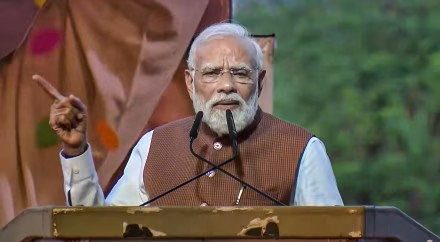
Goenka’s legacy and India’s democratic spirit
Modi opened his address by recalling the courage and conviction of Ramnath Goenka, founder of the Indian Express Group, who challenged authoritarianism during the Emergency and used journalism to strengthen democratic institutions. He noted that Goenka always prioritised national interest over political alignments, supporting leaders from different ideologies as long as their intentions aligned with the country’s welfare.
The Prime Minister also cited Goenka’s commitment to the Bhagavad Gita’s message of performing one’s duty without fear or favour — a value he termed crucial for nation-building in the 21st century.


Calling recent years “a period of global disruption,” Modi highlighted how India remained one of the fastest-growing major economies despite crises ranging from the COVID-19 pandemic to supply-chain shocks and geopolitical instability. India’s sustained growth, he said, has positioned the country not only as an emerging market but as an emerging model for the world.
“Today, the world sees the Indian growth model as a model of hope,” he asserted, emphasising that India’s future is built on “confidence, stability, and reform momentum.”
Record voter turnout and rising aspirations
Referencing the recent Bihar election results, Modi pointed to unprecedented voter participation — particularly among women — as proof of India’s robust democratic engagement. He said rising aspirations are driving voters to support governments that prioritise development over identity politics.
Modi urged all state governments—across ideological lines—to focus on competitiveness in investment, infrastructure, and governance reforms, arguing that public trust follows visible progress.
Social justice through saturation of schemes
Highlighting the government’s welfare-driven governance model, the Prime Minister said true social justice lies in ensuring that no eligible beneficiary is left out. He cited major milestones: construction of 12 crore toilets, opening of 57 crore Jan Dhan accounts, and providing 4 crore pucca houses to the poor.
Modi added that India expanded its social security coverage from 25 crore people a decade ago to 94 crore today, enabling 25 crore people to rise out of poverty. “This is what it means when the world says — democracy delivers,” he said.
Aspirational Districts: From neglect to transformation
Recounting the success of the Aspirational Districts Programme, Modi said the initiative reversed decades of stagnation in districts previously dismissed as “backward.” By identifying targeted indicators and deploying committed administrators, these districts now outperform many established regions in education, health, and development metrics.
He cited Bastar’s transformation — once synonymous with violence — as an example of grassroots empowerment through sports and social cohesion.
Warning against the rise of ‘urban naxal ideology’
In a sharp political critique, the Prime Minister accused previous governments of allowing Maoist ideology to take root not only in remote regions but also in academic and urban institutions. He warned that certain political groups continue to align with extremist thinking, which he described as a threat to national unity.
Call for ending Macaulay’s legacy by 2035
Modi devoted a significant portion of his lecture to urging Indians to free themselves from colonial mindsets. He traced the origin of this mindset to Thomas Macaulay’s 1835 education policies, which he said deliberately undermined India’s cultural and intellectual identity.
“By 2035, two centuries after Macaulay’s design, India must completely eliminate this psychological bondage,” he declared, emphasising promotion of Indian languages, heritage, and indigenous knowledge systems through policies like the National Education Policy (NEP) 2020.
He argued that pride in heritage is essential not only for education but also for sectors like tourism, where global success is driven by cultural self-confidence.
Conclusion
Modi concluded by reminding the audience that Ramnath Goenka’s fearless journalism continues to inspire India’s journey toward becoming a developed nation. He praised the Indian Express Group for preserving Goenka’s values and contributing to national discourse.