
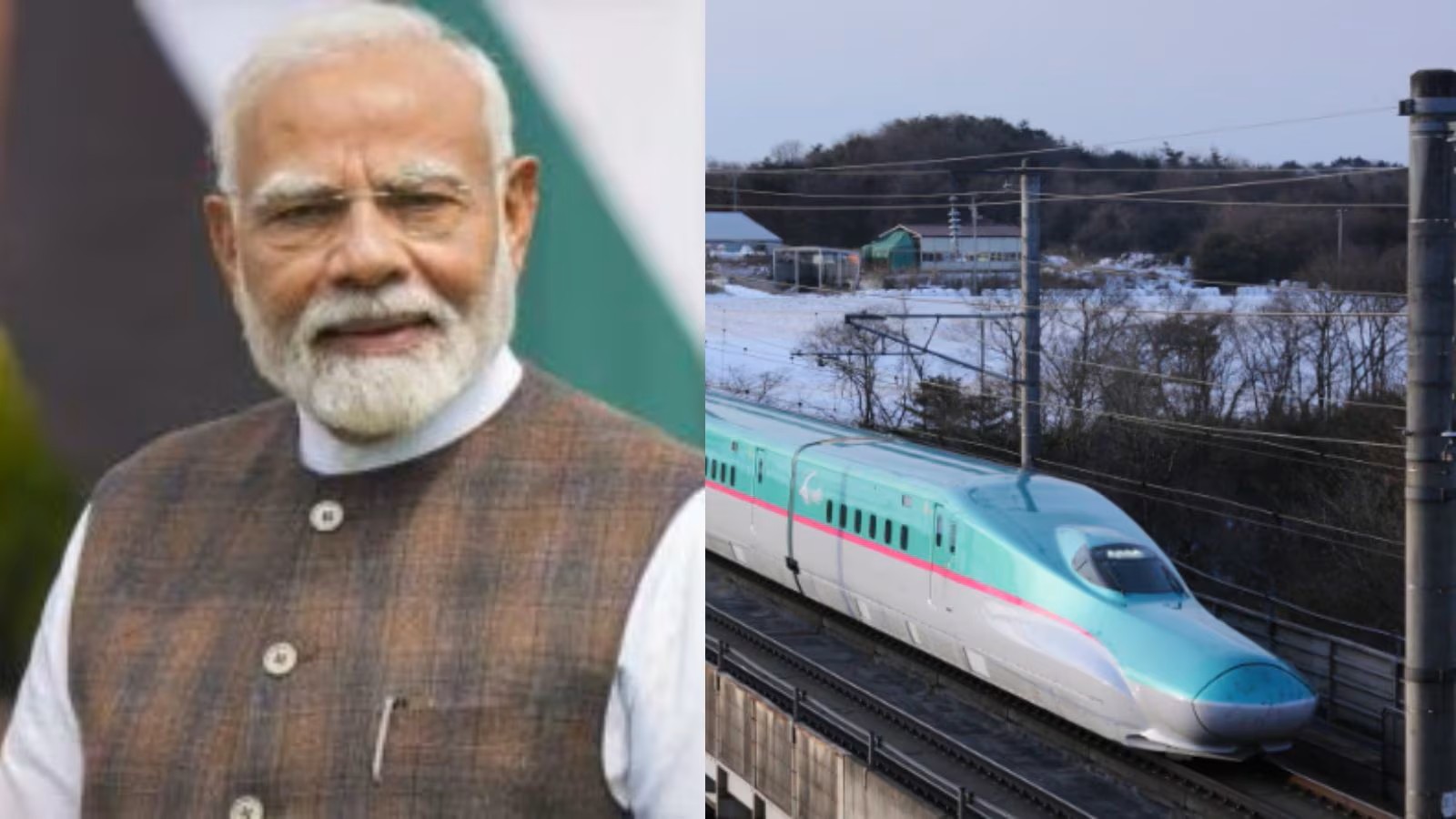
On-site review and worker interactions
Mr Modi engaged directly with the project team and asked pointed questions about adherence to speed and timetable targets. Workers and engineers briefed him on civil works, viaduct completion and schedule milestones. An engineer who is employed at the Noise Barrier Factory in Navsari described robotic welding for rebar cages, prompting the Prime Minister to ask how the worker felt contributing to India’s first Bullet Train.
The engineer described the experience as a “dream project” and a “proud moment” for her family. The Prime Minister also heard from Shruti, the Lead Engineering Manager from Bengaluru, about stringent design checks, engineering controls and stage-wise evaluation that aim to ensure flawless implementation.


Emphasising the spirit of national service, the Prime Minister said that the feeling of contributing to the nation becomes a powerful source of motivation. He drew a historical parallel with India’s early space missions, noting how the sense of purpose among pioneering scientists led to larger achievements that later scaled up to routine successes.
At the Surat site, an employee recited a poem expressing dedication to the project; Mr Modi responded appreciatively, underlining the human element behind large infrastructure programmes.
Blueprint for replication: the proposed ‘Blue Book’
One of the Prime Minister’s central messages was institutional learning. He urged the team to compile detailed records of decisions, challenges and solutions so future projects need not re-learn the same lessons. “Replication must be purposeful — it must be grounded in an understanding of why certain actions were taken,” he said, calling for a consolidated manual of execution learnings that students, engineers and administrators can use.
Mr Modi suggested that such documentation will help avoid repeated experimentation and accelerate large-scale implementation of high-speed rail and other complex infrastructure initiatives.
Progress on the Mumbai–Ahmedabad corridor
The Mumbai–Ahmedabad High-Speed Rail Corridor spans about 508 km — roughly 352 km in Gujarat (including Dadra & Nagar Haveli) and 156 km in Maharashtra. The corridor will link Sabarmati, Ahmedabad, Anand, Vadodara, Bharuch, Surat, Bilimora, Vapi, Boisar, Virar, Thane and Mumbai, with an estimated end-to-end travel time close to two hours once operational.
To minimise land disturbance, about 465 km (nearly 85% of the route) has been designed as viaducts. According to project updates, civil works and viaduct construction are well advanced; 326 km of viaduct work and multiple river bridges are already completed. The Surat–Bilimora section, covering approximately 47 km, reports advanced civil and track-bed progress.
Surat station-design and connectivity
The Surat station’s design takes inspiration from the city’s diamond industry, blending functionality with aesthetic elements. Planned passenger amenities include spacious waiting lounges, retail zones and integrated multi-modal links connecting Surat Metro, city buses and Indian Railways to ensure seamless last-mile connectivity.
Implications for regional growth
When completed, the Bullet Train corridor is expected to transform connectivity between Gujarat and Maharashtra, accelerating business travel, tourism and investment along the route. Project proponents say faster travel times and modern stations will serve as catalysts for job creation and regional development.