

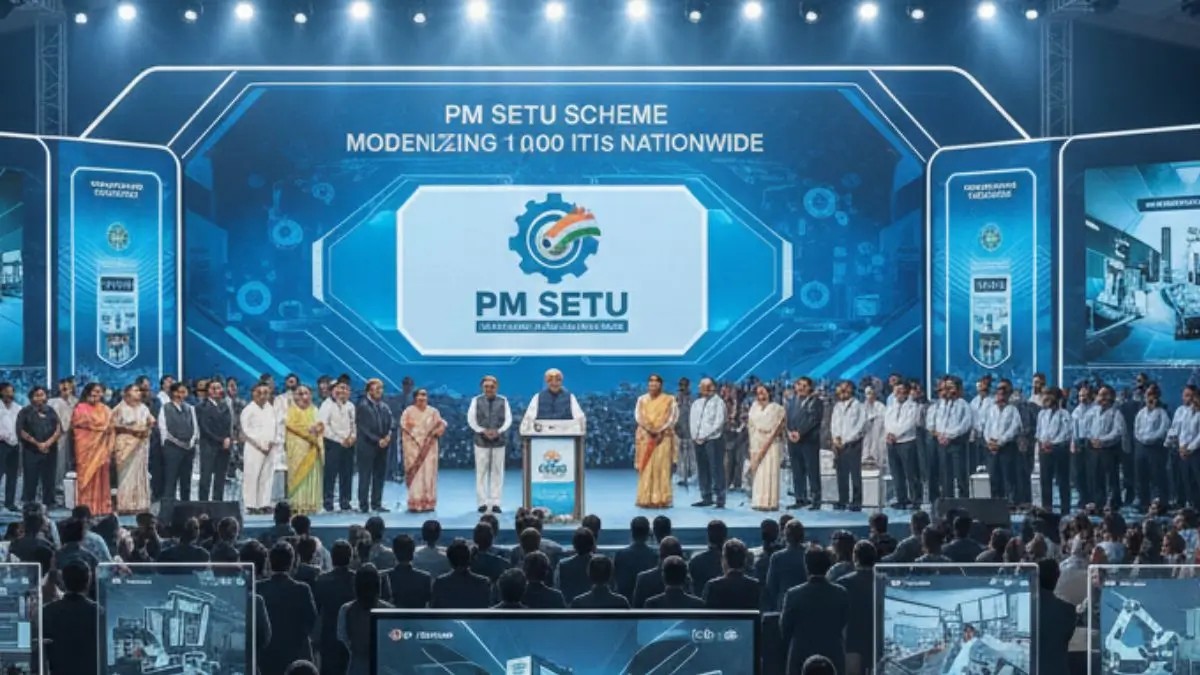

- Improve the quality of training delivery in Industrial Training Institutes (ITIs) and National Skill Training Institutes (NSTIs).
- Modernize infrastructure and equipment according to industry standards.
- Introduce industry-aligned long-term and short-term courses, especially in emerging sectors.
- Strengthen industry linkage for demand-driven skilling and enhanced employment outcomes.
- Enhance the capacity of NSTIs for training trainers.
Scheme Components
PM-SETU consists of two major components:
- Upgradation of 1,000 Government ITIs: Implemented in a Hub and Spoke model, with 200 Hub ITIs and 800 Spoke ITIs. The upgradation includes smart classrooms, modern labs, digital content, and new courses aligned to industry requirements.
- Capacity Augmentation of NSTIs: Five NSTIs located in Bhubaneswar, Chennai, Hyderabad, Kanpur, and Ludhiana will be enhanced, including the creation of sector-specific National Centres of Excellence. The focus is on advanced training for trainers, with potential global collaborations.
Focus on Industry-Led Employability
PM-SETU emphasizes industry-led governance to ensure training aligns with current and emerging workforce requirements. The scheme indirectly supports self-employment and entrepreneurship by equipping learners with practical skills, real-world exposure, and access to career guidance, placement support, and industry networks.
Implementation and Governance
The selection of ITIs under PM-SETU is driven by respective State and UT governments in consultation with industry partners. States and UTs submit proposals for upgradation, ensuring alignment with local industrial potential and emerging skill requirements. A National Steering Committee (NSC), chaired by the Secretary of MSDE, provides policy guidance and monitors the scheme, while 25 States/UTs have established State Steering Committees (SSC) for oversight.
Pilot Phase Updates
In Maharashtra, three clusters in Pune, Nagpur, and Chhatrapati Sambhajinagar districts have been identified for the pilot phase, while no proposal was received from Palghar. In Bihar, two clusters in Patna and Darbhanga are selected, with Requests For Proposals (RFPs) to be issued for industry participation.
Significance of PM-SETU
The PM-SETU scheme strengthens the ITI and NSTI ecosystem by improving infrastructure, introducing industry-aligned training, and fostering industry partnerships. While primarily focused on vocational education and skill enhancement, the program is not a dedicated startup initiative. By modernizing training institutions, PM-SETU aims to produce a workforce that is ready to meet the demands of India’s evolving industries and contribute to economic growth.