
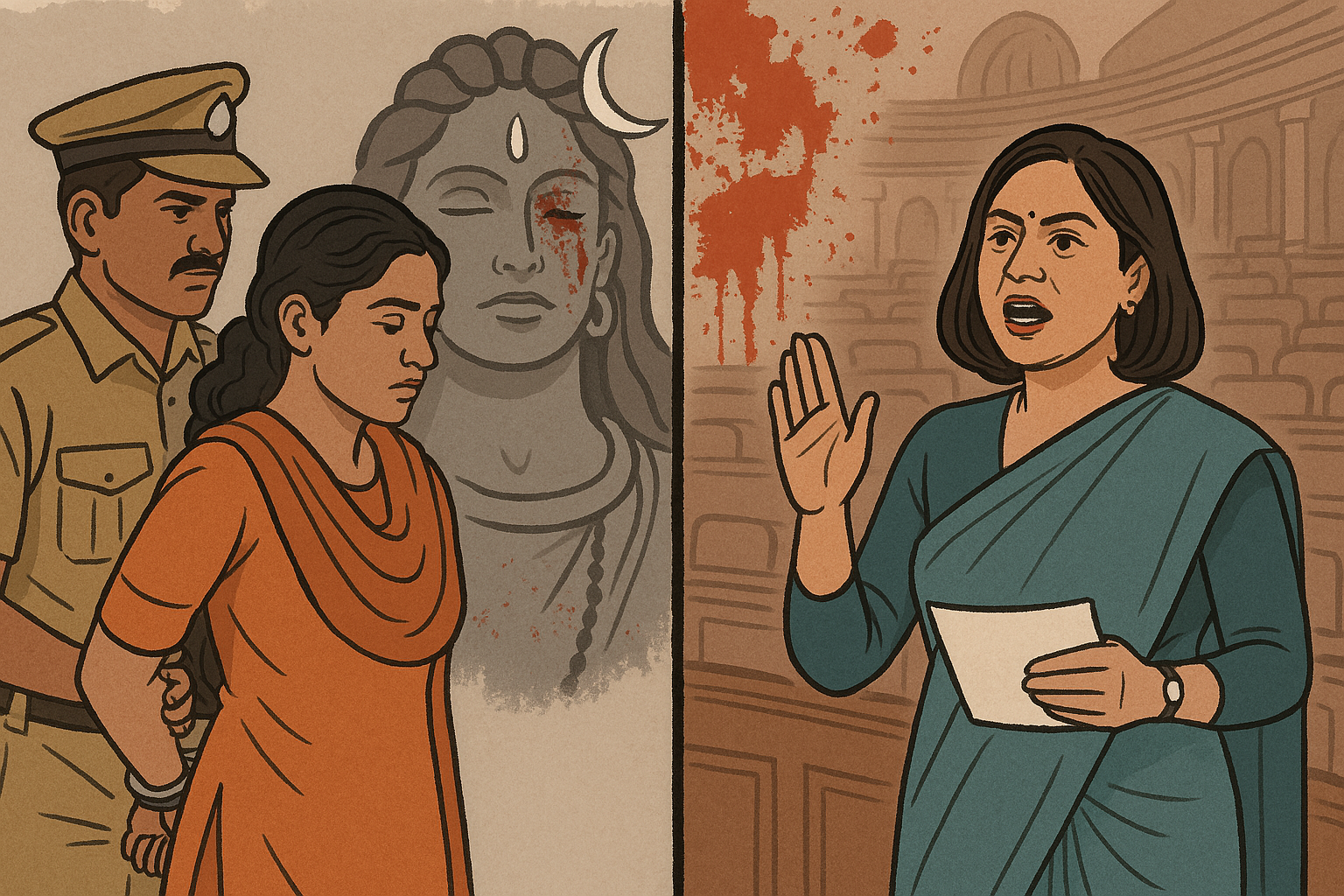
In a time when freedom of expression is hailed as a hallmark of democracy, its selective application—especially in matters of religion—exposes a troubling double standard. Two events involving west bengal illustrate this well: Saayoni Ghosh, now a Member of Parliament with the Trinamool Congress, was associated with a social media post mocking Lord Shiva in 2015. Despite the controversy, she advanced politically. In contrast, Sharmishtha Panoli, a 19-year-old residing in NCE, was recently arrested by the West Bengal Police for a reactive post supporting #OperationSindoor, a pro-Hindu campaign. The stark difference in outcomes raises the question: why is mocking Hindu deities most often overlooked, while criticism of other faiths brings swift and severe repercussions?
This isn’t an isolated occurrence. Public figures like Nupur Sharma faced death threats and widespread backlash for comments on Islam, while prior offenders against Hindu sentiments often walk free or rise in stature. Such cases point to a disturbing pattern—one where Hindus are frequently penalized for asserting their faith, while others leverage institutional and political power to suppress dissent.
The situation grows more complex when considering how faith-based organizations operate strategically. The recent FIR against Sharmishtha Panoli was filed by the Rashidi Foundation, highlighting how NGOs and religious fronts with ideological or sectarian leanings often wield significant legal influence. These groups, well-funded and politically connected, ensure that perceived slights against their faiths do not go unpunished.
Globally, this disparity is not unique to India. Consider the following recent examples:
- Charlie Hebdo (France, 2015): 12 journalists were massacred for publishing cartoons of Prophet Muhammad. The attackers believed they were enforcing Islamic blasphemy codes.
- Taslima Nasreen (Bangladesh/India): The author was exiled and physically attacked for criticizing Islamic orthodoxy. She remains unable to return home.
- Salman Rushdie (UK/US): Issued a death fatwa for The Satanic Verses in 1989; stabbed in 2022, decades later.
- Nupur Sharma (India, 2022): A BJP spokesperson criticized Islamic practices and faced global condemnation, threats, and ostracism.
- Asia Bibi (Pakistan, 2009–2019): A Christian woman was sentenced to death for alleged blasphemy; even after acquittal, she fled the country.
- M.F. Husain (India): Depictions of Hindu deities in the nude sparked protests, but institutional pushback was minimal. He died in exile.
- Jyllands-Posten Cartoons (Denmark, 2005): A Danish newspaper faced global riots for printing Muhammad cartoons.
These incidents underscore a global reality: criticism of some religions leads to violent or legal consequences, while others are routinely disrespected without similar pushback.
What drives this asymmetry? Power, organization, and the strategic use of legal and political tools. The Organization of Islamic Cooperation (OIC) represents a unified front of 57 nations, defending Islamic interests worldwide. In contrast, Hindus remain fragmented—regionally, linguistically, and ideologically—making them easier targets. While some factions respond with activism, they lack institutional support.
The concept of blasphemy, whether legally codified or culturally enforced, acts as a shield around sacred values. For some, violating that shield can lead to exile or death. For others, like Saayoni Ghosh, it can result in celebration and elevation—so long as the religion mocked lacks a powerful defense.
This is not a call for censorship or retribution, but for introspection. If Hindus truly revere Shakti—the divine feminine power—they must embody her strength in practice, not just in devotion. Being proud is not enough. Organization, legal literacy, and cultural unity are the need of the hour.
Freedom of expression must be universal. Until then, the selective application of outrage will continue to breed resentment, division, and injustice.
Sources and References:
- BBC: Charlie Hebdo attack [https://www.bbc.com/news/world-europe-30708237]
- The Guardian: Taslima Nasreen attacked [https://www.theguardian.com/books/2007/aug/10/news.politics]
- NYT: Salman Rushdie stabbing [https://www.nytimes.com/2022/08/12/nyregion/salman-rushdie-attack.html]
- India Today: Nupur Sharma controversy [https://www.indiatoday.in/india/story/explained-what-nupur-sharma-said-and-how-it-snowballed-into-a-diplomatic-nightmare-1968505-2022-06-29]
- The Hindu: M.F. Husain dies in exile [https://www.thehindu.com/news/national/MF-Husain-dies-in-London/article13999642.ece]
- Reuters: Denmark cartoon controversy [https://www.reuters.com/article/us-denmark-cartoon-idUSKCN1VV0VP]
- Human Rights Watch: Reports on blasphemy laws
- UNESCO Report on Cultural Diversity and Freedom of Expression (2022)