
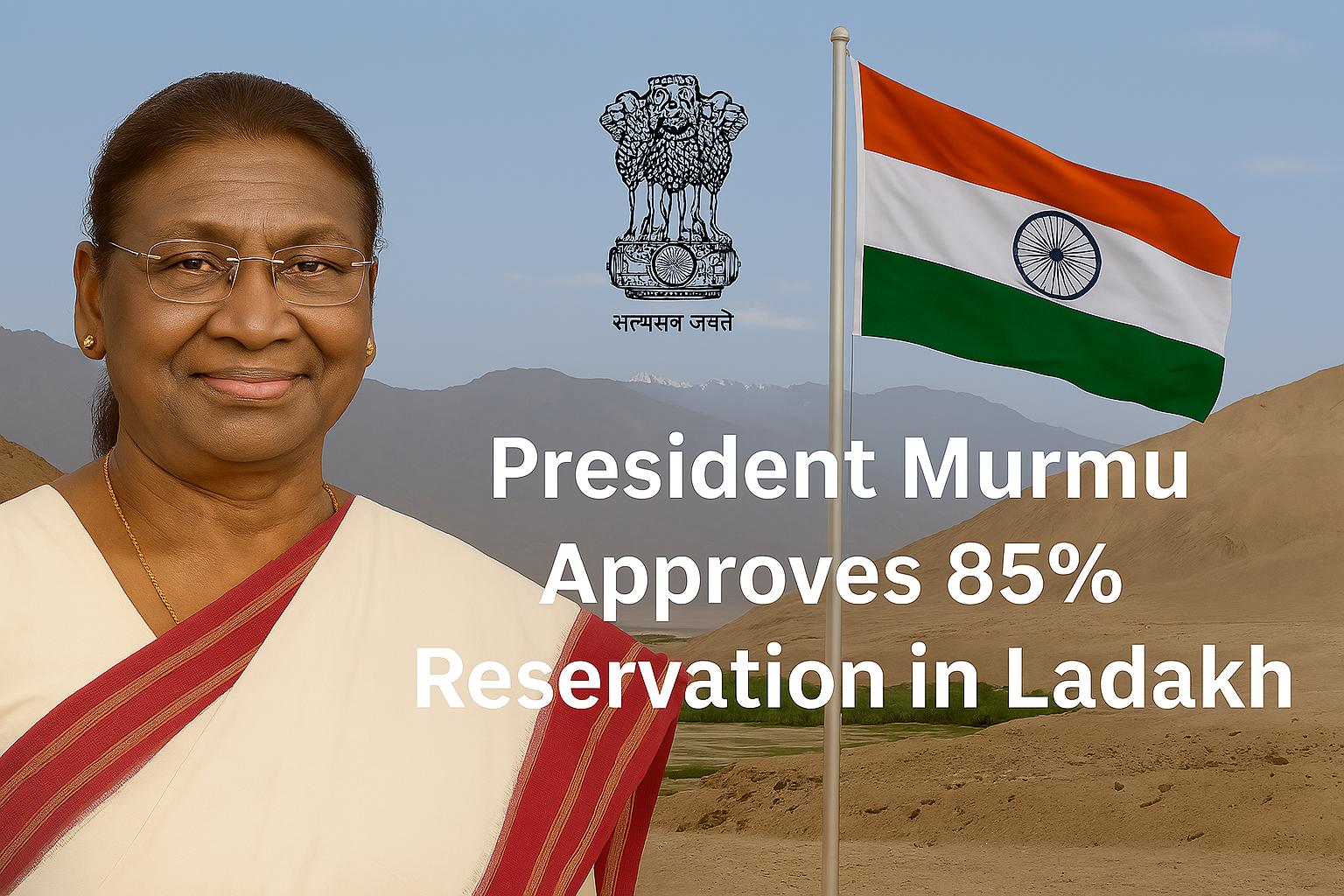
In a major development, President Droupadi Murmu has approved an ordinance to amend the Jammu & Kashmir Reservation Act, implementing a new reservation policy in the Union Territory (UT) of Ladakh. The new ordinance, promulgated on June 3, 2025, brings significant changes to reservation rules for jobs and admissions in Ladakh, capping reservations at 85%, excluding the 10% quota for Economically Weaker Sections (EWS).

What the New Ordinance Says
The key provision of the new regulation is:
“The total percentage of reservation shall in no case exceed 85 percent, excluding reservation for Economically Weaker Sections (EWS).”
This means that the existing 10% EWS reservation, which applies nationwide under Article 15(6) and 16(6), will be in addition to the 85% cap set for other reserved categories in Ladakh.
The ordinance also updates rules related to:
-
Carrying forward vacancies in case suitable candidates are not available.
-
Reservation in promotions for government jobs.
-
Admission to professional educational institutions.
In all such cases, the 85% reservation cap will apply, excluding EWS reservations.
Detailed Reservation Breakdown
According to local reports (including Greater Kashmir), the proposed 85% reservation in Ladakh is divided as follows:
-
Scheduled Tribes (ST): 80%
-
Residents near the Line of Control (LoC): 4%
-
Scheduled Castes (SC): 1%
This reflects Ladakh’s unique demographic and socio-political context, where a large proportion of the population belongs to Scheduled Tribes.
What Happens If Seats Remain Vacant?
The ordinance provides that if suitable candidates are not found for a reserved category during recruitment or admissions, the vacancies will remain unfilled and be carried forward to the next recruitment round. These vacancies will only be opened up for general candidates (de-reserved) if they remain vacant for more than three years.
This rule encourages continued attempts to fill reserved posts with eligible candidates from the respective categories before considering general category applicants.
Scope of Application
The Law Ministry has clarified that the amended reservation rules will apply to:
-
All government posts and admissions under the administration of the Union Territory of Ladakh.
-
Posts under local and other authorities, except the Cantonment Board.
This ensures broad coverage across public employment and education within the UT.
Background: J&K Reservation Act
The original Jammu & Kashmir Reservation Act, 2004 was introduced to provide reservation in public employment and professional institutions to marginalized communities, such as:
-
Scheduled Castes (SC)
-
Scheduled Tribes (ST)
-
Other Socially and Educationally Backward Classes (OBCs)
The 2023 amendment bill introduced in Parliament aimed to adapt this Act to the changed political landscape after Article 370 was revoked in 2019 and J&K was reorganized into two Union Territories — Jammu & Kashmir and Ladakh.