


Since its launch in July 2025, the Adi Karmayogi Abhiyan has mobilised around 20 lakh individuals across one lakh villages. These include officials, self-help group women, youth volunteers, and other community members who are working to strengthen tribal development initiatives. The campaign also identified one lakh Adi Seva Kendras to serve as single-window service hubs and grievance redressal centres.
The President noted that through the Dharti Aba Janjati Gram Utkarsh Abhiyan, basic infrastructure and services are being extended to more than 63,000 tribal-dominated villages. She highlighted the importance of the Forest Rights Act in ensuring social justice, environmental balance, and equality, but added that real empowerment lies in recognising and respecting tribal rights while ensuring their representation in governance.
Call for Active Participation
President Murmu urged tribal communities to express their voices on multiple platforms, hold institutions accountable, and take ownership of their development journey. “True empowerment is not only about schemes,” she remarked, “but about recognition, respect, and representation.”
She emphasised that inclusive growth requires collective efforts to build a society rooted in equality, justice, and respect while preserving cultural traditions. Technology, she said, must be harnessed to connect tribal communities with the mainstream without eroding their distinct identity.
AI for Tribal Inclusion: Launch of Adi Vaani
The President welcomed the launch of Adi Vaani, an AI-powered indigenous language translation tool, describing it as a “milestone in language and education transformation.” The beta version, launched in September 2025, is the world’s first AI-driven platform designed to preserve tribal languages while promoting social inclusion. Built with artificial intelligence (AI) and machine learning (ML), it aims to bridge linguistic gaps and make education more accessible for tribal communities.
This innovation, she noted, reflects India’s broader commitment to using emerging technologies for cultural preservation and welfare of marginalised groups. A short film on the Adi Karmayogi Abhiyan was also screened during the event.
Leaders in Attendance
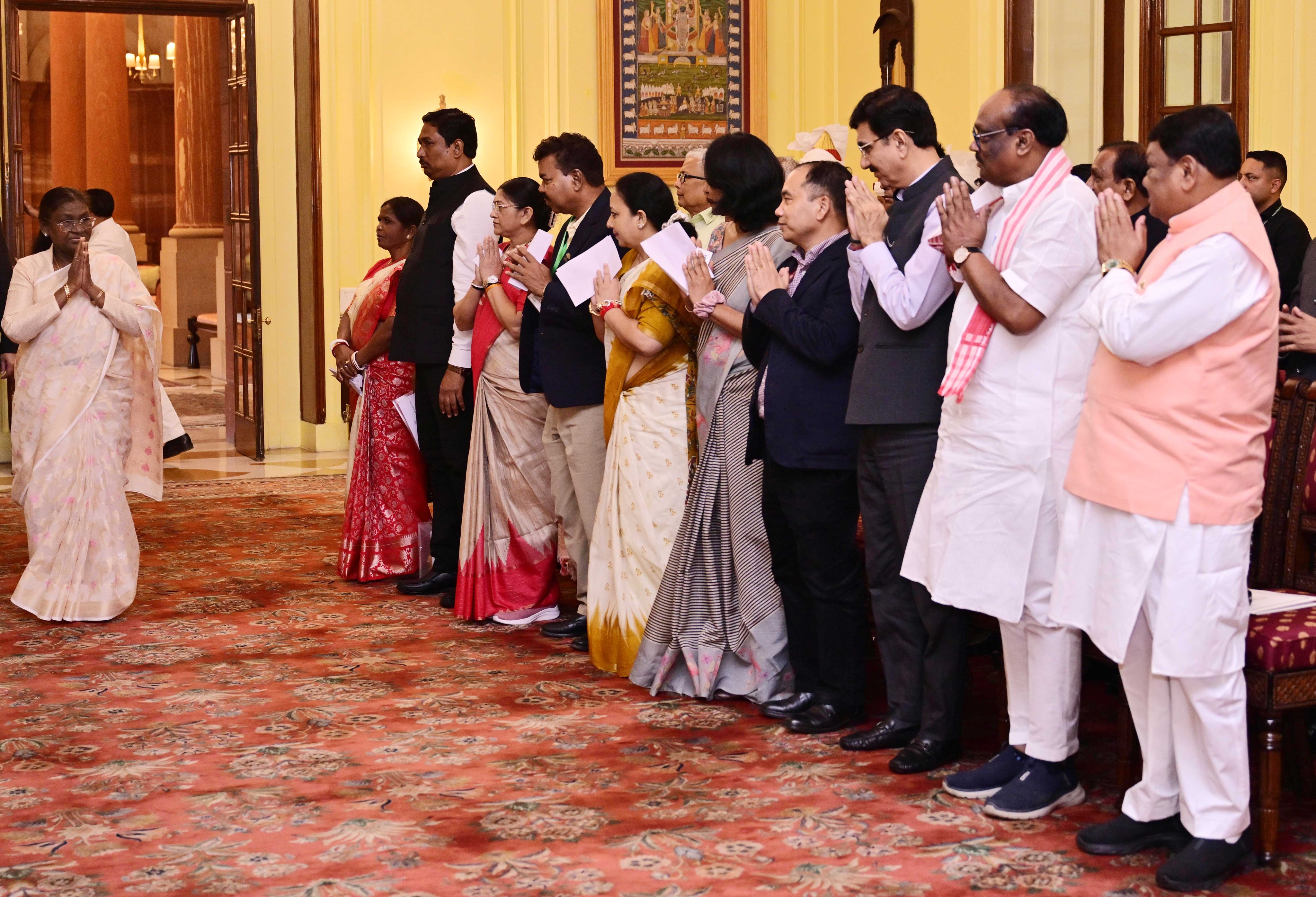
The meeting was attended by Union Minister for Tribal Affairs Jual Oram and Minister of State for Tribal Affairs Durgadas Uikey, who expressed their commitment to expanding the initiative further. Both ministers highlighted how programmes under the Abhiyan align with the government’s long-term vision of inclusive development.
By strengthening rights, expanding services, and integrating technology, the Adi Karmayogi Abhiyan is shaping up as a transformative step in bridging historical gaps and creating pathways for tribal empowerment.