
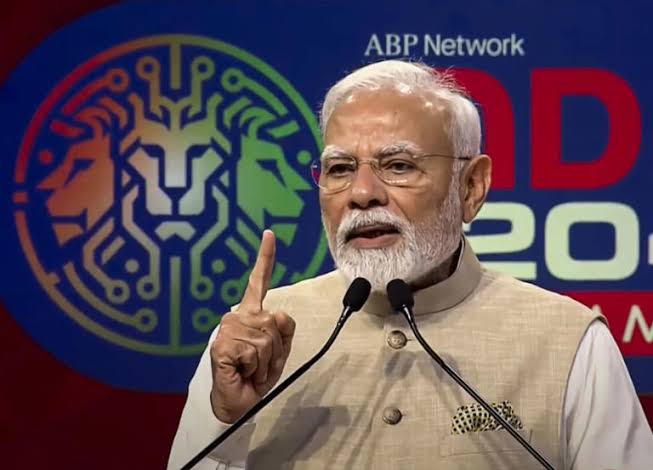
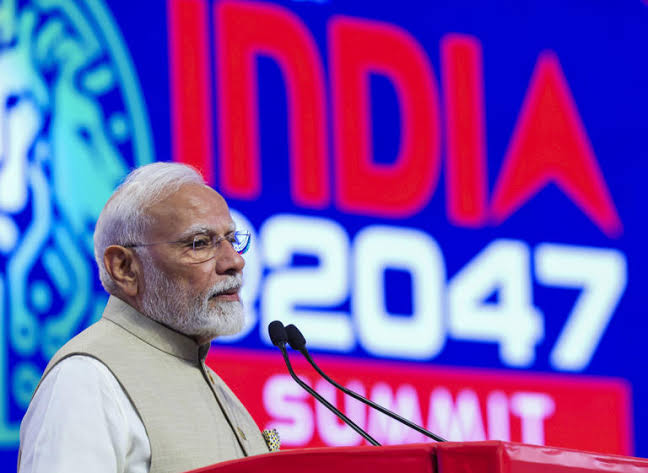
On 6th May 2025, Prime Minister Narendra Modi delivered an impassioned and hopeful address at the ABP Network India@2047 Summit held at Bharat Mandapam. Speaking to a vibrant audience that included a significant number of youth and women, the Prime Minister highlighted Bharat’s transformative journey over the past decade and the nation’s resolute march toward becoming a developed country by 2047.

With warmth and conviction, PM Modi reflected on the stories shared by grassroots leaders like Drone Didis and Lakhpati Didis, whose lives have been uplifted by various government schemes. Their enthusiasm and success symbolize a changing Bharat—one that is vocal, aspirational, and deeply rooted in self-belief.
A major highlight of the address was the announcement of the finalization of the India–UK Free Trade Agreement. Calling it a historic development, the Prime Minister expressed confidence that the deal would open new avenues for Indian businesses, especially MSMEs, and generate fresh employment opportunities for the youth. This builds on a series of global economic engagements Bharat has undertaken with countries like the UAE, Australia, and Mauritius.
Reflecting on the government’s bold policy decisions, PM Modi criticized the previous era where governance was driven by fear of political loss rather than national interest. He pointed to decisive moves made by his administration—such as reforms in the banking sector, privatization of Air India, implementation of One Rank, One Pension (OROP), and the Direct Benefit Transfer (DBT) system—as examples of governance that places the nation first.
With deep empathy, he discussed how DBT eliminated over 10 crore fake beneficiaries, saving more than ₹3.5 lakh crore that now directly reaches the deserving. “This is your money, and we protected it,” he said, reaffirming his government’s commitment to transparency and justice.
The Prime Minister also touched upon long-pending issues like the Women’s Reservation Bill, reservation for economically weaker sections, and the abolition of Triple Talaq—moves aimed at empowering marginalized communities, particularly women and Muslims. Recent amendments to the Waqf Act, he noted, were undertaken not to appease but to genuinely uplift underrepresented groups such as Pasmanda Muslims.
Water management and river-linking initiatives were cited as major infrastructural undertakings to benefit millions of farmers and resolve regional disputes over water. He emphasized that Bharat’s water resources must serve its people and fuel its growth.
PM Modi also acknowledged Bharat’s cultural revival, with efforts like the construction of the new Parliament building and the completion of the Dr. Ambedkar Memorial. These projects, he said, represent the country’s commitment to honoring its heritage while embracing modernity.
In a heartfelt moment, he reminded the audience of the cynicism that surrounded Indian democracy a decade ago. But today, with 25 crore people lifted out of poverty and backward districts transformed into aspirational ones, India has proven that democracy can deliver meaningful change.
The Prime Minister underlined a shift from GDP-centric growth to a model centered on the “Gross Empowerment of People” (GEP). From permanent housing and sanitation to Ayushman Bharat’s health coverage and Digital India’s tech empowerment, these steps signify development with dignity and compassion.
He described the government’s philosophy of “Nagrik Devo Bhava”—citizen is divine—not just as a slogan but a guiding principle. Outdated bureaucratic hurdles have been replaced with digital conveniences like self-attestation and online life certificates for senior citizens. These changes reflect a government that serves rather than rules.
In a forward-looking tone, he celebrated the creative potential unleashed by Digital India. The success of YouTube creators, tribal artists, and women entrepreneurs demonstrates that mobile phones have become instruments of economic empowerment and cultural expression.
Ending on an optimistic note, the Prime Minister reiterated that Bharat’s development journey is grounded in both tradition and progress. With record foreign investment, booming digital transactions, solar energy capacity, and cultural reclamation, India is asserting its global leadership without compromising its roots.
The India@2047 vision, as presented by PM Modi, is not just a roadmap but a heartfelt promise—a commitment to ensure that every Indian, regardless of background, shares in the country’s rise. The emotional resonance of his words echoed the aspirations of a billion people: that a developed, inclusive, and self-reliant Bharat is not a distant dream, but an unfolding reality.