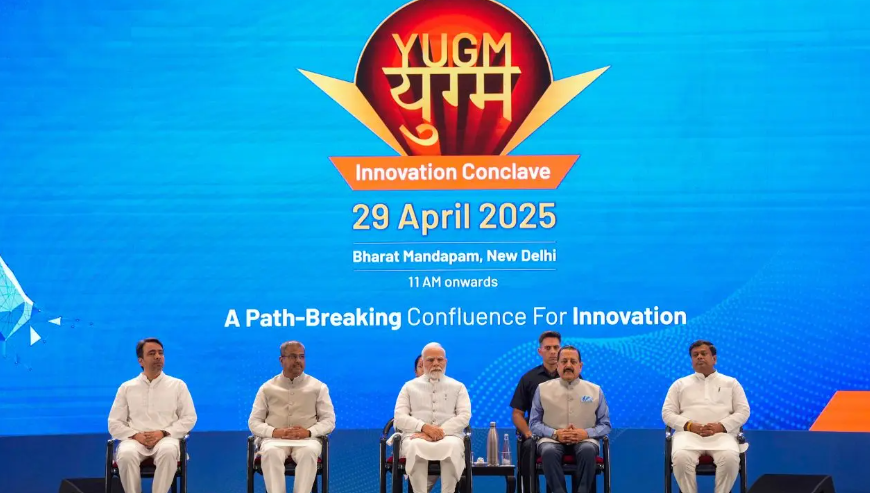
On April 29, 2025, Prime Minister Narendra Modi inaugurated the YUGM Innovation Conclave at Bharat Mandapam, New Delhi. The event brought together leaders from government, academia, industry, and the innovation ecosystem to discuss and promote India’s future in deep-tech and research commercialisation.
Key Highlights from the Conclave
1. Vision for a Developed India by 2047
Prime Minister Modi emphasized the importance of transforming research into real-world applications swiftly. He stated, “Reducing the distance from lab to market ensures faster delivery of research outcomes to the people, motivates researchers, and provides tangible incentives for their work.” He also highlighted the government’s commitment to simplifying regulations and fast-tracking approvals to support innovation.
2. Strengthening the Education and Research Ecosystem
The Prime Minister outlined the government’s efforts to modernize India’s education system to meet 21st-century needs. He mentioned the introduction of the New National Education Policy, the development of the National Curriculum Framework, and the creation of AI-based digital education platforms like ‘One Nation, One Digital Education Infrastructure’ under PM e-Vidya and DIKSHA. These initiatives aim to provide scalable and accessible education across the country.
3. Promoting Research and Innovation
Underlining the importance of research, Modi noted the doubling of gross expenditure on R&D from ₹60,000 crore in 2013–14 to over ₹1.25 lakh crore. He highlighted the establishment of state-of-the-art research parks and the creation of Research and Development Cells in nearly 6,000 higher education institutions. He also mentioned the rapid development of an innovation culture in India, citing the increase in patent filings from around 40,000 in 2014 to over 80,000.
4. Fostering Youth-Led Innovation
Modi emphasized that today’s youth are not just excelling in R&D but are also becoming disruptive innovators. He cited milestones like the commissioning of the world’s longest hyperloop test track at IIT Madras and groundbreaking achievements in nanotechnology at IISc Bangalore. He also noted the development of India’s first indigenous MRI machine. He encouraged startups to give back to society by supporting individuals and institutions in the startup sector. (PM inaugurates Start-up Mahakumbh at Bharat Mandapam, New Delhi | Prime Minister of India)
5. Strategic Collaborations and MoUs
During the conclave, several Memoranda of Understanding (MoUs) were signed to bolster India’s innovation landscape:
- Wadhwani School of AI and Intelligent Systems at IIT Kanpur: With a funding of ₹500 crore, this initiative aims to establish a new 150,000 sq. ft. AI and Intelligent Systems school, including advanced research centres and 50 external hubs in AI, cybersecurity, robotics, and AI policy.
- Wadhwani Hub for Biosciences, Bioengineering, Health, and Medicine at IIT Bombay: With a funding of ₹300 crore, this hub will focus on biosciences and health-tech, establishing research centres and 10 external hubs in biotech, health systems, medical devices, and translation.
- National Co-funding Framework for Translational Research: In partnership with the Anusandhan National Research Foundation (ANRF), this ₹200 crore initiative will enable late-stage research translation in critical domains like AI, quantum computing, biosciences, health tech, and smart mobility.
6. International Collaborations and Global Recognition
Modi highlighted the increasing representation of Indian institutions in global rankings, with over 90 universities listed among 2,000 institutions globally. He noted the growth in QS world rankings, where India moved from having nine institutions in 2014 to 46 in 2025. He also mentioned the establishment of Indian institutions abroad, such as IIT Delhi in Abu Dhabi and IIT Madras in Tanzania, and the upcoming IIM Ahmedabad campus in Dubai.
7. Emphasis on Emerging Technologies
The Prime Minister emphasized the need to consistently promote AI, quantum computing, advanced analytics, space tech, health tech, and synthetic biology. He mentioned the launch of the India-AI Mission to build world-class infrastructure, high-quality datasets, and research facilities. He reiterated the commitment to the vision of “Make AI in India” and the goal to “Make AI work for India.”
8. Support for Startups and Innovation Hubs
Modi announced the establishment of 50,000 Atal Tinkering Labs in schools across the country to provide early exposure to children. He also mentioned the launch of the PM Vidya Lakshmi scheme to provide financial support to students and the establishment of internship cells in over 7,000 institutions to transform students’ learning into real-world experience.
9. Commitment to a Self-Reliant Innovation Ecosystem
The Prime Minister reaffirmed the government’s commitment to developing a self-reliant innovation ecosystem. He emphasized the importance of collaboration between academia, industry, and government to achieve the goal of a developed India by 2047.
The YUGM Innovation Conclave marks a significant step toward realising India’s vision of becoming a global leader in innovation and research commercialisation.