
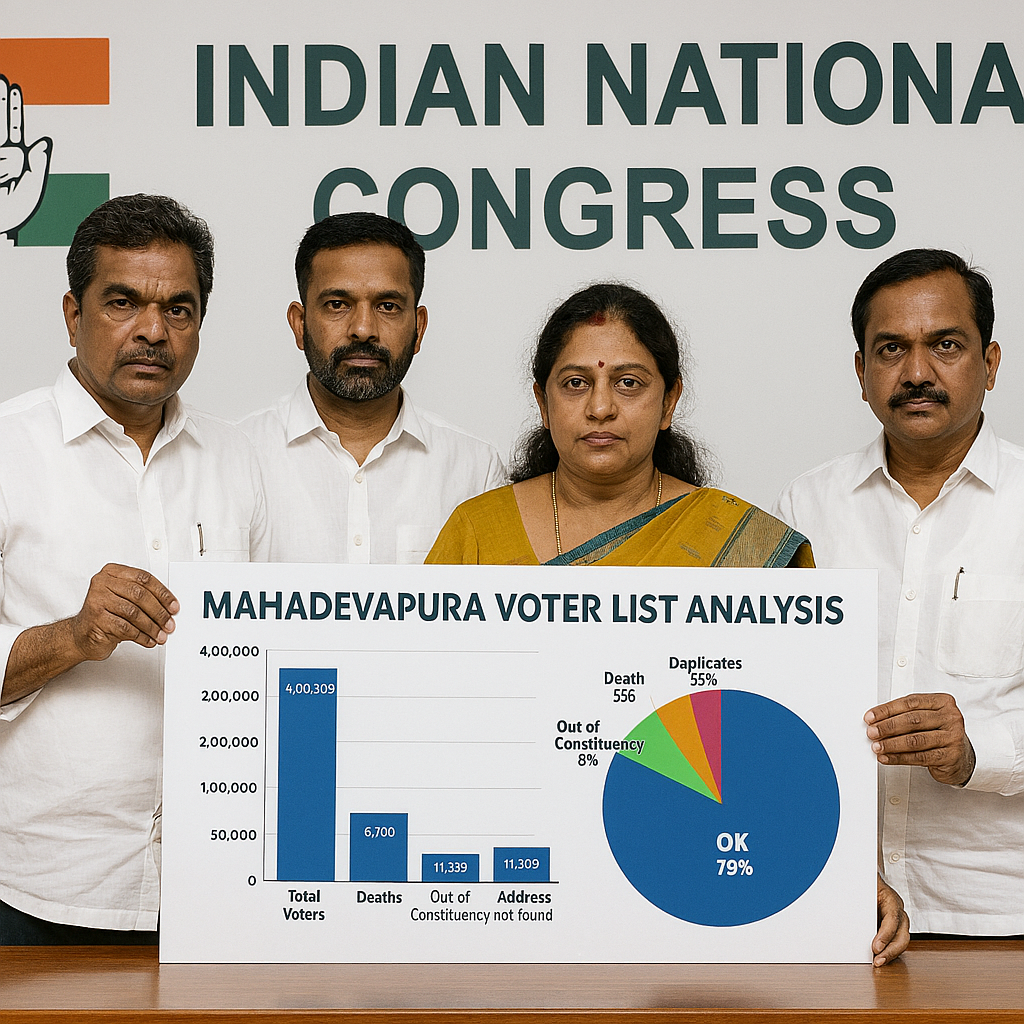
New Delhi: In a fiery press conference on August 8, Congress leader Rahul Gandhi dropped what he called “atom bomb proof of vote chori,” shaking the political ground ahead of crucial elections.
Standing at the AICC headquarters, Gandhi presented detailed claims of large-scale voter list fraud, especially in Bengaluru’s Mahadevapura constituency. The allegations target the Election Commission of India (ECI) and accuse it of colluding with the ruling BJP.
Weeks of Suspense, One Explosive Allegation
For over a week, Gandhi had been teasing the press and public with a promise of explosive evidence. And on August 7, a day after the Hiroshima bombing anniversary, he delivered what he called “irrefutable proof.”
Gandhi claimed that a team of 40 researchers worked for six months to investigate the alleged electoral fraud. Their work, he said, uncovered a network of fake voter IDs, duplicate entries, and forged addresses being used to influence elections in BJP’s favor.


The Congress leader didn’t mince words. He accused the Election Commission of India of being complicit in the manipulation of voter rolls. Gandhi alleged that the ECI failed to prevent widespread misuse of Form 6, which is used to enroll new voters.
He claimed the manipulation was not random but systematic. “This is not clerical error. This is planned vote theft,” Gandhi said. “The ECI is not just turning a blind eye, it is cooperating.”
Key Proof from Mahadevapura
The press conference centered around alleged fraud in the Mahadevapura constituency, a BJP stronghold in Bengaluru. Gandhi’s team claims to have found:
- 11,000 duplicate voters registered at the same address
- Thousands of voters with fake or non-existent addresses
- Multiple entries under different names but with the same photograph
- Mass registrations using the same phone numbers or emails
Gandhi said these patterns show a clear intent to manipulate outcomes by artificially inflating vote counts in targeted areas.
Demand for Urgent Action
Gandhi demanded an immediate investigation into the voter roll discrepancies and an independent audit of electoral rolls.
“This isn’t about one seat or one party. It’s about India’s democracy. If people lose faith in the vote, the entire system collapses,” he stated.
He also called on civil society, media, and opposition parties to press for accountability and transparency from both the ECI and the BJP-led government.
Congress’s 5 Key Takeaways from the Proof
- Systematic duplication of voter entries, especially in urban constituencies.
- Misuse of Form 6 to enroll fake or underage voters.
- ECI inaction and potential collusion with ruling party interests.
- Potential for large-scale election rigging in upcoming polls.
- Call for electoral reform and urgent roll cleanup nationwide.
ECI Yet to Respond
At the time of writing, the Election Commission of India has not officially responded to Gandhi’s allegations. However, sources close to the commission said that a review of the Mahadevapura voter list may be undertaken.
Meanwhile, the BJP dismissed the charges as “political drama” and accused Gandhi of creating confusion ahead of elections.
Not the First Time
This isn’t the first time Congress has raised concerns about voter list integrity. However, this time, Gandhi has backed his claims with detailed documentation, including video recordings of site visits, official voter roll extracts, and data analytics charts.
Party insiders suggest that more such exposés may follow, targeting constituencies across different states.
A Crossroads for Indian Democracy?
Gandhi’s revelations, if verified, could mark a serious threat to the credibility of India’s electoral process. The “vote chori” allegations strike at the very foundation of representative democracy—free and fair elections.
The issue may escalate into a major national debate as the 2026 assembly elections draw closer. With trust in institutions under scrutiny, the coming weeks will test the resilience of India’s democratic framework.