 India Entering a Defining Deep-Tech Phase
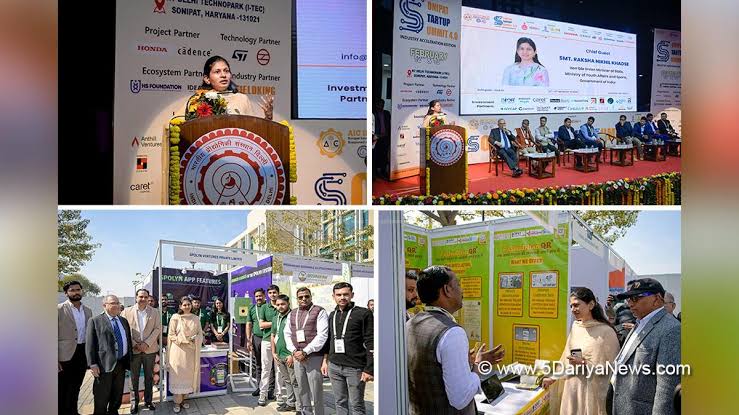
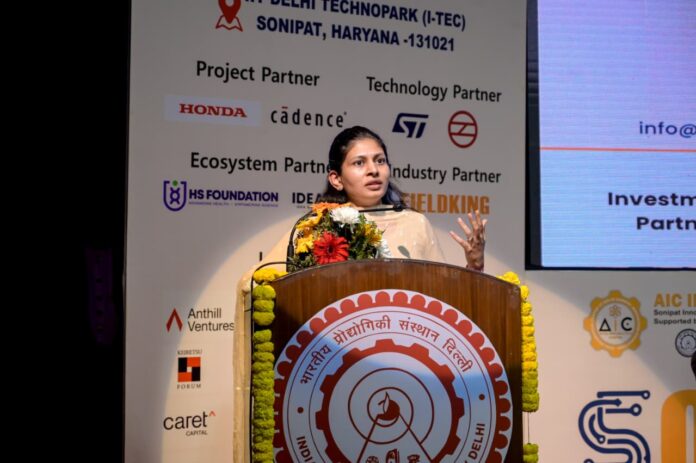
Addressing startup founders, researchers, students, and industry leaders, Khadse emphasized that India is entering a transformative phase powered by deep-tech innovation, capital investment, and global scalability. She noted that the country’s rapidly expanding startup ecosystem is strengthening industrial capacity while positioning India as a global technology leader.
The summit, themed “Industry Acceleration Edition,” provided a platform for startups, MSMEs, corporates, academia, and government stakeholders to collaborate and accelerate innovation-driven enterprise development. Khadse said such platforms play a vital role in transforming ideas into scalable businesses and creating new economic opportunities.
She stressed that India’s youth are not only launching startups but also contributing significantly to economic development, technological independence, and national competitiveness.
Government Initiatives Strengthening Innovation Ecosystem
Khadse highlighted that flagship initiatives such as Startup India, Digital India, Make in India, and Atmanirbhar Bharat have created a strong foundation for innovation-led growth. These programmes are enabling entrepreneurs by providing financial support, incubation infrastructure, mentorship, and access to markets.
She noted that schemes under NITI Aayog’s Atal Innovation Mission and other government-backed startup accelerators are offering funding support of up to ₹50 lakh. These initiatives help early-stage startups overcome financial barriers while promoting technological research and product development.
The Union Budget 2026 has further strengthened support for deep-tech innovation, semiconductor manufacturing, green growth, and expanded credit guarantees for startups and MSMEs. Khadse said these measures will help Indian startups compete globally and contribute to long-term industrial development.
Focus on Emerging Technologies and Regional Growth
The Minister emphasized that emerging sectors such as artificial intelligence, robotics, semiconductors, advanced manufacturing, green energy, defence technology, and agri-tech are creating new opportunities for startups. These technologies are expected to drive economic growth and enhance India’s technological sovereignty.
Special emphasis was placed on strengthening startups in Tier II and Tier III regions, particularly across the Haryana NCR industrial corridor. Khadse noted that empowering entrepreneurs in smaller cities will help create balanced regional development while connecting local innovators to national and global markets.
The summit demonstrated how public-private collaboration can accelerate startup growth by providing access to intellectual property guidance, regulatory frameworks, and global investment networks.
New Opportunities in Sports Technology and Manufacturing
Khadse also highlighted emerging opportunities in sports technology and manufacturing, pointing to innovations in sports analytics, wearable technology, biomechanics, and AI-driven performance monitoring. She said these areas present significant potential for sports-focused startups and manufacturing enterprises.
She noted that provisions in the Union Budget 2026 supporting sports goods manufacturing and innovation will help India strengthen its position in the global sports economy. These developments will encourage startups to explore new solutions in sports science, health technology, and performance optimization.
The convergence of sports science, technology, and manufacturing is expected to open new avenues for entrepreneurship while supporting India’s ambitions to become a global sporting powerhouse.
Strong Participation from Academia and Industry
The summit witnessed participation from leading academic institutions, industry experts, startup founders, and policymakers. Senior representatives from universities, research institutions, industry associations, and technology incubation centres shared insights on accelerating startup growth and fostering innovation.
Khadse appreciated the efforts of incubation leaders and startup mentors who are nurturing young entrepreneurs and helping transform innovative ideas into commercially viable solutions.
The event highlighted the importance of collaboration between academia, industry, and government to build a resilient and globally competitive innovation ecosystem.
Startups Driving India’s Vision of Viksit Bharat
Khadse reaffirmed that India’s young innovators are playing a crucial role in shaping the country’s future. She said startups are strengthening industrial capacity, promoting technological independence, and contributing directly to the vision of Viksit Bharat 2047.
She emphasized that innovation-led entrepreneurship is not only creating jobs but also building solutions that address national and global challenges. By fostering innovation, India is positioning itself as a global leader in technology and manufacturing.
The Sonipat Startup Summit 4.0 reflects India’s growing ambition to scale its innovation ecosystem globally while empowering youth to lead the country’s economic and technological transformation.