
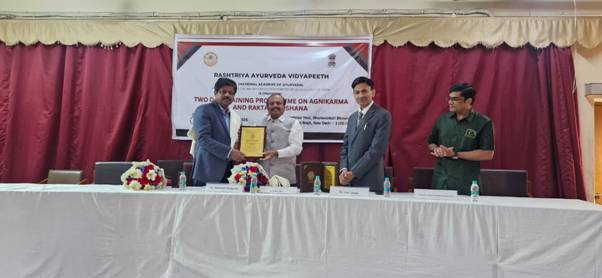

The programme was attended by eminent dignitaries from India’s Ayurveda and Indian Systems of Medicine fraternity. Among the distinguished guests was Dr. Mukul Patel, President of the Medical Assessment and Rating Board for Indian System of Medicine under the National Commission for Indian System of Medicine (NCISM).
Other notable participants included Dr. Hemant Panigrahi, Incharge Director of the Central Ayurveda Research Institute (CARI), and Dr. Santosh Bhatted, Head of the Department of Panchkarma at the All India Institute of Ayurveda (AIIA).
Senior practitioners and academicians such as Dr. Ravi Gogia and Dr. Chandramouleeswaran P. also shared their clinical insights and experiences, enriching the academic depth of the sessions.
Focus on Practical Clinical Competence
The core objective of the training was to provide intensive practical exposure in Agnikarma and Rakta-Mokshana, two important para-surgical therapies rooted in classical Ayurvedic texts.
Participants received live clinical demonstrations and detailed procedural guidance to ensure accurate application in real-world settings. Experts explained patient selection, procedural steps, safety protocols and post-procedure care.
The interactive format encouraged active engagement, allowing attendees to clarify doubts and refine their hands-on skills under expert supervision.
Reviving Classical Therapies with Modern Standards
Agnikarma involves controlled therapeutic cauterization to manage specific musculoskeletal and chronic conditions, while Rakta-Mokshana focuses on therapeutic bloodletting techniques to address various disorders. Both therapies require precision, training and clinical judgment.
Speakers emphasized that such structured training programmes are vital to maintaining quality standards in Ayurvedic practice. They highlighted the need to combine traditional wisdom with scientific documentation and standardized procedures.
The sessions also discussed integrating these therapies into broader clinical practice while adhering to regulatory frameworks and patient safety guidelines.
Strengthening Ayurvedic Education and Skill Development
RAV officials reiterated the institution’s commitment to promoting excellence in Ayurvedic education and skill development. The training programme was designed not only for knowledge dissemination but also for enhancing practitioner confidence and competence.
By facilitating collaboration among institutions such as NCISM, CARI and AIIA, the initiative reinforced the collective effort to elevate the standards of Indian Systems of Medicine nationwide.
Looking Ahead
The successful completion of the two-day programme reflects growing interest in advanced clinical training within the Ayurvedic community. Participants expressed appreciation for the hands-on approach and expert mentorship.
RAV is expected to continue organizing similar national-level workshops to expand access to specialized training modules.
With focused efforts on practical skill enhancement and academic collaboration, the initiative marks another step toward strengthening India’s traditional healthcare systems while ensuring clinical rigor and quality care.