
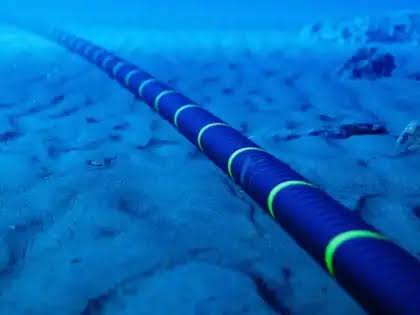
Global tech giants confirm disruptions
Microsoft confirmed on its service status website that the Middle East “may experience increased latency due to undersea fiber cuts in the Red Sea.” While traffic outside the Middle East remains unaffected, businesses and users within the region reported slower speeds and connectivity drops.
Internet monitoring group NetBlocks also reported widespread degradation in connectivity, linking the incident to failures in the South East Asia–Middle East–Western Europe 4 (SMW4) and India-Middle East-Western Europe (IMEWE) cable systems. Both routes are critical for data traffic between Asia, Europe, and the Gulf.


The SMW4 cable system is operated by Tata Communications, while IMEWE is managed by a consortium led by Alcatel-Lucent. Both operators have yet to issue official statements on the outage. These cable systems carry a significant share of India’s international internet traffic, making their disruption particularly sensitive for businesses and financial services.
Regional impact
In the United Arab Emirates, subscribers of Etisalat and Du, the state-owned telecom providers, reported slow connections and interrupted video conferencing services. Similar complaints surfaced in Pakistan, where users faced difficulties accessing cloud platforms and financial applications.
Saudi Arabia has not formally acknowledged the outages. Meanwhile, governments in the region are monitoring the situation, as such disruptions highlight vulnerabilities in critical digital infrastructure that underpins trade, finance, and communications.
Geopolitical backdrop
The cable cuts come amid heightened tensions in the Red Sea, where Yemen’s Houthi rebels have carried out repeated attacks on ships as part of their campaign linked to the Israel-Hamas conflict. While there is no confirmation that the Houthis are responsible for the latest disruption, concerns remain about intentional targeting of undersea cables, which carry more than 95% of the world’s international data.
In early 2024, Yemen’s government-in-exile warned that the Houthis planned to attack cable systems. Although the group denied responsibility for earlier cuts, their al-Masirah satellite channel acknowledged Sunday’s disruptions without assigning blame.
Past incidents raise alarms
From late 2023 through 2024, Houthi attacks in the Red Sea escalated, targeting more than 100 ships with drones and missiles. The strikes sank several vessels and killed multiple mariners. Such incidents underline the fragile nature of maritime infrastructure and its critical role in global internet stability.
What comes next
Repairing subsea cables often requires specialized ships and can take weeks, depending on weather and security conditions. Telecom operators are expected to reroute traffic through alternate cables until repairs are complete. However, with the Red Sea being a key corridor for global data, further disruptions could pose challenges for businesses and consumers alike.
Experts are urging governments and companies to invest in diversified cable routes and satellite backups to reduce dependency on a handful of vulnerable lines. For India and other South Asian nations, resilience in digital infrastructure remains crucial for safeguarding economic activity and cybersecurity.