


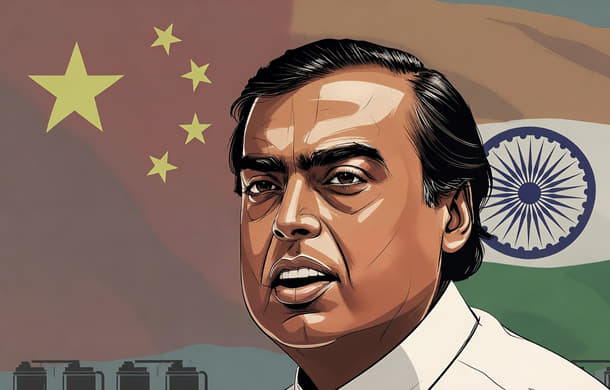
Structural Vulnerability in Battery Technology
Reliance Industries, India’s largest private conglomerate, sought to license advanced battery technology from a comparatively small Chinese startup. The disparity—Reliance being 63 times larger than Hithium—underscores India’s current industrial limitations in key sectors. Even the possibility of technology denial reveals the fragility of India’s domestic capabilities.
Lessons from China’s Technological Self-Reliance
China’s experience offers a blueprint. Past Western embargoes, from GPS jamming to semiconductor restrictions, pushed Beijing to invest in indigenous capabilities like the BeiDou navigation system, 7nm chips, and the Tiangong space station. Denial, when met with determination, turned vulnerability into global technological leadership.
Reliance’s Technology Accumulation
Reliance has made strategic acquisitions in battery technologies, including Faradion, Lithium Werks, Ambri, and Altigreen. However, integration and commercialisation have lagged. Ambri filed for bankruptcy, Altigreen halted production, and Lithium Werks produces limited volumes from China. The Jamnagar gigafactory, central to domestic scaling, is delayed, reflecting a gap between patent acquisition and manufacturing capability.
The Missing Research Link
Reliance’s Jio Institute, despite a ₹9,500 crore investment, lacks research programs in battery chemistry, electrochemistry, or energy storage materials. While AI and telecom research thrives through partnerships with IITs, there is no dedicated initiative for energy storage, leaving India reliant on external technology despite significant capital and patent acquisition.
Government Initiatives and the Little-Giants Model
The Indian government has launched the Research, Development and Innovation (RDI) Fund, providing long-term, patient capital for high-tech innovation. However, small and medium enterprises (SMEs) remain underdeveloped. China’s “Little Giants” program, which nurtures specialised SMEs in strategic industries, provides a model India could adopt to strengthen its domestic manufacturing ecosystem and reduce foreign dependence.
From Vulnerability to Determination
The Reliance-Hithium episode serves as a strategic warning. India’s clean energy transition relies on technologies controlled by a potential rival. The RDI Fund and a potential “little-giants” program could provide a framework, but corporate India must act decisively. Reliance has the resources, patents, and institutional partnerships to become self-reliant in battery technology if it prioritises integration and domestic research.