
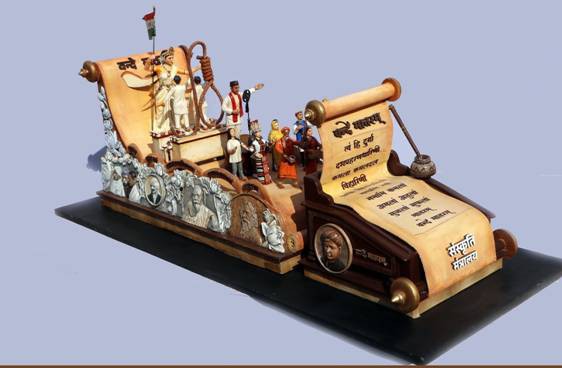
The Ministry of Culture will present a powerful and evocative tableau at the Republic Day Parade 2026, commemorating 150 years of Vande Mataram, India’s national song. The tableau aims to foreground the song as a living symbol of India’s civilisational memory, cultural continuity, and collective national consciousness, connecting the freedom struggle with contemporary India.

Explaining the theme, Vivek Agarwal, Secretary, Ministry of Culture, described Republic Day tableaux as moving archives of India’s civilisational memory. He said these visual narratives go beyond ceremonial display, translating the nation’s history, values, and ideas into a shared language accessible to all citizens.
Within this continuum, Vande Mataram occupies a unique and enduring place. Agarwal underlined that culture is not an ornament of the Republic but its sustaining spirit, and the national song stands as one of the most profound expressions of that spirit.
From Revolutionary Chant to National Song
Composed in 1875 by Bankimchandra Chattopadhyay, Vande Mataram envisioned the nation as a nurturing mother sujalam, suphalam abundant in natural and spiritual wealth. During the colonial era, the song became a rallying cry for freedom, echoing through protests, prisons, and political gatherings.
The song inspired courage and unity across regions, languages, and faiths. Sri Aurobindo famously described it as possessing spiritual power capable of awakening collective consciousness, a vision that history later affirmed through its widespread adoption during the freedom movement.
Visual Narrative of a 150-Year Journey
The Republic Day 2026 tableau translates this layered journey into a striking visual form. The moving tractor features the original manuscript of Vande Mataram, symbolising its historical roots. Folk artists from all four directions of India follow, representing the country’s vast cultural plurality.
At the centre stands the present generation, represented as Gen-G, rendering Vande Mataram in a style inspired by the historic rendition of Vishnupant Pagnis. His version, recorded in Raga Sarang by altering the sequence of verses to bypass colonial censorship, remains a powerful example of artistic resistance.
IGNCA’s Role in Shaping Cultural Narratives
Since 2021, the Indira Gandhi National Centre for the Arts (IGNCA) has been entrusted with conceptualising and executing the Ministry of Culture’s Republic Day tableau. Over the years, IGNCA has drawn upon India’s philosophical, historical, and cultural foundations to create themes that resonate across generations.
Dr. Sachchidanand Joshi, Member Secretary, IGNCA, said the Ministry of Culture’s tableau reflects collective national emotions rather than the work of a single department. He noted that while other ministries highlight programmes and achievements, the Culture Ministry integrates multiple cultural dimensions into a unified narrative.
Linking Freedom’s Memory with Present Responsibility
As India celebrates Republic Day 2026, the tableau calls upon citizens not only to remember freedom but to remain worthy of it. By presenting Vande Mataram as a continuing source of ethical, cultural, and emotional resonance, the Ministry of Culture seeks to bridge the memory of the freedom struggle with the responsibilities of the present.
The tableau underscores the national song’s enduring relevance in shaping India’s aspirations for the future, reaffirming unity amid diversity and continuity amid change.