
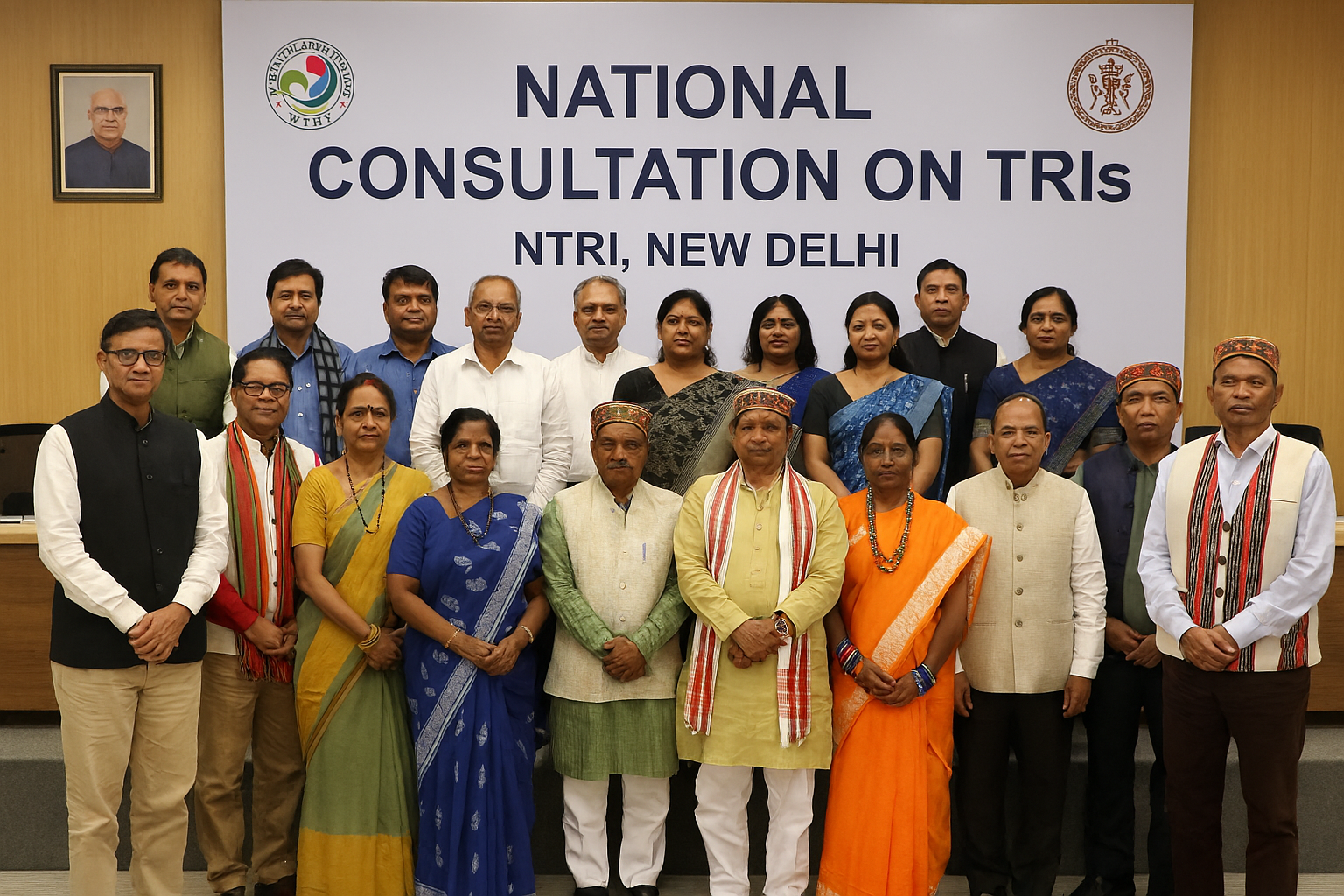
The Ministry of Tribal Affairs (MoTA), in partnership with the National Tribal Research Institute (NTRI), hosted a transformative two-day National Consultation aimed at reimagining the role of Tribal Research Institutes (TRIs) in India’s journey towards Viksit Bharat by 2047.
The consultation, held from July 28 to 29 at NTRI, New Delhi, brought together over 50 stakeholders from across India. Experts, policymakers, scholars, and tribal practitioners gathered to discuss how TRIs can better serve the aspirations of India’s tribal communities through research, training, and capacity building.


Tribal Research Institutes have long played a critical role in documenting indigenous knowledge and supporting community welfare. But in recent years, many have struggled with outdated frameworks, limited budgets, and declining relevance.
To address this, the National Consultation focused on building model TRIs that are modern, inclusive, and rooted in field realities. The event emphasized strategies to boost institutional performance, capacity building, and meaningful engagement with tribal communities.
Voices from the Ground: A Call for Action
Shri Vibhu Nayar, Secretary, MoTA, set the tone by stressing the need to move beyond administrative boundaries. “Workshops matter only when they touch real lives. We must step into villages to understand their truth,” he said. He also encouraged the use of community-led visual tools—painted walls and public blackboards—for participatory governance and shared learning.
Shri R. Balasubramaniam, Member of the Capacity Building Commission, emphasized a shift to participatory tribal research. “We must respect tribal voices and traditional knowledge. Let’s embrace a convergence model—scientific research alongside indigenous wisdom,” he said.
Adi Karmayogi Abhiyan: A Grassroots Movement
Shri Anant Prakash Pandey, Joint Secretary, MoTA, highlighted the Adi Karmayogi Abhiyan—a flagship initiative under which two million grassroots change leaders will be developed across 1 lakh tribal villages. He envisioned TRIs as key players in this mission. “TRIs must evolve from research units into drivers of last-mile development,” he urged, inviting NGOs, CSOs, and district administrations to collaborate in this journey.
Bridging Gaps and Building Capacity
Ms. Deepali Masirkar, Director at MoTA, underlined the importance of fund allocation and policy convergence. “TRIs must align with major missions like Adi Karmayogi, supported by strong financial and institutional mechanisms,” she said.
Prof. Virginius Xaxa, a renowned academic, urged a redefinition of the TRI mandate. “They must evolve beyond anthropology. Integrate political science, health, education, and economics to remain relevant to the times,” he said.
Institutional Strengthening: A Shared Responsibility
Prof. Akhil Bihari Ota, Former Director, SCSTRTI, emphasized the need for robust project management and adequate infrastructure. He proposed establishing Project Management Units (PMUs) in every TRI and ensuring seamless coordination between central and state bodies. “Without timely funding and skilled human resources, TRIs cannot function as agents of change,” he warned.
Prof. Nupur Tiwary, Special Director, NTRI, reaffirmed the consultation’s goal: to draft actionable strategies to rejuvenate TRIs. “Collaboration, planning, and knowledge exchange will create future-ready TRIs that truly serve tribal communities,” she said.
Outcomes and Next Steps
The two-day consultation ended with a powerful consensus. Stakeholders resolved to:
- Develop Model TRIs with replicable frameworks.
- Document and scale up best practices.
- Design a National Capacity Building Plan for tribal stakeholders.
- Promote convergence among ministries, institutions, and grassroots actors.
This marks a turning point in India’s tribal development landscape. With shared vision and strategic action, TRIs can become engines of empowerment, equity, and inclusive growth.
Why It Matters for Viksit Bharat 2047
India’s tribal communities are custodians of rich heritage and untapped potential. Strengthening TRIs means strengthening the bridge between tradition and progress. By investing in tribal research and capacity building, India can ensure no community is left behind on the path to Viksit Bharat.
The message is clear: field-led, people-first research is the future. And TRIs are at the heart of that transformation.