
Sanatan Reawakens: VP Dhankhar Calls for Unity, Educational Reform, and Civil Dialogue
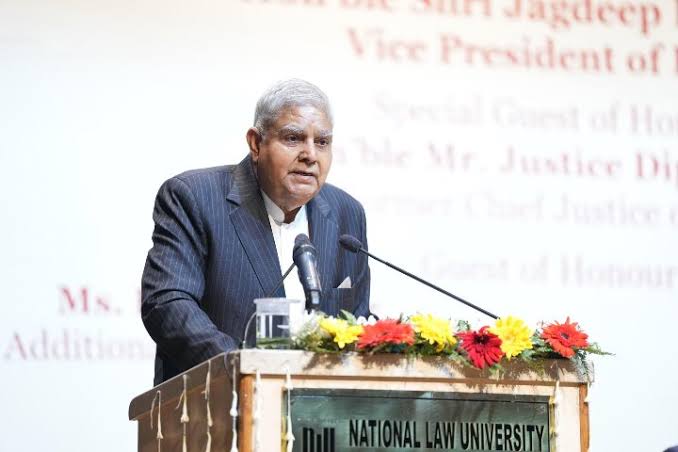
India’s civilizational strength is being rebuilt with renewed spirit, said Vice-President Jagdeep Dhankhar during his address at Pondicherry University on June 17, 2025. Urging the youth to reconnect with their roots and the political class to moderate public discourse, he called this era “a time of Sanatan resurgence.”

Drawing parallels with India’s ancient educational institutions, the Vice-President evoked the grandeur of Nalanda, Takshashila, Mithila, and Vallabhi—once global centers of knowledge. He recalled the destruction of Nalanda’s nine-story library, known as Dharamganj, during Bakhtiyar Khilji’s invasion, calling it “an attempt to raze India’s soul.”
“But the soul of Bharat is indestructible,” he affirmed, asserting that Sanatan pride is rising again—stronger than ever.
This remembrance wasn’t merely nostalgic. It was a rallying cry for India’s academic and cultural revival—rooted in knowledge, unity, and spirituality.
Education: Service, Not Commodity
Shri Dhankhar raised concerns about the commercialization of education, cautioning against the trend of treating learning as a business. He stressed a return to the Gurukul system, where education was a sacred duty and a means of character-building.
> “Education as service stands at odds with the commercial model that is fast emerging,” he warned.
He appealed to corporate leaders to redirect CSR funds toward building greenfield institutions of global eminence, thus realigning education with philanthropy rather than profit.
Political Temperature Must Cool Down
In a passionate appeal to the political class, the Vice-President said:
“Why should we melt the glaciers of our patience?”
He highlighted the rising political aggression and called for a revival of India’s Vedic philosophy of debate (Vaad-Vivaad) and dialogue (Abhivyakti). He criticized the mindset of rejecting ideas just because they originate from political opponents.
Instead of confrontation, he urged for cooperation, citing that India’s rise as the world’s most aspirational nation requires mature and unified leadership.
Languages Are a Bond, Not a Barrier
Reflecting on India’s linguistic diversity, VP Dhankhar asked:
> “How can we be divided on languages?”
He praised India’s 22 official languages, including Sanskrit, Tamil, Telugu, Kannada, Malayalam, Odia, and others as symbols of inclusivity, not division. Sanatan Dharma, he said, teaches togetherness and shared purpose, which must guide India’s linguistic and cultural discourse.
The Power of Alumni and Small Steps
The Vice-President also encouraged universities to build endowment funds through alumni support, just as leading global universities do.
“It may be a small step, but it becomes a giant leap over time,” he said, quoting Neil Armstrong’s iconic moon landing words
He emphasized the spirit of giving back, stating that even small contributions strengthen the bond between alumni and alma mater.
Conclusion: A Call to Reflect, Rebuild, and Rise
VP Dhankhar’s speech was not just a lecture—it was a mirror to the nation’s soul. He urged students, leaders, and citizens alike to introspect, to rise above pettiness, and to reclaim India’s cultural and intellectual legacy.
His words echo India’s civilizational ethos—where knowledge is sacred, dialogue is divine, and unity is strength.