
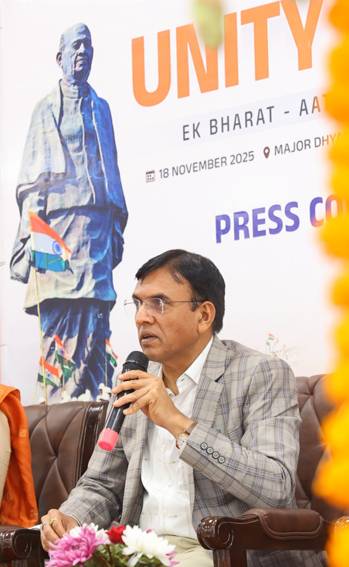
New Delhi: The Sardar@150 Unity March — a nationwide padyatra organised by the Ministry of Youth Affairs & Sports through the MY Bharat platform has transformed into a mass youth movement that, organisers say, combines the legacy of Sardar Vallabhbhai Patel with the government’s vision of Ek Bharat, Aatmanirbhar Bharat. Union Minister Dr. Mansukh Mandaviya on Tuesday described the campaign as “the heartbeat of a united nation,” announcing that more than 10 lakh people have taken part in 842 district- and constituency-level padyatras ahead of a national march from Nov 26 to Dec 6.
Scale and reach: numbers that matter
According to the Ministry’s briefing, the district-level phase — which began on October 31 — covered 471 districts and engaged participants across 349 Lok Sabha and 329 Assembly constituencies. Over 11,000 institutions, including colleges, universities, NGOs and youth organisations, partnered with MY Bharat to mobilise volunteers and local communities.
Regional activity was robust: the North East recorded 96 padyatras with more than 70,000 participants, Jammu & Kashmir held 14 padyatras (17,000 participants), and Ladakh organised three (2,000 participants). Major congregations in states such as Rajasthan, Uttar Pradesh, Maharashtra, Gujarat and Andhra Pradesh reported local turnouts that sometimes exceeded 10,000 people in single events.
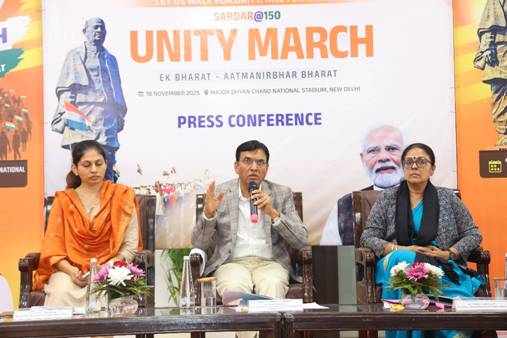

Dr. Mandaviya told reporters the padyatra is designed to promote civic values and local enterprise. “The message of Swachhata, Swadeshi and Aatmanirbharta is at the heart of the padyatra,” he said, stressing that the campaign channels youth energy into nation-building while celebrating Sardar Patel’s contributions to India’s unity and integration.
From digital phase to on-ground mobilisation
The Sardar@150 campaign began with digital engagement — reels, quizzes and an essay competition — before moving into a sustained on-ground effort. As the district-level phase wound down, organisers compiled a select group of district representatives to join four “Pravah” routes (Ganga, Yamuna, Narmada and Godavari) that will converge on Gujarat ahead of the national padyatra.
National Padyatra: route, schedule and events
The 11-day National Padyatra will start on 26 November from Karamsad — Sardar Patel’s family home — and culminate on 6 December at the Statue of Unity. The route covers nearly 190 km, with padyatris expected to walk 15–18 km daily. Each day will be anchored by thematic “Sardar Sabhas” addressing topics such as cooperative movements, Bardoli Satyagraha, constitutional vision, and administrative leadership.
Organisers said the march will include 150 thematic stops featuring exhibitions, cultural programmes, Gram Sabhas and community outreach. Cabinet ministers, state leaders, MPs and civil society figures will address gatherings along the route while local NSS and NCC units carry out parallel social initiatives.
Grassroots actions: pledges and local enterprise
Participants across the district padyatras took pledges including Aatmanirbhar Bharat and Nasha Mukt Bharat. Swadeshi stalls and local enterprise displays along padyatra routes aimed to promote indigenous goods and micro-entrepreneurship while creating a marketplace for local crafts and produce.
Pravah routes and district representation
The Pravah plan allows two participants from each district to join their respective route; the four pravahs will be launched from Delhi, Jaipur, Nagpur and Mumbai and later converge for the national segment in Gujarat. The pravah yatra also features youth dialogues, outreach to coaching institutes, tree plantations, yoga sessions and cleanliness drives to widen civic participation.
Administration and registrations
Registrations and the detailed schedule are being hosted on the MY Bharat portal. State and district authorities have been asked to coordinate logistics, security and medical support for participants and to ensure that the padyatra remains non-partisan, cultural and civic in character.
For more details and updates, organisers refer participants to the official MY Bharat portal and the Ministry’s announcements.
As the national padyatra approaches, the Sardar@150 Unity March aims not only to commemorate an iconic leader but also to convert symbolism into sustained civic engagement — mobilising young Indians to carry forward a message of unity, self-reliance and local empowerment.