
Supreme Court Urges ECI to Accept Aadhaar, Ration Card for Bihar Voter List Revision
The Supreme Court has urged the Election Commission of India (ECI) to accept Aadhaar, ration cards, and voter ID (EPIC) as valid proof of identity in Bihar’s Special Intensive Revision (SIR) process.
While the Court did not stop the ongoing voter list update, it asked the ECI to explain why it excludes these common documents.
What Is the Bihar SIR Process?
On June 24, 2025, the ECI launched a special revision of Bihar’s electoral rolls ahead of the state elections in November.
Voters missing from the 2003 list must now provide fresh proof of citizenship. Those born after December 2004 must submit both parents’ citizenship documents — a first in Indian electoral history.
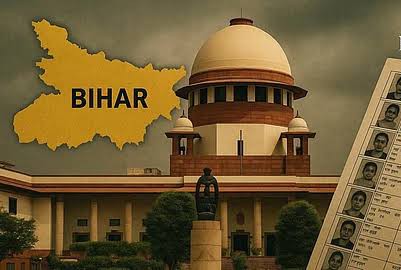

A Bench of Justices Sudhanshu Dhulia and Joymalya Bagchi chose not to halt the revision. However, they questioned the exclusion of widely-used IDs.
“It would serve justice if Aadhaar, EPIC, and ration cards were allowed,” said the Court. It added that the list should not be rigid or unfair.
Concerns Over Voter Exclusion
Opposition leaders and civil groups like the Association for Democratic Reforms (ADR) filed petitions. They said the directive violates Articles 14, 19, 21, 325, and 326 of the Constitution.
Senior lawyers Kapil Sibal and Abhishek Manu Singhvi raised alarms. They warned that poor and rural voters could be excluded due to lack of documents.
Sibal said, “If you’re not on the 2003 list, you now need to prove your parents’ citizenship. That’s unfair.” Singhvi added, “Over three crore voters could lose their right to vote.”
Court Supports Aadhaar as Valid ID
Justice Dhulia noted that Aadhaar is accepted for caste and government certificates. Rejecting it for voter ID purposes is not justified.
Justice Bagchi agreed. “Aadhaar is widely used to prove identity. Why not here?” he asked.
The Court reminded the ECI that Aadhaar is allowed under Section 23 of the Representation of the People Act. Excluding it now seems inconsistent.
ECI’s Stand and the Court’s Concerns
Senior Advocates Rakesh Dwivedi and Maninder Singh represented the ECI. They said the directive aims to prevent illegal voting and that voters missing from the 2003 list must prove citizenship.
But the Court warned the ECI not to exceed its powers. Justice Dhulia remarked, “Even I may not be able to provide all the documents they demand in such a short time.”
Key Questions for July 28 Hearing
- Can the ECI legally conduct this special revision?
- Is the process fair and within the law?
- Is the timing justified, with elections so close?
The Court has directed the ECI to file a response by July 21. The case will be heard again on July 28, 2025.
Why This Case Matters
This case impacts more than Bihar. It raises national concerns about voter rights and fair elections.
Many Indians, especially the poor, lack birth certificates or passports. Aadhaar, voter ID, and ration cards are often their only proof of identity. Ignoring these could silence millions in the world’s largest democracy.
Final Thoughts
The Supreme Court’s balanced approach aims to protect democracy and ensure fairness. It wants the ECI to be transparent while safeguarding citizens’ voting rights.
The hearing on July 28 could shape India’s voter verification process for years to come.