Bench emphasises fairness and impartiality
A bench of Justices J.K. Maheshwari and Vijay Bishnoi on Friday rejected the Tamil Nadu government’s plea to change its October order that suspended the state’s one-man inquiry commission and SIT. The court stressed the need for a probe that is fair, impartial and free from local bias.
 CBI, supervisory committee remain in place
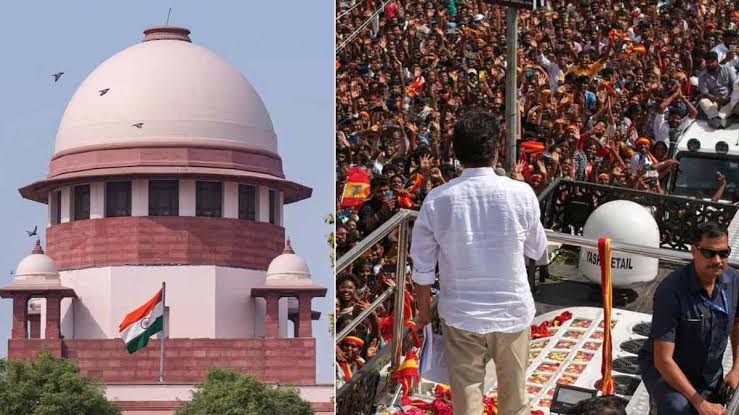
On October 13 the Supreme Court ordered a Central Bureau of Investigation (CBI) probe into the September 27 Karur stampede, which claimed 41 lives. The court also formed a three-member supervisory committee, led by former Supreme Court judge Justice Ajay Rastogi, to monitor the inquiry. The bench reaffirmed those directions and refused the state’s request to dilute them.
State assures non-interference; court remains cautious
Senior advocate P. Wilson, representing Tamil Nadu, told the court the state-appointed commission would only make safety recommendations and would not obstruct the central probe. The court, however, asked to see the notification appointing the commission and made clear that any parallel action must not undermine the independence or perception of the CBI investigation.
Procedural anomalies at Madras High Court
The apex court reviewed a report from the registrar general of the Madras High Court that flagged irregularities in case listing and classification. The bench remarked, “there is something wrong going on in the high court,” noting that a petition seeking SOPs for rallies had been registered as a criminal writ petition — an action the court found troubling.
Political undertones and media statements
The Supreme Court has repeatedly warned against media statements by officials that could prejudice investigations. It noted the high political temperature around the Karur tragedy and stressed that public comments must not compromise the fairness of the probe.
Families and public scrutiny
Victims’ families and legal observers will be watching the CBI’s progress, the supervisory committee’s composition and functioning, and any clarification the court provides on the interaction between state-level inquiries and the central probe. The court’s insistence on transparency aims to preserve public confidence in the outcome.