

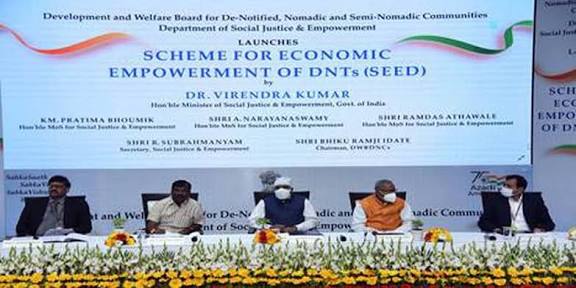

The SEED scheme has been designed around four key components to ensure holistic development. Under educational empowerment, financial assistance is provided for free coaching to help students from DNT communities gain admission into reputed institutions and secure employment in both public and private sectors.
In the health sector, Ayushman Bharat cards are being distributed to eligible DNT families. This initiative enables access to cashless healthcare services and reduces the financial burden caused by medical emergencies.
Livelihood support forms a major pillar of the scheme. Self-Help Groups (SHGs) have been created in DNT clusters to promote collective economic activity and income generation. These SHGs play a crucial role in fostering entrepreneurship and financial discipline at the grassroots level.
The fourth component focuses on land and housing. The scheme facilitates access to permanent housing for eligible families under Pradhan Mantri Awas Yojana (PMAY-G and PMAY-U) and convergence with other government welfare schemes.
Skill Development and Enterprise Creation
A significant objective of the SEED scheme is to preserve traditional skills while opening new livelihood avenues. To achieve this, skill development training has been extended to 2,199 Self-Help Groups, benefitting 10,554 individuals across the country.
Training programmes covered diverse sectors such as sewing, soap making, jewellery design, beauty parlour services, food processing, animal husbandry, home essentials and crafts, along with basic computer education. These skills have enabled beneficiaries to explore self-employment and micro-enterprise opportunities.
Financial Inclusion and Women’s Empowerment
Each SHG received a revolving fund of ₹25,000 to promote financial stability and sustainability. The initiative also encouraged a culture of savings and inter-lending within groups, reducing dependence on informal moneylenders.
Women beneficiaries have emerged as key drivers of change. Many have used small loans to start kirana shops, bangle businesses, goat rearing units and other local enterprises. These initiatives have not only enhanced household incomes but also strengthened women’s decision-making roles within their communities.
According to the Ministry, all 10,554 beneficiaries supported under the scheme were assisted through a combination of skill training, financial inclusion and enterprise development, ensuring long-term income generation.
Preserving Culture While Promoting Growth
Beyond economic assistance, SEED also aims to protect the traditional art forms and cultural identity of Denotified and Nomadic Tribes. The scheme encourages community-based organisations and SHG clusters to market traditional products, linking heritage skills with modern market opportunities.
Officials believe that such an approach balances cultural preservation with economic growth, ensuring that development does not come at the cost of community identity.