
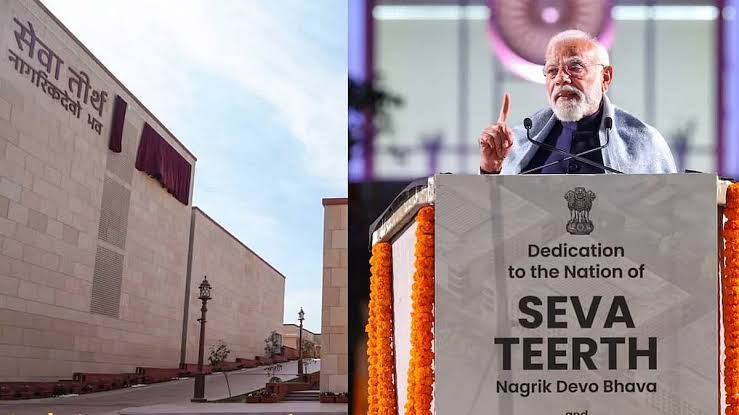
New Delhi, February 24, 2026: In a historic move symbolising a new era in governance, the Union Cabinet on Monday adopted the “Seva Sankalp Resolution” at its first meeting held at the newly established Prime Minister’s Office complex, ‘Seva Teerth’. Chaired by Prime Minister Narendra Modi, the meeting marked what the government described as a transformative moment in India’s development journey.
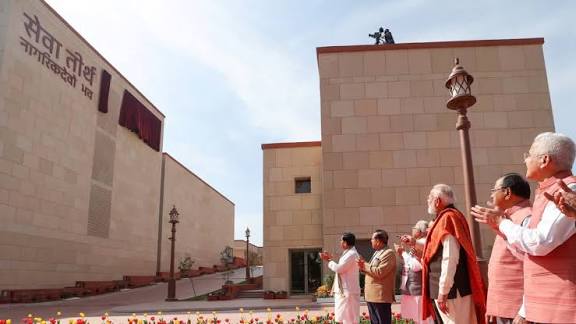

Seva Teerth has been constructed at the site of temporary British-era barracks, transforming a colonial-era space into a centre of sovereign decision-making. The government described this as a powerful symbol of India’s transition from colonial structures to a self-confident, modern nation.
For decades after Independence, Prime Ministers operated from South Block. The shift to Seva Teerth reflects an attempt to combine indigenous thought with modern infrastructure. The Cabinet emphasised that the workplace would embody the ideals of duty, service, and dedication values traditionally associated with a ‘teerth’ or sacred space.
‘Nagrik Devo Bhava’ as Governance Mantra
The resolution reiterated the principle of “Nagrik Devo Bhava”, asserting that governance must prioritise the dignity, equality, and justice of every citizen. The Cabinet stated that Seva Teerth would not be a centre for displaying authority, but a hub for empowering citizens.
Officials highlighted that decisions taken within the new premises would aim to simplify the lives of the last person in the queue, reinforcing the government’s emphasis on transparency, responsiveness, and sensitivity.
Decade of Transformation
Reflecting on the past ten years, the Cabinet cited key achievements, including lifting over 25 crore people out of poverty. It pointed to flagship schemes such as Ayushman Bharat, which expanded health coverage to crores of beneficiaries, and the Pradhan Mantri Garib Kalyan Anna Yojana, which ensured food security for nearly 80 crore citizens.
Sanitation efforts under the Swachh Bharat Mission led to the construction of over 12 crore toilets, while housing initiatives delivered more than four crore homes to families across the country. The Jal Jeevan Mission connected over 12 crore rural households to tap water.
Reforms such as GST, Direct Benefit Transfer (DBT), and Digital India were described as milestones in making governance more efficient and transparent. The Cabinet reiterated its commitment to the principle of “Minimum Government, Maximum Governance”.
Economic Aspirations and Reform Momentum
The resolution expressed confidence that India is on track to become one of the world’s top three economies in the near future. The Cabinet referred to the continuing reform momentum as a “Reform Express” aimed at strengthening India’s global standing.
Faceless tax assessment and digital governance initiatives were cited as measures that have improved trust between citizens and the state. According to the government, these reforms have enhanced transparency and reduced bureaucratic friction.
Viksit Bharat 2047 Vision
The Cabinet dedicated the first meeting at Seva Teerth to the long-term national vision of Viksit Bharat 2047. It stressed that decisions taken today will shape the lives of future generations, underscoring the need for responsible and prudent governance.
Modern technology and efficient systems at Seva Teerth are expected to improve coordination and accelerate policy implementation. The Cabinet resolved to promote optimal use of resources and sustain the reform trajectory.
As India advances toward 2047, the Seva Sankalp Resolution signals the government’s intent to anchor governance in service, accountability, and national aspiration. Whether Seva Teerth becomes a lasting symbol of that commitment will unfold in the years ahead.