
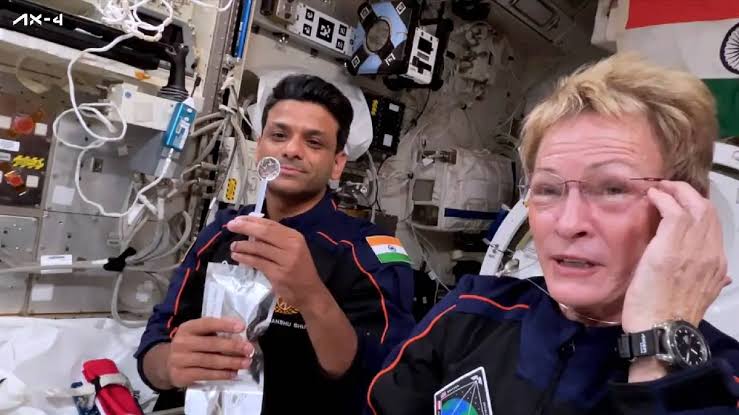
Historic ISS Mission Marks India’s Space Milestone
Union Minister Dr. Jitendra Singh highlighted that the space experiments conducted by Group Captain Shubhanshu Shukla personify India as “Vishwabandhu” Bharat. Even though these experiments were conducted using indigenous kits, their results are expected to benefit all of mankind. The studies focused on life sciences, plant physiology, biotechnology, and cognitive research, emphasizing India’s growing capabilities in cost-effective space technology and indigenous innovation.
The Minister described Shukla’s presence aboard the International Space Station (ISS) as a “historic milestone” that reflects India’s march toward a developed nation by 2047.
Cost-Effective Innovation and Global Collaboration
Dr. Singh noted that India’s ISS mission was achieved at a fraction of the global cost, demonstrating the country’s ability to merge intellectual resources with scientific planning. This success is attributed to policy reforms that allowed private sector participation, now fueling over 300 space startups contributing to India’s $8 billion space economy.
“These achievements highlight the talent of our scientists and the supportive ecosystem,” Dr. Singh told the Lok Sabha during a special discussion on the Critical Role of the Space Programme for Viksit Bharat by 2047.
Life Science Experiments and Indigenous Innovation
The experiments conducted by Shukla span agriculture, biotechnology, cognitive sciences, and life sciences, all designed and developed in India. Dr. Singh emphasized that their outcomes will have practical applications beyond space, including healthcare, agriculture, disaster management, and urban planning.
This initiative reinforces the vision of an Atmanirbhar Bharat, showcasing India’s capability to innovate in high-tech domains while contributing to global knowledge.
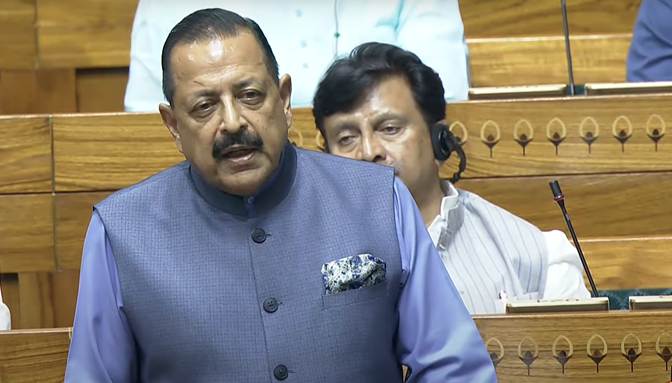

Tracing India’s space program trajectory, Dr. Singh credited Prime Minister Narendra Modi for establishing a robust policy framework since 2018, which paved the way for India’s human spaceflight ambitions.
Key milestones include:
-
Vyommitra humanoid mission in 2026
-
Gaganyaan mission with the first Indian astronaut in 2027
-
Indian Space Station by 2035
-
Moon landing by an Indian astronaut in 2040
Dr. Singh remarked, “A few years before 2047, a young Indian will declare from the lunar surface the arrival of a Viksit Bharat.”
Inspiring the Next Generation
“This mission is not just about one astronaut,” Dr. Singh stated. “It symbolizes India’s place in the world and the aspirations of every child who dreams of reaching the stars.” The mission demonstrates that India’s space program is both visionary and inclusive, with tangible benefits for society at large.
Experts also emphasized that the integration of scientific rigor with indigenous technology strengthens India’s global standing in space science, fostering international collaboration and knowledge exchange.
Space Economy and Startups Driving Growth
India’s growing space economy is driven by a combination of government-led programs and private sector innovation. With 300+ startups contributing, the sector is witnessing rapid growth in satellite technology, space research, and applied sciences. These startups are also expected to play a key role in achieving the ambitious roadmap of Gaganyaan, the Indian Space Station, and lunar exploration missions.
Dr. Singh’s address underscored that space reforms and public-private synergy have positioned India as a leader in cost-efficient and innovative space missions.
Looking Ahead: A Vision for Viksit Bharat
The ISS mission and Shukla’s experiments represent a strategic leap for India. The knowledge gained from life sciences and plant physiology studies will inform terrestrial applications in agriculture, medicine, and urban planning.
As India progresses toward its 2047 goal, space exploration becomes central to national development, blending technology, research, and innovation. Dr. Singh concluded that India’s success in space is a source of national pride and inspiration, motivating the next generation of scientists, engineers, and explorers.
Conclusion: India’s Global Space Leadership
Shubhanshu Shukla’s mission aboard the ISS exemplifies India’s scientific excellence, cost-effective innovation, and global vision. The experiments conducted not only advance life sciences research but also reinforce India’s leadership in the global space community.
With the upcoming milestones in Gaganyaan, Indian Space Station, and Moon landing missions, India is charting a path toward Viksit Bharat by 2047, inspiring millions and asserting its presence as a Vishwabandhu nation committed to innovation and collaboration.