
A Hero’s Return After Axiom-4
Shubhanshu Shukla, the second Indian to travel to space after Rakesh Sharma in 1984, returned to Earth on July 15, 2025. The Axiom-4 mission had launched from the Kennedy Space Center on June 25. After spending 20 days aboard the International Space Station (ISS), Shukla came back not just with data, but with vision and emotion.
Speaking during a virtual press conference on August 1, Shukla recalled the overwhelming experience of readjusting to Earth’s gravity. “Even the phone felt heavy,” he said. “I dropped my laptop thinking it would float.”


Born in Lucknow, Uttar Pradesh, Shukla grew up dreaming of space. Now, he’s become a symbol of India’s re-emergence in global space exploration. His mission aboard Axiom-4 was not just scientific—it was deeply nationalistic and emotional.
“After 41 years, a Bharatiya returned to space,” he said, echoing national pride. “But this time, it’s not a solitary leap. This is the beginning of India’s second orbit.”
A Moment with the Prime Minister
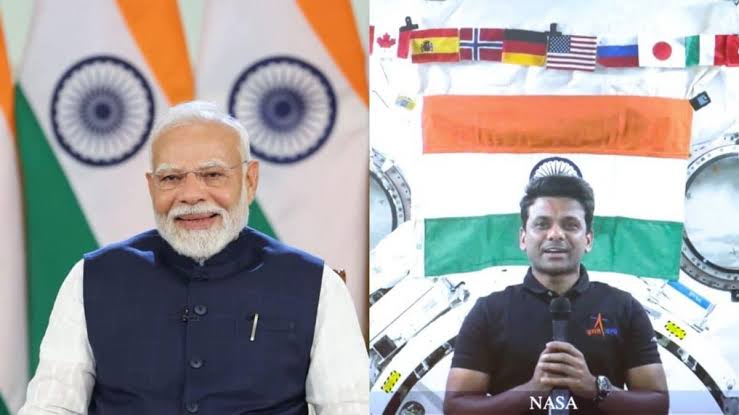
On June 28, while floating inside the ISS, Shukla spoke with Prime Minister Narendra Modi. Behind him, the Indian flag floated weightlessly—an image that captured the heart of the nation.
“It was a powerful moment,” Shukla said. “I felt like I was a messenger showing what’s possible.”
Preparing for Gaganyaan
Shukla emphasized that the Axiom-4 mission was a training ground for India’s upcoming Gaganyaan mission. The Indian Space Research Organisation (ISRO) plans to launch Gaganyaan with a crew of Indian astronauts in the near future.
“The experience exceeded expectations,” said Shukla. “Everything I documented up there will serve Gaganyaan.” He completed the “homework” PM Modi assigned him—recording observations, behavioral changes, and environmental conditions.
Relearning Gravity: The Emotional Impact
Returning to gravity wasn’t easy. Simple tasks like holding a phone or using a laptop felt foreign. “The phone I held all day now felt like a brick,” he laughed. It was a reminder of how fragile and unique the human body is in different environments.
Thankfully, the dropped laptop landed on a carpet. “No damage, but I was surprised I forgot gravity,” he admitted.
Inspiring the Next Generation
For Shukla, this journey is about more than exploration. It’s about inspiration. “If children are now asking how to become astronauts, then our mission succeeded,” he said.
He sees the space program as a tool to ignite young minds. “We need to believe we can be explorers too. That’s the real mission,” he added.
The Bigger Picture: India’s Space Leadership
The Axiom-4 mission, conducted in partnership with NASA and Axiom Space, represents India’s increasing role in international space collaboration. As the country prepares for future missions, including Gaganyaan, it signals a shift from being a participant to becoming a leader in the space domain.
India is now investing in both human and robotic missions, deep-space technologies, and orbital infrastructure. This return to Earth is not the end, but a new beginning.
Conclusion: More Than Just a Mission
Shubhanshu Shukla’s return has become a defining moment in India’s space history. His humility, sense of duty, and deep connection to the motherland make him a powerful symbol of modern India’s aspirations.
As he returns home in mid-August, he brings with him more than research—he brings a renewed sense of national purpose and inspiration for generations to come.