

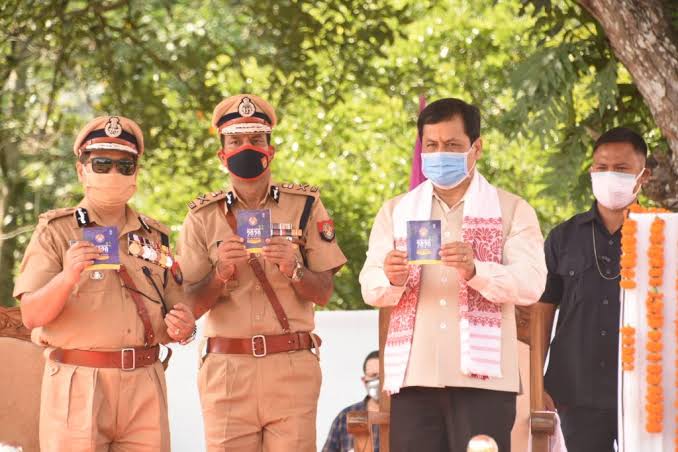

Sonowal said India adopted the concept of SMART policing under Prime Minister Modi’s leadership Strict and Sensitive, Modern and Mobile, Alert and Accountable, Reliable and Responsive, Tech-enabled and Trained. Assam aligned itself with this framework to build a more professional and responsive force.
He noted that the earlier perception of policing as distant and authority-driven has been replaced by a service-oriented, accountable and humane approach. According to him, Union Home Minister Amit Shah strengthened India’s internal security architecture by improving intelligence coordination and investing in modern infrastructure.
Transparent Recruitment and Infrastructure Push
Highlighting reforms in recruitment, Sonowal said Assam replaced opaque practices with transparent, merit-based and technology-driven processes. The large-scale recruitments were completed without litigation, a first in the state’s history.
Administrative restructuring and expansion of personnel strength have strengthened grassroots governance and operational depth. The MOITRI scheme Mission for Overall Improvement of Thana for Responsive Image has transformed police stations into citizen-friendly centres.
More than 100 new police stations have been completed and hundreds upgraded, backed by investments exceeding ₹1,500 crore. Sonowal emphasised that strong institutions require robust infrastructure, but must also reflect compassion and professionalism.
Human-Centric Initiatives and Technology Integration
The minister pointed to cyber forensic laboratories, dedicated women’s cells, child-friendly police spaces and the Assam Police Sishu Mitra programme as examples of a more socially responsive policing system. A 24/7 Child Rights Resource Hub further strengthens community engagement.
Technology now plays a central role in everyday policing, including digital case tracking, online complaint systems and the strategic use of social media for real-time grievance redressal. These measures, he said, have enhanced transparency and public trust.
Sustainable Peace and Economic Growth
Sonowal credited decisive leadership for achieving sustainable peace in Assam and the Northeast. He referred to the signing of the Bodo Peace Accord in January 2020 and agreements involving various insurgent groups as a historic shift from conflict to integration.
More than 10,800 former militants returned to the mainstream and over 1,500 weapons were surrendered. Sonowal described this as not merely a security achievement but a social transformation that paved the way for economic growth.
Peace and stability, he said, have encouraged industrial expansion, infrastructure development and investor confidence, positioning Assam as a gateway to the Northeast’s economic corridor.
10th APBN: A Modern Policing Campus
The newly announced 10th APBN campus will be developed at a cost exceeding ₹260 crore, with a built-up area of more than 42,000 square metres. The integrated facility will combine residential quarters, operational infrastructure and advanced training facilities.
Strategically located with connectivity to National Highway 37 and the proposed Guwahati Ring Road, the campus is designed for rapid deployment and future scalability. Sonowal said the battalion represents continuity in Assam’s policing reform journey and reflects a modern, welfare-oriented system.
Strong Policing, Stronger Governance
Concluding his address, Sonowal reiterated that robust law enforcement is the foundation of development. He maintained that Assam’s transformation demonstrates how decisive leadership and institutional reforms can convert law enforcement into a pillar of progress.
“Strong policing has enabled strong governance. And strong governance is building a stronger Assam and a stronger India,” he said.