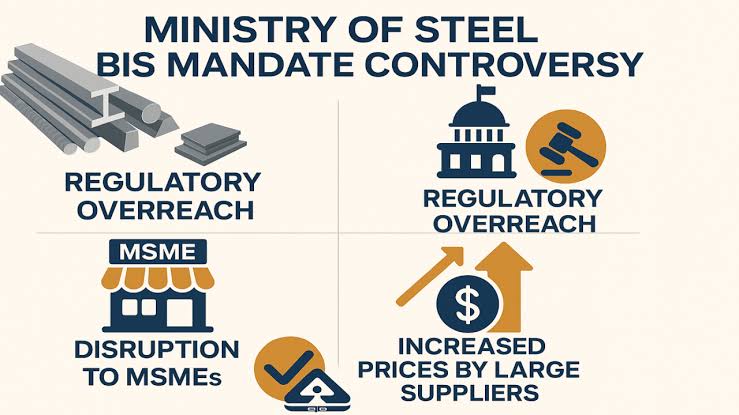
The Ministry of Steel has issued an official order providing key exemptions to stakeholders regarding the clarificatory Office Memorandum (O.M.) dated June 13, 2025. The O.M. clarified that intermediate materials used in the production of final steel products under BIS standards must also comply with relevant BIS standards. However, it did not introduce any new Quality Control Orders.
 Background of the Clarification
The O.M. was meant to ensure that steel products, including intermediate materials used during manufacturing, align with BIS norms. This sparked concern among stakeholders, particularly around compliance timelines and shipment status.
In response, the Ministry held a stakeholder consultation on July 7, 2025, chaired by the Hon’ble Minister of Steel. Industry leaders, producers, and users participated and largely supported the clarification in principle.
Stakeholder Concerns Addressed
Participants requested some practical relaxations, especially for steel consignments that were already in transit. They also sought clarity on compliance expectations for Integrated Steel Plants (ISPs), which handle the entire manufacturing process in-house.
The Ministry had earlier clarified via a press brief dated July 2, 2025, that such ISPs with BIS licenses covering the full production chain do not require additional licenses for each production stage.
Key Exemptions Granted
Based on industry feedback, the Ministry of Steel has now issued a formal order with the following two major exemptions from the June 13 O.M.:
- Imported Steel Products: Consignments with a Bill of Lading date on or before July 15, 2025, will be exempt from mandatory BIS input steel requirements.
- Integrated Steel Plants (ISPs): Final products from ISPs will be exempt after BIS verifies their licenses. Until then, ISPs can email a declaration to
tech-steel[at]nic[dot]inalong with operative BIS licenses. Any misdeclaration may result in debarment under SIMS (Steel Import Monitoring System).
Digital Coordination for ISPs
The Ministry will soon update the SIMS portal to include provisions for Integrated Steel Plants to streamline verification and declarations. This move aims to simplify processes while ensuring regulatory compliance.
This proactive decision by the Ministry is expected to reduce operational disruption and ease the burden on compliant industry players. It also reflects the government’s openness to stakeholder engagement and practical policymaking.
Why It Matters
India’s steel industry is a vital component of infrastructure and industrial growth. Ensuring consistency in quality through BIS norms enhances global competitiveness. At the same time, allowing reasonable exemptions supports uninterrupted supply chains.
This balance of standardization with flexibility positions India’s steel sector for better compliance, export readiness, and long-term development.