

New Delhi, December 17: In a significant move aimed at curbing worsening air pollution, the Supreme Court on Wednesday withdrew the protection earlier granted to owners of BS-III and older end-of-life vehicles in the Delhi-National Capital Region (NCR), allowing authorities to resume coercive action against such vehicles.
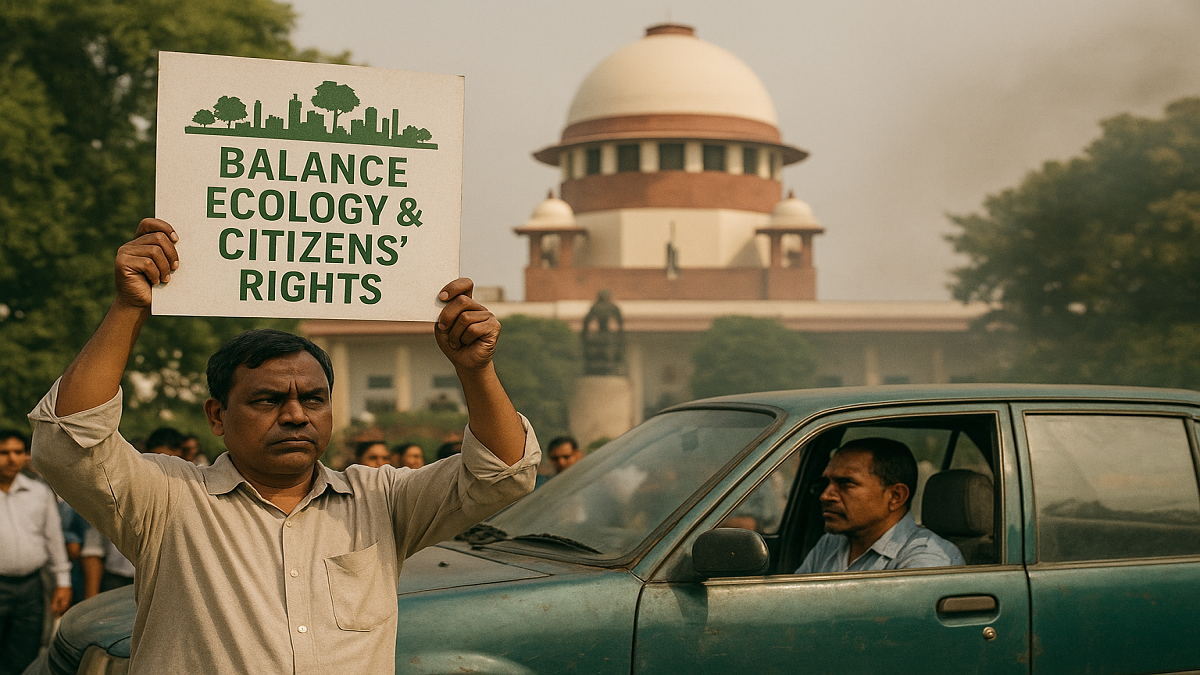

A bench comprising Chief Justice of India Surya Kant and Justices Joymalya Bagchi and Vipul M Pancholi clarified that protection from coercive action would now apply only to BS-IV and newer emission-standard vehicles. Owners of BS-III, BS-II and BS-I vehicles, even if covered earlier by the age-based relaxation, will no longer enjoy immunity from penalties or impounding.
“The August 12, 2025 order is modified to the extent that no coercive steps shall be taken against owners of BS-IV and newer vehicles on the ground of age,” the bench said, effectively excluding older and more polluting vehicles from relief.
CAQM Flags Rising Pollution Load
The CAQM’s recommendation was presented to the court by Additional Solicitor General Aishwarya Bhati, who stressed that BS-III and older vehicles had returned to Delhi-NCR roads due to the earlier order. According to the expert body, this significantly increased the vehicular pollution load at a time when air quality remains persistently poor.
The commission pointed out that vehicles meeting BS-I, BS-II and BS-III emission norms are far more polluting compared to BS-VI vehicles currently being sold. Allowing them to operate freely, it said, posed a serious public health risk.
Long-Standing Restrictions on End-of-Life Vehicles
Restrictions on end-of-life (EoL) vehicles in Delhi-NCR are not new. The National Green Tribunal (NGT) issued a series of orders between 2014 and 2015 banning the plying of 10-year-old diesel and 15-year-old petrol vehicles in the region. These directions were later upheld by the Supreme Court in October 2018.
The CAQM noted that BS-III vehicles have been on Indian roads for over 15 years, BS-II vehicles for more than two decades, and BS-I vehicles for nearly 25 years. Their continued operation, the commission said, is incompatible with the region’s fragile air quality.
Winter Pollution and Health Concerns
Delhi-NCR faces an “extraordinary situation” every winter due to unfavourable meteorological conditions that trap pollutants close to the ground. The CAQM highlighted that vehicular emissions remain one of the most significant contributors to poor air quality, alongside dust, industrial emissions and biomass burning.
The commission warned that allowing older vehicles to ply during the winter months could further aggravate respiratory illnesses, particularly among children, the elderly and those with pre-existing health conditions.
Fuel Denial and Enforcement Measures
As part of its enforcement strategy, the CAQM had earlier directed fuel stations to deny petrol and diesel to all end-of-life vehicles in Delhi from November 1, 2025. Similar measures are scheduled to be rolled out in five high vehicle-density NCR districts from April 1, 2026.
According to official estimates, nearly 93 per cent of vehicles in Delhi-NCR fall under the category of light motor vehicles and two-wheelers, which together form the bulk of older, high-emission vehicles still on the roads.
Implications for Vehicle Owners
The Supreme Court’s latest order means that owners of BS-III and older vehicles can now face penalties, impounding, or denial of fuel, irrespective of temporary relaxations granted earlier. Environmental experts believe the decision sends a strong signal that emission standards, not just vehicle age, will determine enforcement priorities.