
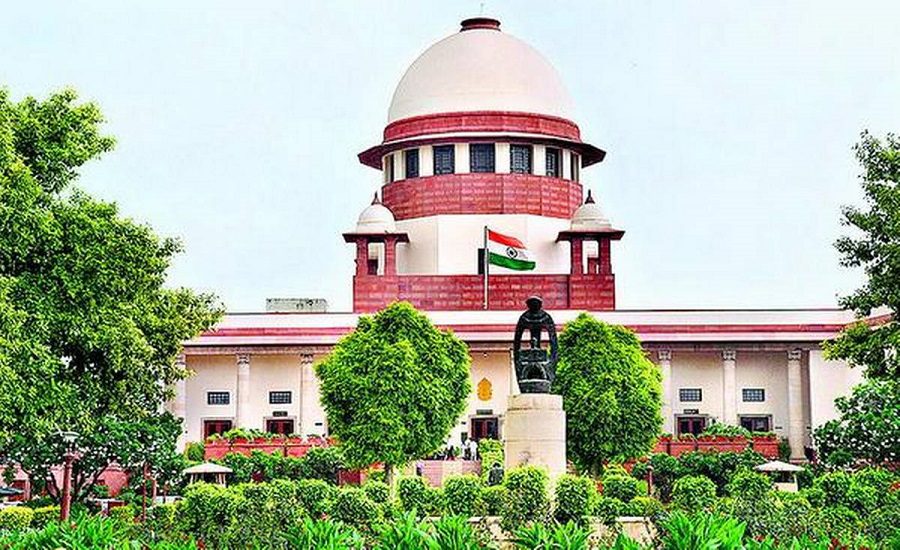
New Delhi: A five-judge Constitution Bench of the Supreme Court on Wednesday ruled that Regular Promotees (RPs) cannot claim a separate quota for appointment to the Higher Judicial Service (HJS). The Bench — led by Chief Justice of India B.R. Gavai and comprising Justices Surya Kant, Vikram Nath, K. Vinod Chandran and Joymalya Bagchi — held that past service as a civil judge cannot, by itself, create an intelligible differentia to favour RPs in HJS appointments.
Judgment: no quota, but clear seniority rules
The Court rejected petitions seeking a special classification or quota for officers who joined the judicial service at lower rungs, holding that perceived “heartburn” or a sense of slower progression is not enough to create preferential treatment. Instead, the judgment prescribes mandatory, uniform guidelines for determining inter-se seniority once officers enter the common cadre of District Judges.


Key among the directions is an annual four-point roster to determine seniority for officers appointed in a given year. The repeating sequence will be:
- 2 Regular Promotees (RPs)
- 1 Limited Department Competitive Examination (LDCE) candidate
- 1 Direct Recruit (DR)
The roster must be adopted in the statutory service rules of each State/UT in consultation with the respective High Court, the Court said.
Why length of service in lower judiciary was rejected
The Bench emphasised that once RPs and LDCE candidates enter the HJS their prior service in the lower judiciary “loses its significance” for purposes such as fixation in selection grade or super time scale. The Court noted that allowing separate classification based on earlier service would require a statutory foundation and a compelling, reasonable justification — which is absent here.
Opportunities already available
The Court observed that promotees have multiple avenues for career advancement — including LDCEs and, under recent precedents such as Rejanish K.V. v. K. Deepa, opportunities in direct recruitment — and therefore, mere dissatisfaction with the pace of promotion cannot justify quotas. The Bench also concluded that there is no proven all-India phenomenon of direct recruits systematically crowding out promotees from HJS posts.
Practical directions and implementation
The judgment lists a series of implementation rules: how belated appointments are to be slotted into an earlier year’s roster, treatment of unfilled DR/LDCE vacancies (to be carried forward as RP slots), and the requirement that rules prescribe exact modalities of the annual roster. States and UTs have been directed to amend statutory HJS rules in consultation with High Courts to align with the judgment.
What this means for judicial careers
For younger lawyers and judicial officers, the ruling emphasises a single, common cadre approach: once in the HJS, seniority and career progression will be governed by uniform merit-cum-seniority norms within the cadre and by the new annual roster — not by length of past service at junior levels.