
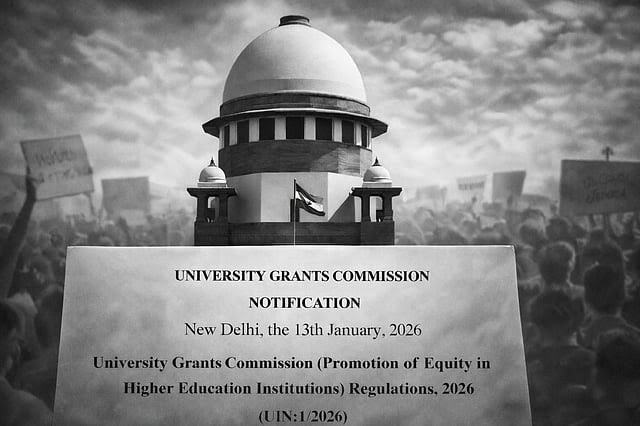
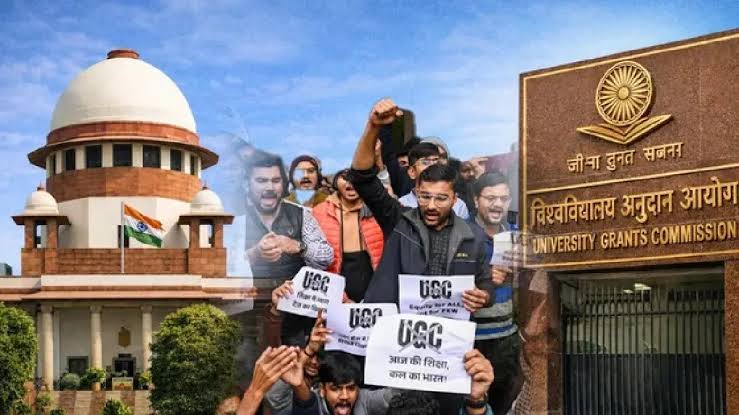

The regulations were challenged before the apex court on the ground that their grievance redressal mechanism excludes students belonging to the general category. Petitioners argued that the framework provides institutional protection only to Scheduled Castes, Scheduled Tribes, and Other Backward Classes, while denying similar remedies to others.
According to the petitioners, such selective protection amounts to impermissible State discrimination and violates Article 14 of the Constitution. They contended that the regulations, instead of promoting equity, risk becoming a tool for social division within educational campuses.
Vagueness in Key Definitions Flagged
The Bench took particular exception to the definitions contained in Sections 3(c) and 3(e) of the regulations. Section 3(c) defines “caste-based discrimination” as discrimination only against members of SC, ST, and OBC communities, while Section 3(e) defines “discrimination” in much broader terms, covering unfair treatment of any stakeholder on grounds including caste, gender, religion, or place of birth.
The Court questioned why a narrow definition under Section 3(c) was required when Section 3(e) already covered all forms of discrimination. The judges observed that the coexistence of these provisions could bar certain individuals from seeking redress despite being subjected to discriminatory conduct.
Risk of Social Fragmentation
Warning of the broader implications, the Court remarked that the regulations, if left unchecked, could fuel divisions in society. The Chief Justice noted that even after 75 years of Independence, discrimination based on caste, region, and class continues to persist, and any legislative or regulatory measure must aim to reduce, not reinforce, such fault lines.
The Bench also expressed concern over the possibility of misuse of vague language, stating that the provisions need careful re-examination to ensure they are not exploited in academic environments.
Call for Expert Committee Review
Observing that the issues raised require nuanced consideration, the Court suggested that the regulations be examined by an expert committee. It emphasised the need for precise and balanced language that promotes inclusivity without creating fresh categories of exclusion.
The Court issued notice to the UGC and the Central government, tagging the present petitions with an earlier plea filed in 2019 that also deals with discrimination in educational institutions. The matter has been listed for further hearing on March 19.
Background of the Regulations
The stated objective of the UGC Equity Regulations, 2026, is to eradicate discrimination in higher education institutions and promote equity and inclusion among all stakeholders. The framework mandates the creation of Equal Opportunity Centres and Equity Committees to address complaints and oversee implementation.
However, since their notification, the regulations have triggered protests and criticism from various quarters, particularly over concerns that they are one-sided and could be misused against certain categories of students.
What Lies Ahead
With the Supreme Court’s interim stay, the implementation of the regulations has effectively been paused nationwide. The final outcome will depend on the Court’s assessment of their constitutional validity and the response of the UGC and the Union government.
Legal experts say the case could have far-reaching implications for how equity, affirmative action, and grievance redressal mechanisms are structured in India’s higher education system.