 Where Was the Eclipse Visible?
The complete annular phase was limited to Antarctica. However, a partial solar eclipse was observed across parts of Africa, South America, the Pacific Ocean, the Atlantic Ocean, and the Indian Ocean.
In South Africa, observatories and universities live-streamed the event as the eclipse reached its regional peak during the afternoon hours. The “Ring of Fire” effect was especially prominent in select southern locations.
India did not witness this Surya Grahan directly. However, space agencies and global observatories streamed the celestial event online, allowing skywatchers in India to follow it live.
What Is an Annular Solar Eclipse?
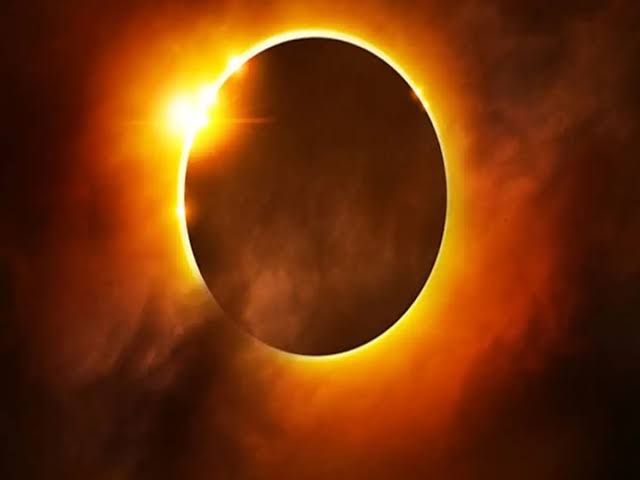
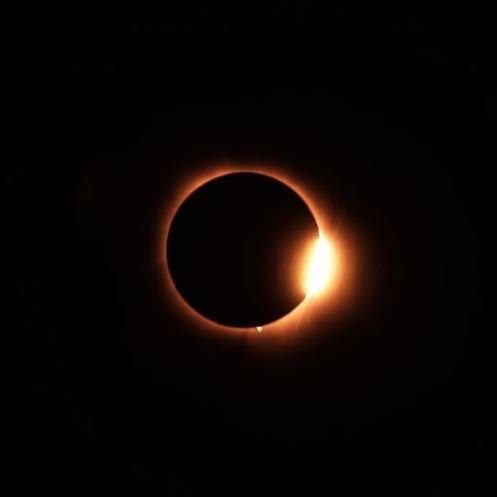
An annular solar eclipse occurs when the Moon passes between the Earth and the Sun but is positioned at or near its farthest point from Earth. Because the Moon appears slightly smaller in the sky, it does not completely block the Sun.
This alignment results in a bright ring of sunlight around the Moon, commonly referred to as the “Ring of Fire.” Unlike a total solar eclipse, the Sun is never fully obscured.
Space experts explain that the difference between total and annular eclipses depends on the Moon’s distance from Earth. When closer, it can fully cover the Sun; when farther away, it leaves a visible solar ring.
For scientific insights into eclipses and celestial alignments, readers can refer to NASA’s official portal at https://www.nasa.gov and India’s space research updates via ISRO at https://www.isro.gov.in.
Scientific Impact on Earth
Solar eclipses can briefly influence the Earth’s upper atmosphere, particularly the ionosphere. During the eclipse, reduced solar radiation leads to temporary changes in ionisation levels, affecting radio signal propagation and satellite communication systems.
Scientists note that shortwave radio frequencies and GPS accuracy may experience minor fluctuations during such events. However, these effects are temporary and return to normal once sunlight is restored.
Experts continue to stress that viewing a solar eclipse without certified protective eyewear can cause serious eye damage, known as solar retinopathy.
Surya Grahan and Cultural Significance in India
Although the eclipse was not visible in India, Surya Grahan holds cultural and spiritual significance in many Hindu households. Traditionally, the period of eclipse is associated with “Sutak Kaal,” considered inauspicious in certain beliefs.
Mythological explanations trace eclipses to the legend of Rahu and Ketu. However, scientists clarify that eclipses are predictable astronomical events resulting from orbital alignments and have no supernatural causes.
When Is the Next Solar Eclipse?
The next major solar eclipse of 2026 will occur on August 12, and it will be a total solar eclipse. According to astronomical projections, it will be visible from Greenland, Iceland, Spain, Russia, and parts of Portugal, with partial visibility across wider regions of Europe, Africa, and North America.
In a total solar eclipse, the Moon completely covers the Sun, casting a dark central shadow on Earth and allowing the Sun’s corona to become visible a phenomenon regarded as one of nature’s most dramatic spectacles.