
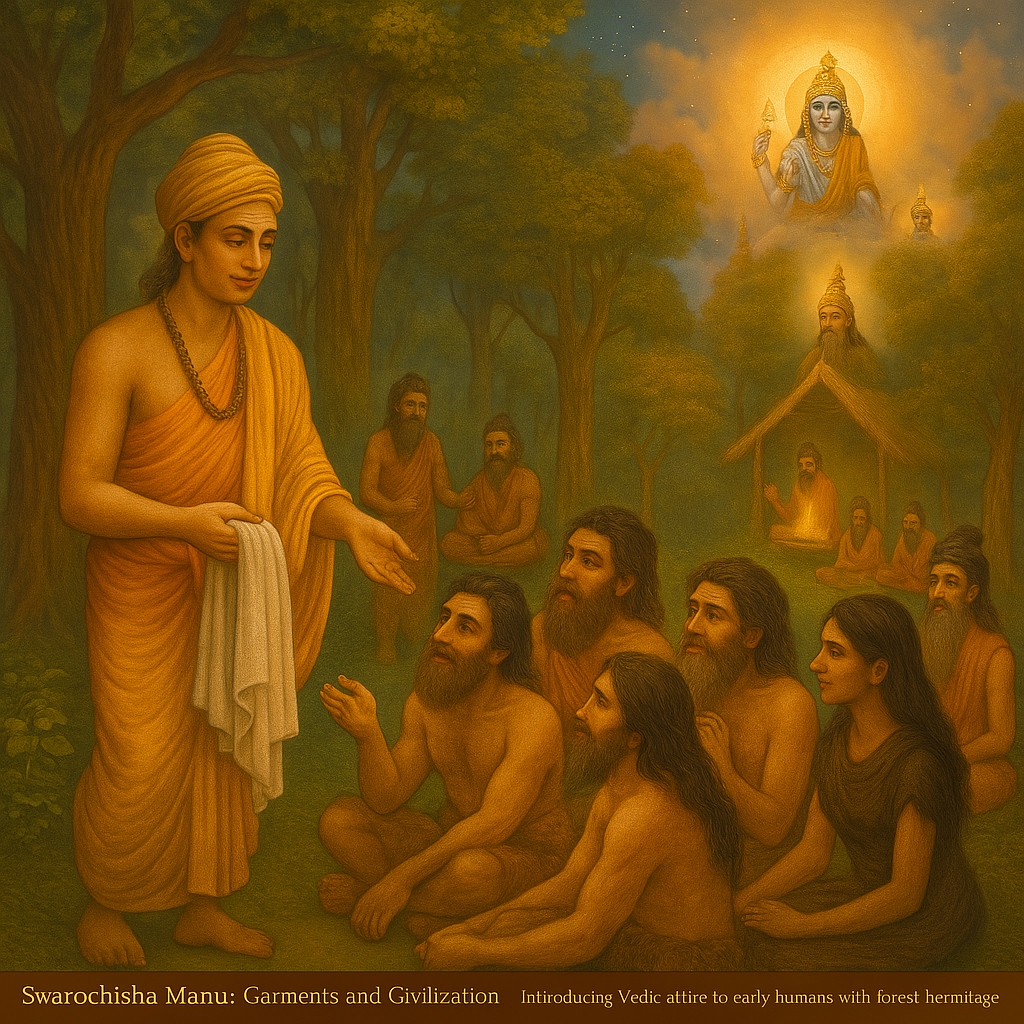
Swarochish Manu, recognized as the second Manu in the ancient Indian historical framework, is revered not merely as a mythological figure, but as a pivotal contributor to the early development of human civilization. According to deeply preserved Vedic records, he was the son of Agni—the primal fire—and played a transformative role in shaping early societal norms and technological advances.
One of Swarochisha Manu’s most influential contributions to humanity was the invention of clothing. This innovation not only signified a leap in human adaptation and modesty but also laid the groundwork for textile culture and industry that would evolve over millennia. Near the end of his life, the sage Devala was born from the third eye of Shiva, a symbolic yet historically regarded event, ensuring the continuation of this vital human craft.
During the era of Swarochisha Manu, known as the Swarochish Manvantara, the world was governed by the divine principles established through Manu’s wisdom. The celestial king, Indra, during this epoch was Rochana. The demigods of this time were led by the Tushitas, and the great sages, or Saptarishis, included Urjastambha, Agni, Prana, Danti, Rishabha, Nischara, and Charvarivan.
One of the most revered personalities of this Manvantara was Vibhu, the incarnation of Vishnu. Born to the sage Vedasira and his wife Tushita, Vibhu lived as a lifelong Brahmachari (celibate). His influence was immense—he mentored eighty-eight thousand sages known as Dridha-vratas, emphasizing inner discipline, self-restraint, and austerity.
Far from being a mere myth, Swarochisha Manu represents a rich and instructive phase of ancient human history. His life embodies the Vedic understanding of leadership, innovation, and spiritual discipline—values that shaped the early trajectory of civilization in the Indian subcontinent and beyond.