🕉️ Swayambhuva Manu: First Human & Lawgiver of Dharma
Published by: RamRajya News |

🌅 Born from Thought, Not Flesh
Long before time was measured in days and nights, the divine creator Brahma envisioned the first human. From his mind—not womb or seed—emerged Swayambhuva Manu, the first of our race.
Alongside him appeared Shatarupa, the cosmic feminine principle. Together, they were the first couple in Sanatan Dharma—our own sacred ancestors. Their union did not merely birth a family. It birthed humanity.
Across traditions, Manu is remembered. Many scholars note that Abrahamic faiths refer to him as Adam, the first man. But in Bharat, he is much more than that—he is a lawgiver, sage, king, and patriarch of Dharma.
🌳 A Family That Became Civilizations
Swayambhuva Manu and Shatarupa had five children: Priyavrata, Uttanapada, Akuti, Devahuti, and Prasuti. These names are not just historical—they are foundational.
Devahuti became the mother of Kapila Muni, a Vishnu avatar and founder of Sankhya Darshan. Akuti gave birth to Yagya, another Vishnu avatar who later became Indra. Prasuti married Daksha and became mother to the divine feminine lineages.
This was no ordinary household. It was the seed of Sanatan civilization.
🕯️ Dharma in Action and Silence
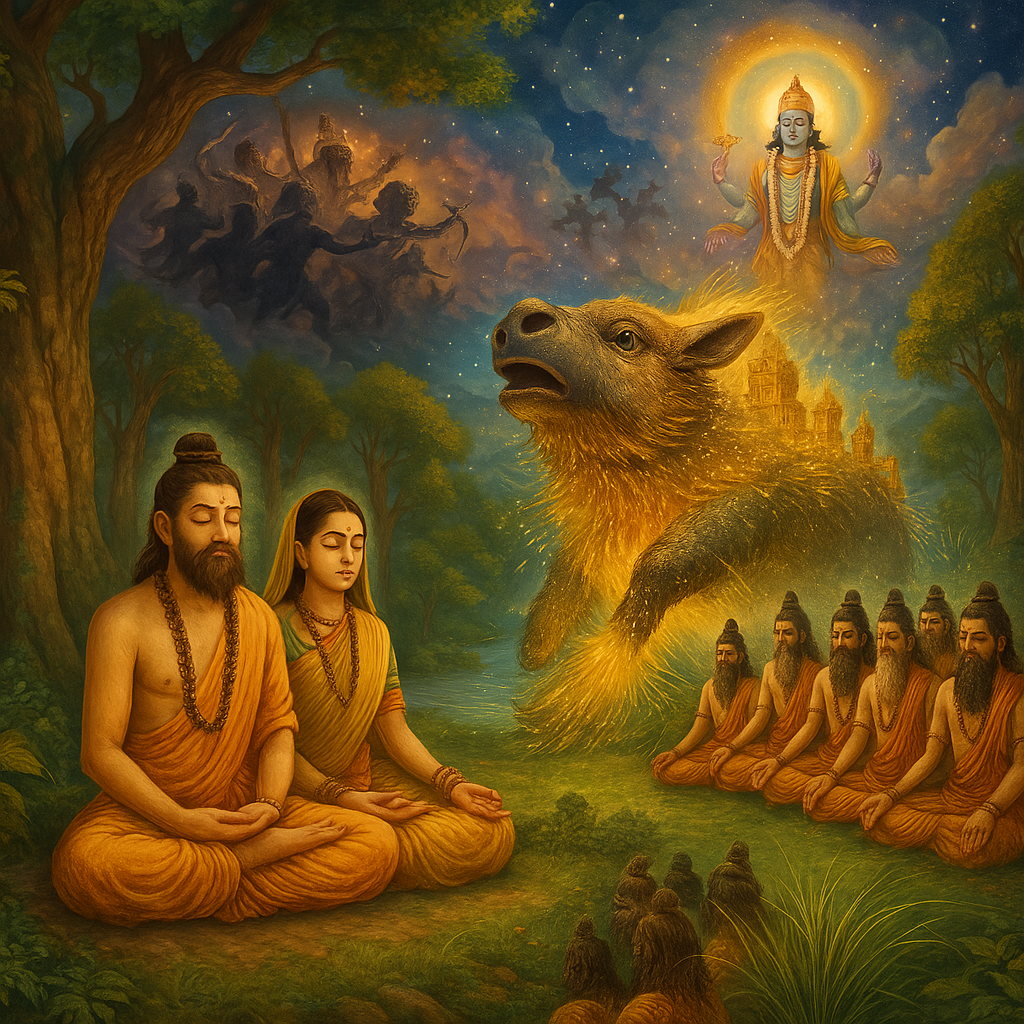
After establishing the structure of society, Manu and Shatarupa retired to perform tapasya on the banks of River Sunanda. But their peace was not without tests.
When rakshasas attacked, their own son Yagya—a form of Vishnu—intervened with divine force. The threat was defeated. Dharma remained intact.
🏛️ Barhismati: City of Divine Origin

Manu’s capital was Barhismati—a city not built by human hands but formed by divine incident. When Vishnu, as Varaha, rescued Bhumi Devi from the cosmic ocean, strands of his celestial hair fell to Earth.
From these strands emerged the sacred grasses kusa and kasa, and the very land of Barhismati. To this day, these grasses are used in yajnas and rituals—a living memory of divine origin.
📜 The Saptarishis and the First Rulebook
The age of Swayambhuva Manu was blessed with the presence of the Saptarishis: Marichi, Atri, Angiras, Pulaha, Kratu, Pulastya, and Vashishtha. These sages safeguarded the cosmic rhythm of Dharma.
It was during this time that Manu codified early Dharma—through laws, customs, and Vedic order that shaped the world’s earliest functioning society.
🪔 Why Manu Still Matters
Today, our customs, ethics, and family values rest on pillars that Manu helped raise. His life wasn’t mythology—it was the earliest architecture of a conscious, dharmic society.
His name lives in the word manuṣya (and also the English term ‘man’). His spirit lives in every conscious act of dharma we perform.