
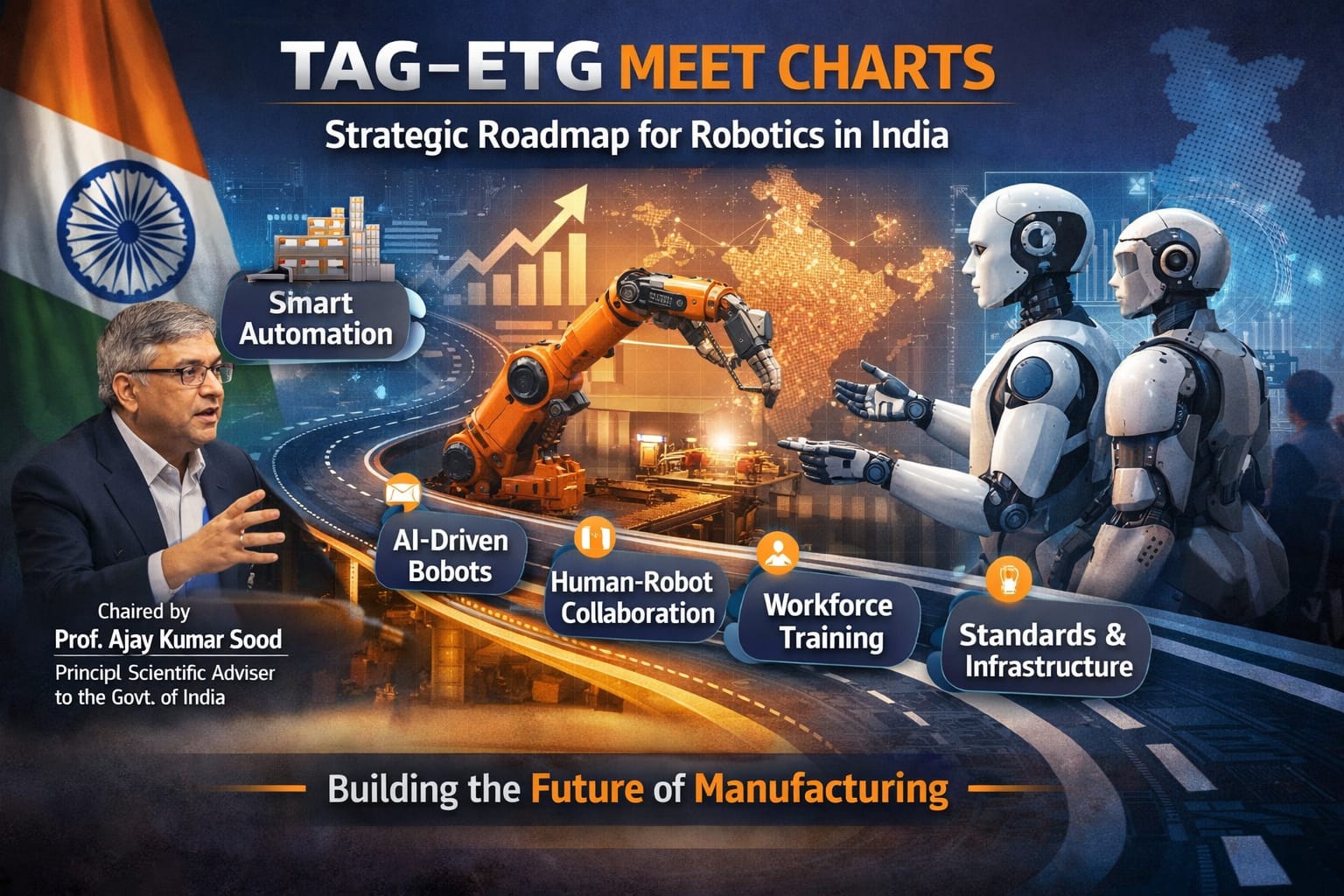


In his keynote address, Prof. Sood articulated a vision of a self-reliant India in robotics, driven by indigenisation and innovation. He highlighted a paradigm shift in the sector, stressing that modern robotics must augment human capabilities rather than replace human labour.
He identified sector-specific priorities including collaborative robots and physical AI for healthcare, as well as unmanned and dual-use platforms for defence and internal security. According to Prof. Sood, robotics should be viewed as a force multiplier for national missions and a cornerstone of India’s transition into a product-led economy.
Policy Frameworks and Strategic Missions
Shri S. Krishnan, Secretary, Ministry of Electronics and Information Technology (MeitY), highlighted the draft National Strategy on Robotics developed through extensive inter-ministerial and stakeholder consultations. He noted that existing initiatives such as the IndiaAI Mission and the India Semiconductor Mission provide a strong foundation for a future dedicated robotics mission.
Dr. Sameer Kamat, Chairman of the Defence Research and Development Organisation (DRDO), emphasised the importance of software sovereignty. He called for the indigenisation of critical design, simulation, and development tools to eliminate strategic vulnerabilities in defence-related robotics systems.
Industry, Academia and Defence Perspectives
Former DBT Secretary Dr. Renu Swarup advocated a demand-driven approach, stressing that clear needs prioritisation must precede product development. Lt Gen N.S. Raja Subramani (Retd), Military Advisor to the National Security Council Secretariat, stated that integrating robotics into national defence architecture is no longer optional but a strategic necessity.
Mr. Rohit Gupta, CTO at the Office of the PSA, provided an overview of global and national robotics trends, setting the context for expert presentations from academia and industry leaders.
Key Gaps and National Priorities Identified
Deliberations revealed significant gaps in India’s hardware ecosystem, including actuators, sensors, chipsets, precision gears, and simulation tools. Participants agreed on the need for robust testing, certification, and standardisation frameworks aligned with global norms such as ISO and CE.
There was also consensus on creating shared national data infrastructure and federated platforms to support robotics applications across defence, healthcare, agriculture, and logistics. Such infrastructure, experts said, would democratise innovation and accelerate deployment.
Mission-Mode R&D and Unified Regulation
Summarising the outcomes, Dr. Parvinder Maini, Scientific Secretary at the Office of the PSA, highlighted the shift from legacy automation to embodied intelligence and adaptive systems. She emphasised mission-linked grants for startups and MSMEs, unified regulatory frameworks, and accredited testing labs to boost exports.
In his concluding remarks, Prof. Sood reiterated that a structured robotics strategy is essential for India’s long-term industrial and defence growth. He urged stakeholders to submit concrete recommendations to shape a national roadmap for physical AI and robotics.