Tapas Manu, also known as Tamas Manu, was the fourth ruler in the ancient lineage of Manus, the legendary progenitors and lawgivers of early human civilization according to Vedic history. As the younger brother of Uttama Manu, he inherited not just royal lineage but a legacy of moral order, governance, and dharma that shaped the direction of early societies during what is known as the Tapasa Manvantara—the fourth epoch of mankind.
Tapasa Manu fathered ten sons, among whom were Prithu, Khyati, Nara, and Ketu—names still resonant in Indian spiritual and cultural history. These sons played significant roles in developing the socio-political fabric and dharmic laws of their time, acting as regional rulers and sages who furthered the ideals of justice, spiritual duty, and societal order.
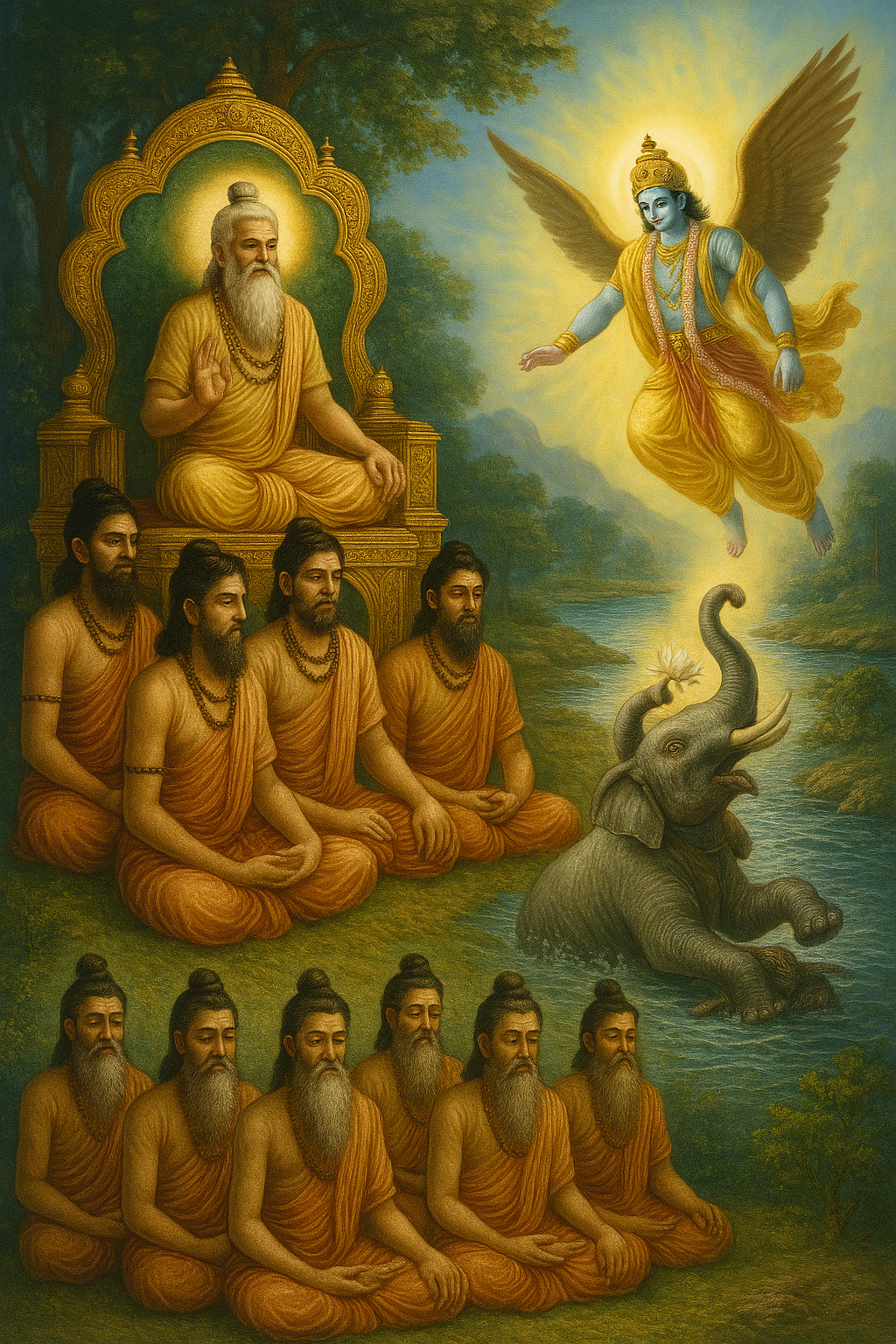
The divine order of this era was supported by Satyakas, Haris, and Viras, celestial beings who embodied various forces of nature and cosmic principles. During Tapasa Manu’s reign, Trisikha held the position of Indra, the king of the heavenly worlds. The Saptarishis—the seven great sages of the age—were Jyotirdhama, Prithu, Kavya, Chaitra, Agni, Vanaka, and Pivara, all of whom were custodians of spiritual knowledge and dharma.
In this age, the Supreme Being manifested as Hari, the Vishnu avatar of the era, who was born to the sage Harimedha and his wife Harini. Hari’s purpose was profound: to liberate Gajendra, a devoted soul trapped in material bondage—symbolizing divine intervention to uphold righteousness and devotion in a time of crisis.
Tapasa Manu’s reign, as chronicled in ancient Indian texts, is not a myth but a preserved historical memory—reflected in genealogical accounts, oral traditions, and sacred literature. He remains a pillar of ancient governance, reminding us of a time when spiritual law and civil order walked hand-in-hand.