
In the summer of 2022, a remark by BJP spokesperson Nupur Sharma regarding the Prophet Muhammad triggered widespread outrage across the Islamic world. Qatar led the charge diplomatically, and many Muslim-majority nations demanded an apology from Bharat. In response, the Bharatiya Janata Party (BJP) swiftly distanced itself from Sharma, suspending her and issuing a clarification.
This distancing, however, caused a wave of disillusionment and outrage among Sanatanis—the followers of Sanatan Dharma—within Bharat. Many felt betrayed, not by Sharma’s words, but by the government’s apparent capitulation under international pressure.
Some critics labeled Prime Minister Narendra PM Modi and his party as symbols of political timidity—incapable of standing up to external and internal aggression against Bharat’s civilizational ethos. The question lingered: was this a moment of necessary diplomacy, or a failure of moral courage?
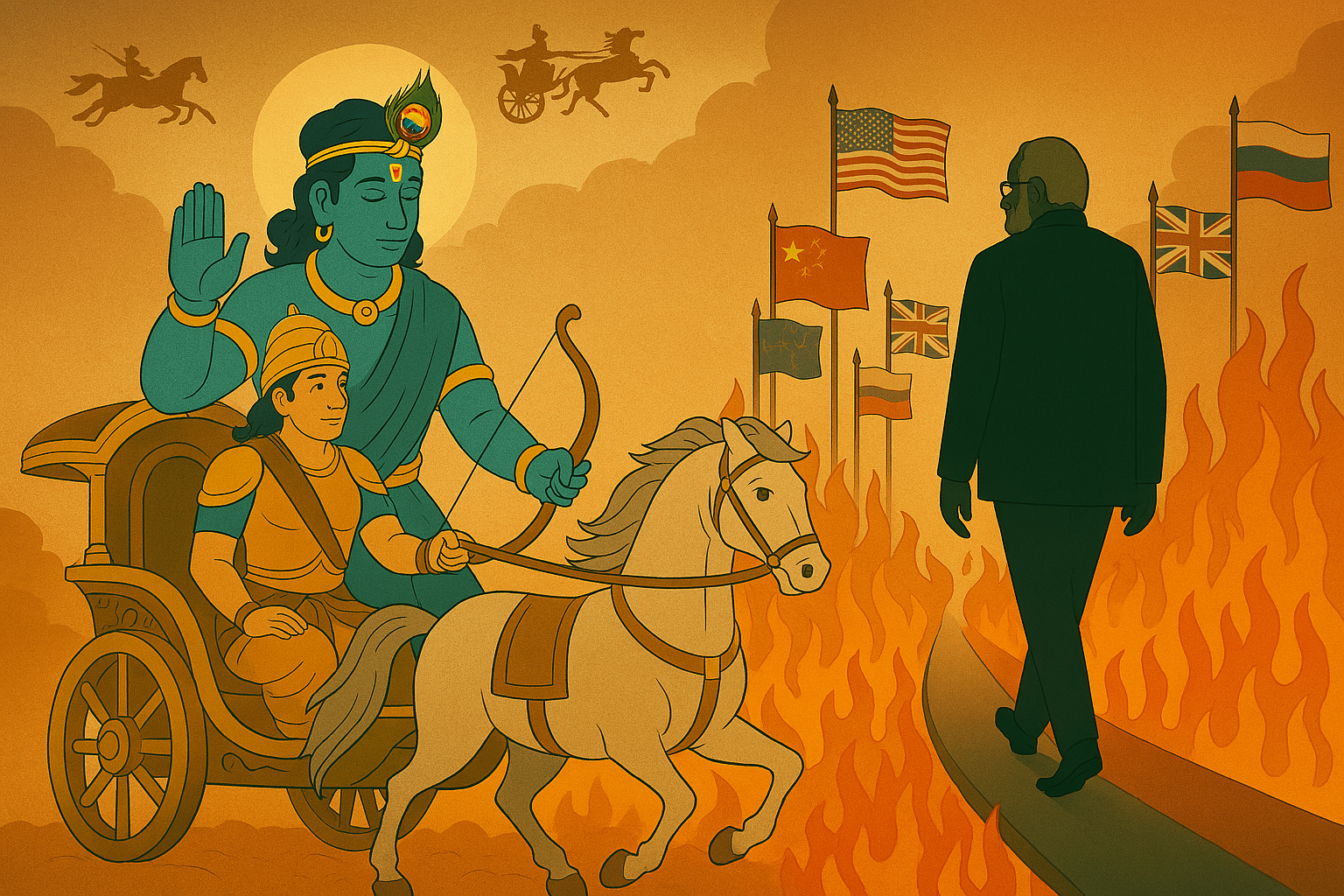
Seen from a purely critical lens, PM Modi’s silence appeared akin to Dhritarashtra’s blind eye or Bhishma’s helplessness during Draupadi’s disrobing in the Mahabharata. Yet that analogy, upon deeper reflection, is insufficient.
A more apt comparison may be with Lord Krishna—strategic, patient, and deeply aware of the stakes. Just as Krishna allowed Abhimanyu’s martyrdom while guiding the greater war effort, PM Modi’s actions in 2022 may reflect a larger design. He sought to stabilize Bharat while global geopolitics simmered and communal tensions within threatened to erupt.
In the long view, PM Modi’s measured restraint may have been an effort to delay inevitable conflict, buying precious time for the Sanatani psyche to awaken and unify. Much like Krishna sought peace through diplomacy before the Kurukshetra war, PM Modi too appeared to ask, metaphorically, for “five villages” in order to avert premature conflict.
This episode revealed another uncomfortable truth: many who demand assertive leadership are unwilling to embrace personal sacrifice. They seek a modern-day Nathuram Godse—but from someone else’s household. Their call for valor ends where their comfort zone begins.
PM Modi, unlike his critics, seems acutely aware of the fragile intellectual, emotional, and cultural fabric of those he leads. His struggle lies not only against external forces but also against internal disunity, apathy, and entitlement.
Bharat’s federal structure, the absence of strong nationalist leadership in several states, and the permissive environment in opposition-ruled territories all constrained PM Modi’s hand. And yet, despite the apparent retreat, he preserved India’s global posture, while quietly recalibrating domestic narratives.
Fast-forward to 2025, and the relevance of that 2022 episode is strikingly clear. Sanatan Dharma faces the same ideological siege, and Bharat continues to walk a tightrope between pluralism and appeasement, assertion and restraint.
PM Modi’s 2022 restraint may now be understood not as weakness, but as strategic foresight. The world is inching toward an age of unpredictable disruption. If Bharat remains internally stable, it is poised to emerge by 2030 as a global power—economically robust, spiritually grounded, and geopolitically assertive.
But for that to happen, Sanatanis must recognize the warning embedded in PM Modi’s silence. Unity is no longer optional. The time to awaken has long passed; what remains now is the time to act.