
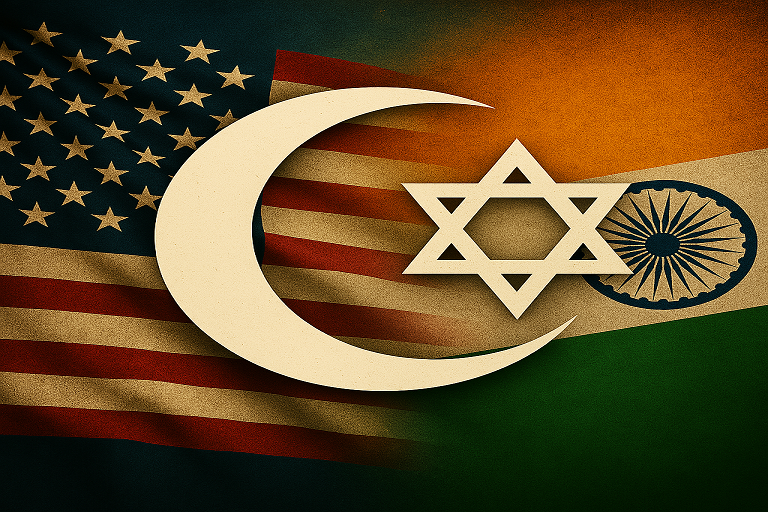
Why is the West Islamophilic?
You may often wonder why former imperial powers like Britain and its settler colonies—Canada, Australia, and others like France and Germany—appear increasingly Islamophilic under the leadership of the United States. Why do these countries, despite historically having clashed most violently with Islamic forces, now seem deeply concerned about Muslims in India? Why do they often ignore Islamic terrorism and openly criticize India or even Israel, the very state they helped establish and long supported?
There are three primary reasons behind this apparent contradiction:
1. Islamophilia as a Strategic Mask
What appears to be “Muslim sympathy” is often a strategic front. Western powers use it to interfere politically and economically in rising nations like India. By championing “minority rights” and “human rights,” they gain entry into domestic politics and disrupt the momentum of nationalist governments.
In countries like Russia and China, this strategy doesn’t work, as such nations have no “vote-bank-driven opposition” like India’s Congress, SP, RJD, or DMK—parties often seen as sympathetic to Islamic causes. In India, however, these vested interests collaborate with Western narratives, creating chaos that even a nationalist party like the BJP is sometimes forced to pacify through diplomatic compromise.
2. Oil Wealth and Arab Lobbying
A second and more tangible factor is the immense wealth of Arab nations. These oil-rich states command large investments and frequently offer expensive gifts and partnerships to politicians, intellectuals, and business leaders in the West—and in India. In return, Western countries appease Arab sentiments by overlooking Islamic terrorism and portraying themselves as protectors of Muslims under threat, especially in non-Muslim countries like India.
It’s not about genuine concern—it’s about financial leverage and oil diplomacy.
3. A Fractured Jewish Global Lobby
This is more speculative but worth considering: the global Jewish lobby appears to be internally divided. One faction seeks to preserve Israel’s existence and strategic value; another sees emerging powers like India as a threat to global dominance.
Historically, Israel has had a strong emotional and strategic bond with India. But recent signals suggest that a section of the global elite wants to cut both down to size.
Donald Trump’s shift in foreign policy seems to reflect a compromise with the George Soros–aligned arms and pharmaceutical lobbies. Whether out of fear—after the attack on his person—or due to ambitions tied to his business empire, Trump appears to have agreed to not interfere with these lobby interests.
This deal has weakened both India’s and Israel’s global positions. Even Elon Musk, once a bold voice against establishment narratives, seems to have faded from the scene.
Trump’s early gestures—such as skipping Israel during his first Middle East tour, shaking hands with terrorists in Syria, and doing billion-dollar deals with Qatar and Saudi Arabia—confirmed this strategic shift. His administration even allegedly appointed individuals with ties to radical outfits like Lashkar-e-Taiba. The West’s increasingly hostile posture toward Israel aligns with this new playbook.
The India-Israel Parallel
What Israel is beginning to face now—Western indifference, media bias, and political double standards—India has been enduring for a decade. Israel’s geopolitical weakness lies in its limited population and geographical size. In contrast, India’s vulnerability stems from an internal enemy: a significant Islamist population, supported by vote-hungry political parties and opportunistic intellectuals.
Israel’s crisis is recent. India’s has been brewing steadily.
Conclusion: The Real Battle Has Begun
India must now battle both internal and external forces. Externally, diplomacy under leaders like S. Jaishankar must continue to be sharp and assertive. Internally, the responsibility has increased manifold for leaders like Amit Shah, who have already begun rooting out the “real problems”—illegal infiltrators, unauthorized madrasas, rogue mosques, and extremist elements.
This assertiveness, particularly visible after Operation Sindoor, appears to have stemmed from rising military confidence and preparedness.
But let’s be clear: Western Islamophilia is not going away. It is a tool—disguised as virtue—that continues to destabilize rising nations in the name of human rights and tolerance.
India, like Israel, must navigate this terrain with clarity, courage, and strategic resilience.