
Bengaluru scientists at the Centre for Nano and Soft Matter Sciences (CeNS) have demonstrated a low-complexity
activation strategy that transforms a conventional vanadium oxide cathode into a zinc-stabilised form, enabling
zinc-ion batteries (ZIBs) to deliver markedly higher energy density and improved cycle stability.
Simple activation, big gains
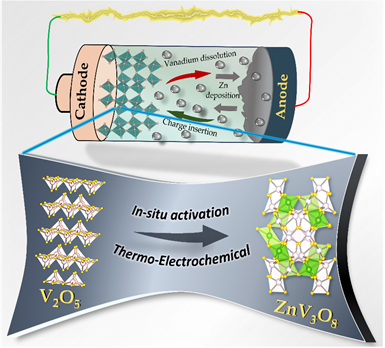
The team, led by Dr. Ashutosh Kumar Singh, employed an in-situ thermo-electrochemical treatment on V2O5,
deliberately creating structural defects and incorporating zinc to form a Zn-V2O5 phase. This
controlled modification produces a porous, defect-rich framework that increases pathways for ion transport and
offers enhanced structural stability during repeated charge-discharge cycles.

Zinc-ion batteries have attracted interest as a safer, more environmentally friendly alternative to lithium-ion systems.
Using aqueous electrolytes, ZIBs lower flammability risks and rely on more abundant zinc resources. However,
developing cathodes that balance capacity, longevity and rate performance has remained a central challenge.
How the activation works
Instead of introducing complex chemistries or rare dopants, the CeNS approach combines heat and electrochemical bias
to tune the V2O5 lattice. The process intentionally forms vacancies and nano-channels, allowing
zinc ions — and in some cases protonic species from the electrolyte — to intercalate more readily. The result is a
cathode that stores more charge while resisting structural breakdown over many cycles.
Performance and implications
According to the researchers, the activated Zn-V2O5 cathode exhibited substantially higher
energy storage performance and long operational life compared with untreated V2O5. Co-author Rahuldeb Roy
stated the team intentionally pursued an “oversimplified but novel” activation strategy to overcome longstanding
cathode stability problems in ZIB systems.
Broader impact and next steps
The technique is presented as a general route that could be applied to other oxide cathodes, potentially accelerating
development of sustainable energy-storage solutions for grid storage, stationary backup and low-cost electric devices.
The findings were communicated by PIB and build on efforts by Indian research institutions to develop locally relevant
battery technologies.
What this means for India
For India, advances in cost-effective and safe battery chemistries help reduce dependence on imported lithium and
support a domestic innovation pipeline. By prioritising methods that use abundant materials and simple processing,
researchers aim to make green storage technologies more accessible and scalable.
The CeNS team’s work was recently published and publicised via the Press Information Bureau; the approach is expected
to guide further academic and industry research into robust, low-cost cathode engineering for next-generation ZIBs.