
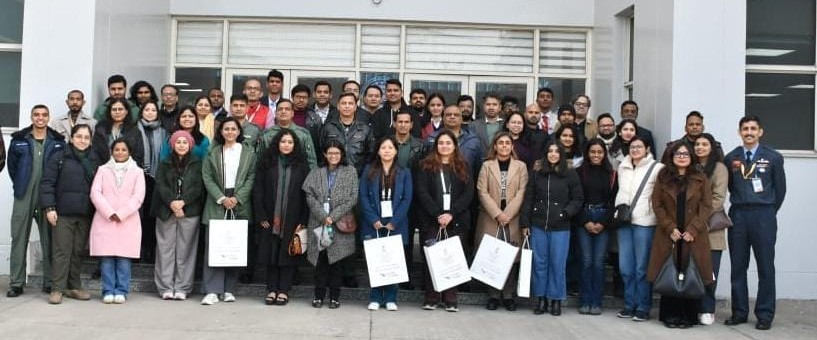
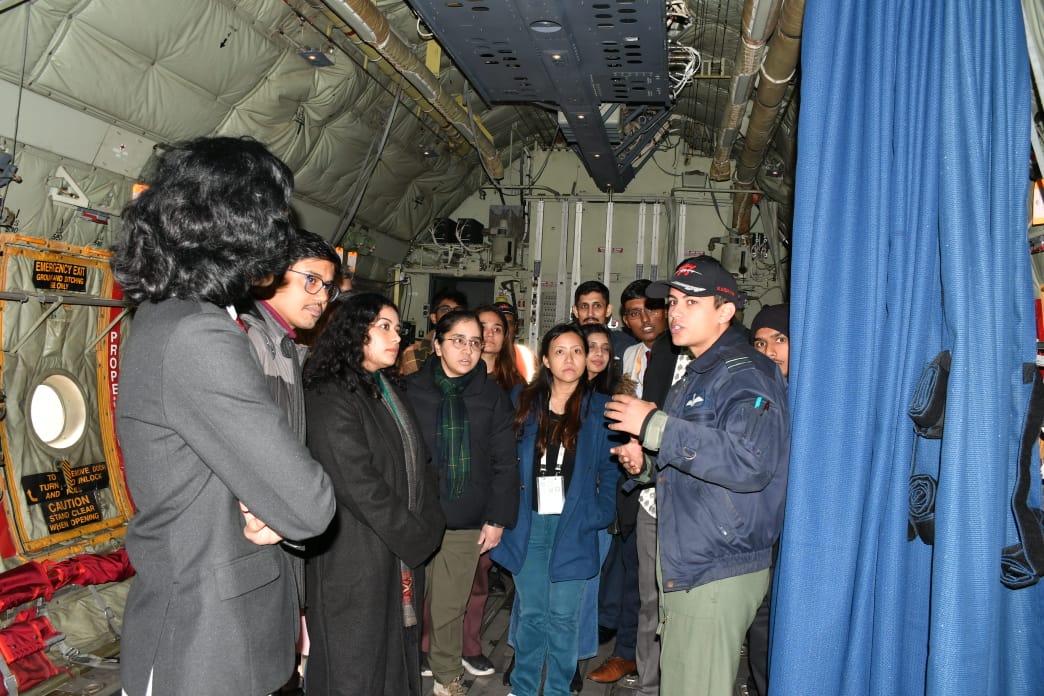

The visiting delegation comprised 57 research scholars representing some of India’s most prominent strategic and defence policy institutions. These included the Manohar Parrikar–Institute for Defence Studies and Analyses (MP-IDSA), Observer Research Foundation (ORF), Vivekananda International Foundation (VIF), Centre for Aerospace Power and Strategic Studies (CAPSS), Centre for Land Warfare Studies (CLAWS), National Maritime Foundation (NMF), India Foundation, Centre for Contemporary China Studies (CCCS), United Service Institution of India (USI) and the Centre for Joint Warfare Studies (CENJOWS).
The diversity of institutions reflected the growing interdisciplinary interest in air power, joint warfare doctrines and India’s evolving defence posture in an increasingly complex regional and global security environment.
Engagement with IAF Leadership and Personnel
The scholars were formally received by the Air Officer Commanding of Air Force Station Hindon, who welcomed the delegation and underlined the importance of constructive engagement between the armed forces and the academic community. He expressed optimism that such interactions would help bridge gaps between operational realities and strategic discourse.
Senior officers of the station interacted closely with the scholars, offering insights into the Indian Air Force’s organisational ethos, mission readiness and professional culture.
Briefings on IAF Operations and Capabilities
As part of the visit, the delegation was given a comprehensive briefing on the Indian Air Force’s operational framework. The presentations covered the service’s historical evolution, core capabilities, operational achievements and its role in safeguarding India’s airspace and national interests.
Scholars gained exposure to the complexities involved in air operations, logistics planning and coordination, as well as the integration of technology and human resources in mission execution.
Encouraging Research and Academic Collaboration
Beyond operational familiarisation, the visit aimed to explore avenues for sustained collaboration between the Indian Air Force and India’s strategic research community. Scholars interacted with serving personnel, discussing contemporary challenges such as jointness, aerospace power, regional security dynamics and future warfare trends.
The exchange of perspectives was seen as a foundation for future research projects, academic exchanges and policy-oriented studies that could contribute to informed decision-making in defence and security matters.
Building Mutual Understanding
The outreach programme highlighted the IAF’s commitment to transparency, intellectual engagement and knowledge sharing. For scholars, the visit provided a rare opportunity to observe operational environments firsthand and contextualise theoretical research within real-world defence practices.
Such initiatives are increasingly viewed as essential for developing a robust strategic culture, where military professionals and civilian experts collaborate to address emerging security challenges.
Strengthening India’s Strategic Ecosystem
The visit to Air Force Station Hindon marks another step in strengthening India’s broader strategic ecosystem, linking operational experience with policy research. As India’s security landscape continues to evolve, deeper engagement between the armed forces and think tanks is expected to play a vital role in shaping informed, forward-looking defence strategies.
The Indian Air Force reiterated its willingness to engage with academic institutions and research bodies, reinforcing the idea that national security is best served through cooperation, dialogue and shared understanding.