Mini Loops Could Explain How the Sun Releases Its Energy
Scientists have made a major discovery in solar research. They found miniature plasma loops in the Sun’s atmosphere. These loops may help explain how the Sun stores and releases magnetic energy.
What Makes This Discovery Special?
The Sun may look calm. But underneath, it is full of powerful magnetic forces. These forces drive solar flares, storms, and other space weather.
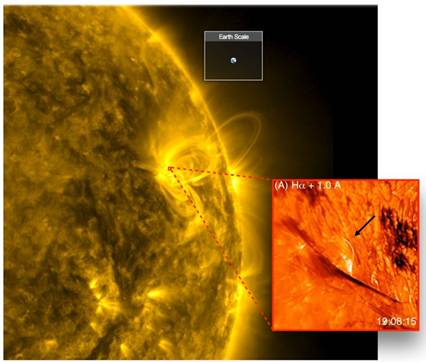
Researchers from the Indian Institute of Astrophysics (IIA) spotted tiny loops in the solar corona—the outermost layer of the Sun. Each loop is only 3,000 to 4,000 kilometers long. That’s about the distance from Kashmir to Kanyakumari. Yet, they are less than 100 kilometers wide.
Earlier telescopes couldn’t detect these small structures. Now, thanks to high-resolution technology, scientists can study them in detail.
 Why Are These Tiny Loops Important?
For years, scientists have studied large coronal loops—bright arcs of plasma shaped by magnetic fields. But now, these smaller loops are getting attention.
Though small, these loops show powerful magnetic activity. They live for only a few minutes. But during that short time, they produce large bursts of energy.
“These loops live fast and die young,” said Annu Bura, a Ph.D. student at IIA. “Still, they tell us a lot about the Sun’s magnetic behavior.”
How Scientists Spotted Them
The research team used top instruments to capture these tiny loops. They combined data from:
-
Goode Solar Telescope (BBSO)
-
NASA’s IRIS (Interface Region Imaging Spectrograph)
-
Solar Dynamics Observatory (SDO)
These tools cover many wavelengths—visible, ultraviolet, and extreme ultraviolet. This helped scientists view the loops across all layers of the Sun’s atmosphere. These include the chromosphere, transition region, and corona.
The Role of the H-alpha Line
A key tool in this study was the H-alpha spectral line, created by hydrogen atoms. It helps examine the chromosphere, a layer just above the Sun’s visible surface.
In the redder part of this spectral line, the tiny loops appeared as bright arcs. This is the first time they have been seen so clearly. It highlights India’s growing strength in solar research.
Magnetic Reconnection: A Mini Explosion
One of the most exciting findings was a sudden broadening of spectral lines. This signals a process called magnetic reconnection. In this process, twisted magnetic field lines break and reconnect. When that happens, they release strong bursts of energy—like a solar mini explosion.
“We also saw plasma jets erupting from the top of these loops,” said Dr. Tanmoy Samanta, a scientist at IIA. “These jets and loops seem to form together during the same explosive event.”
This behavior is similar to bigger eruptions in the solar corona. It shows that even tiny structures can act like larger ones.
Heat Beyond Expectations
The team used a method called Differential Emission Measure (DEM) analysis. It showed that the loops heat up to over a few million degrees. That’s hot enough to glow in extreme ultraviolet light.
But here’s the mystery: these loops lie in the chromosphere, where plasma is much denser than in the corona. Heating dense plasma to such high temperatures is difficult. “We still don’t know how it happens,” said Dr. Jayant Joshi. “Future tools may help us solve this puzzle.”
India’s Next Big Step in Solar Study
India is planning a powerful new telescope called the National Large Solar Telescope (NLST). It will be built near Pangong Lake in Ladakh. With a 2-meter mirror, it will help scientists see even smaller solar details. This will help us learn more about these tiny loops and their role in solar activity.
Global Team Behind the Research
This study was published in the Astrophysical Journal. It was led by IIA scientists along with experts from NASA, the Max Planck Institute (Germany), and the Big Bear Solar Observatory (USA).
Conclusion: Small Loops, Big Impact
These tiny loops in the solar corona might seem small, but they hold the key to huge secrets. They show how the Sun releases its energy and could help predict future solar storms.
Thanks to new technology and international teamwork, we are getting closer to understanding our Sun—one tiny loop at a time.