 Ensuring Fair and Forward-Looking Regulation
In his address, TRAI Chairperson Anil Kumar Lahoti emphasized the Authority’s role in ensuring a level playing field across telecom and broadcasting sectors. He noted that connectivity today spans mobile, fixed line, fiber and satellite networks, enabling digital services nationwide.
Highlighting emerging technologies such as Artificial Intelligence, 5G and the coming era of 6G, he stressed that regulatory frameworks must remain adaptive and transparent. Balanced regulation, he said, is essential to protect consumer interests while encouraging innovation.
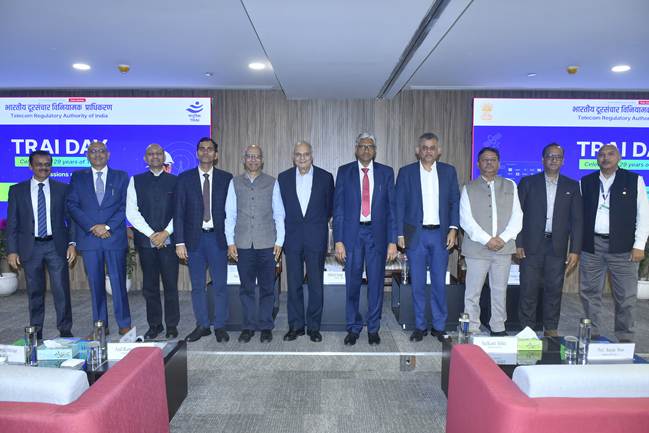
A video message from Communications Minister Jyotiraditya M. Scindia congratulated TRAI on completing 29 years. He underscored the need for regulatory guardrails that foster innovation while safeguarding fairness and public interest in an evolving digital ecosystem.
Television Access and Digital Inclusion
The first technical session focused on “Taking Television to All Homes,” examining policy, technology and business strategies to expand access, especially in rural and underserved regions. Participants discussed the continued relevance of television as a widely accessible medium for information, education and social inclusion.
Speakers from the Ministry of Information & Broadcasting, industry and academia explored sustainable models for last-mile connectivity and affordable service delivery. The deliberations emphasized that universal access to broadcasting remains a key pillar of inclusive development.
As India expands broadband and fiber networks, policymakers stressed that television must continue to complement digital services, ensuring no segment of society is left behind.
Network Slicing and Net Neutrality Debate
The second technical session addressed network slicing and its compatibility with net neutrality principles. Network slicing allows telecom operators to create virtual segments within a single network to serve diverse use cases, from industrial IoT to ultra-reliable low-latency services.
Industry representatives discussed how differentiated services can enhance efficiency in advanced networks. However, experts also highlighted the importance of preserving an open and non-discriminatory internet.
The discussion focused on balancing technological innovation with consumer rights and equitable access. As India scales 5G services and prepares for future 6G research, regulatory clarity will be critical to maintaining trust and competition.
Market Sustainability and Technological Evolution
TRAI members reflected on the Authority’s evolving regulatory approach in sustaining competition and investment. Transparent consultations, tariff rationalisation and efficient spectrum utilization were cited as key measures supporting affordability and sectoral growth.
Experts also underscored the importance of evidence-based regulation, Quality of Service benchmarks and digital infrastructure resilience. With AI-enabled systems and data-intensive applications expanding, robust oversight mechanisms are seen as essential for network security and reliability.
Telecom’s Role in India’s Growth Story
Participants noted that telecom and broadcasting sectors now form the backbone of India’s digital economy. Reliable connectivity supports productivity, financial inclusion and digital public infrastructure initiatives.
Stakeholders emphasized that predictable regulation attracts long-term capital into fiber deployment, satellite broadband and next-generation technologies. Regulatory foresight will be vital in assessing the economic implications of AI-driven networks and emerging digital platforms.
The event concluded with a reaffirmation of TRAI’s commitment to inclusive growth, consumer protection and competitive neutrality. As India navigates rapid technological shifts, the Authority’s role in shaping fair and forward-looking policies remains central to building a resilient communications ecosystem.