

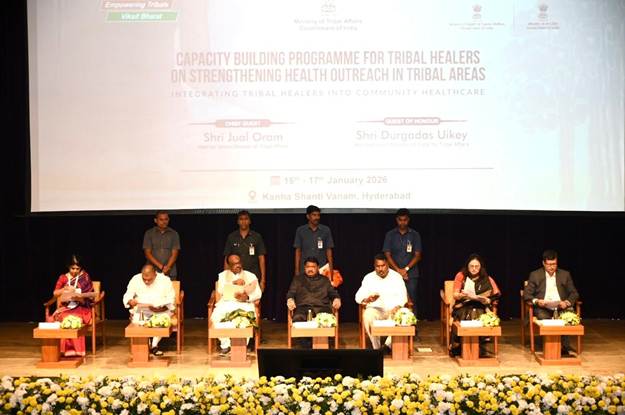

The inaugural session was attended by Union Tribal Affairs Minister Shri Jual Oram, Minister of State Shri Durgadas Uikey, Telangana Tribal Welfare Minister Shri Adluri Laxman Kumar, and Member of Parliament Shri Balaram Naik, along with senior officials, health experts, and nearly 400 tribal healers from across India.
The presence of healers from diverse geographies underlined the government’s commitment to recognising indigenous knowledge systems that have sustained tribal health for generations.
Tribal Healers as Health Partners
Additional Secretary Shri Manish Thakur emphasised that tribal healers enjoy deep-rooted trust within their communities and can play a transformative role in preventive healthcare, early illness identification, and timely referrals. He noted that cultural and geographical barriers often restrict access to formal health services in tribal areas.
Secretary, Ministry of Tribal Affairs, Smt. Ranjana Chopra, highlighted that community-led health solutions are cost-effective, sustainable, and locally relevant. She announced an ambitious target to formally recognise and enable one lakh tribal healers nationwide.
MoU Signed for National Tribal Health Observatory
A major highlight of the programme was the signing of a Memorandum of Understanding between MoTA and the ICMR–Regional Medical Research Centre, Bhubaneswar, to establish India’s first National Tribal Health Observatory, named the Bharat Tribal Health Observatory (B-THO).
The observatory, under Project DRISTI, will institutionalise tribe-disaggregated health surveillance and research, focusing on diseases such as malaria, tuberculosis, and leprosy, addressing long-standing gaps in tribal health data.
Integrated Health and Knowledge Systems
Union Minister Shri Jual Oram stated that indigenous medicinal traditions have survived centuries and continue to offer valuable solutions. He emphasised that technical sessions led by experts from AIIMS, ICMR, WHO, and AYUSH would enhance healers’ capabilities without diluting traditional practices.
Minister of State Shri Durgadas Uikey stressed the need to combine ancient wisdom with modern science to tackle both communicable and lifestyle diseases affecting tribal populations.
Technical Sessions and Global Perspectives
Expert-led sessions covered tribal health status, public health system orientation, global best practices, disease-specific interventions, and preventive healthcare. International case studies presented by WHO underscored the effectiveness of culturally safe engagement models.
Discussions also highlighted the role of tribal healers in addressing sickle cell disease, malnutrition, anaemia, and emerging non-communicable diseases through awareness and early referral.
A New Model for Tribal Health Governance
The programme reinforces India’s commitment to inclusive development by anchoring tribal healthcare in scientific evidence, institutional partnerships, and cultural respect. It positions tribal healers not as alternatives, but as vital connectors within the public health ecosystem.